
Physics · Glossary

What is Joule effect?

Also known as: fuse

Definition 12.14 High School Physics · Chapter 12 — Electric Circuits and Power

The dissipation P=RI2P = RI^2 turning electrical energy into heat in every resistor is the Joule effect. Heaters, kettles, toasters and old-style bulbs are resistors by design; a fuse is a thin wire calibrated to melt — opening the circuit — when the current exceeds its rating.
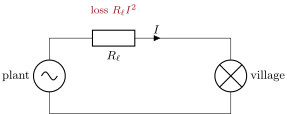
The delivery of : raising U at fixed P = UI shrinks I, and the loss falls with I2.
The delivery of Example 12.15: raising UU at fixed P=UIP = UI shrinks II, and the loss falls with I2I^2.

Examples

Example 12.15 (Why pylons run high)

A village needs P=100kWP = 100\,\mathrm{kW} through a line of resistance R=5.0ΩR_\ell = 5.0\,\Omega. Delivered at U=500VU = 500\,\mathrm{V}: I=P/U=200AI = P/U = 200\,\mathrm{A} and the line wastes RI2=200kWR_\ell I^2 = 200\,\mathrm{kW} — twice the delivery: absurd. At U=20kVU = 20\,\mathrm{kV}: I=5.0AI = 5.0\,\mathrm{A} and RI2=125WR_\ell I^2 = 125\,\mathrm{W}. Forty times less current, 16001600 times less loss.

Read in context →