Flip a switch: a lamp lights, because a generator many kilometres away pushes charge around a loop of copper through your wall. Earlier years mapped the circuit — current, voltage, Ohm’s law. This chapter reopens it with the account book of Chapter 9: what the meter charges, why thin wires glow, why the grid runs at 400kV.
12.1 Charge on the move
Definition 12.1(Current and the coulomb)
An electric current is an ordered flow of charge (electrons, in a metal). Its intensity I, in amperes (A), is the charge passing through a cross-section of the wire per second: a steady current I flowing for a time t transports the charge
q=It,
in coulombs (C), with 1C=1As. The elementary charge is e=1.6×10⁻¹⁹C. Current is measured by an ammeter, inserted in series.
Example 12.2(Lightning versus phone)
A lightning stroke carries some 3.0×10⁴A for about 1.0×10⁻⁴s: q=3.0×104×10−4=3.0C. Your phone, at 2.0A, moves the same charge every 1.5 seconds.
Definition 12.3(Voltage and the volt)
The voltageU between two points of a circuit, in volts (V), is the energy exchanged per unit of charge travelling between them: 1V=1J/C, so a charge q crossing a device under voltage U exchanges the energyE=qU with it. A voltmeter, connected in parallel, measures it.
Proposition 12.4(Circuit laws)
In a circuit running steadily:
junction law: the currents arriving at a junction add up to the currents leaving it;
series law:voltages along a path add up: UAC=UAB+UBC;
parallel law: two branches joining the same two points carry the same voltage.
Proof. In a steady state charge does not pile up anywhere, so what flows into a junction flows out. Energy per coulomb is additive along a path and depends only on its endpoints — not on the branch taken between them. ∎
12.2 Ohm’s law and resistor networks
Definition 12.5(Resistance)
The resistance of a conductor is the ratio R=U/I of the voltage across it to the current through it, measured in ohms (Ω): 1Ω=1V/A.
Proposition 12.6(Ohm’s law)
For a metallic conductor held at fixed temperature, R is constant: voltage and current are proportional,
U=RI.
Proof.Admitted at this level.∎
Remark 12.7
An experimental law, not a universal one: a diode, a heating lamp filament or your own skin do not obey it. Why metals do is derived in the university volumes.
Proposition 12.8(Series and parallel resistors)
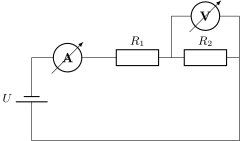
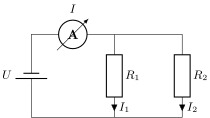
Two resistors in series are equivalent to one resistor Rs=R1+R2; two in parallel, to one resistor Rp given by
Proof. Series: the same I crosses both and voltages add (Proposition 12.4), so U=(R1+R2)I. Parallel: both sit under the same U and currents add, so I=R1U+R2U. ∎
Series (left): one current, voltages add. Parallel (right): one voltage, currents add.
Example 12.9(Equivalent resistance)
R1=100Ω and R2=150Ω: in series, 250Ω; in parallel, 250100×150=60Ω — less than either: the current gets a second road.
12.3 Energy and power in a circuit
Proposition 12.10(Electrical power)
A device under voltageU crossed by a current I receives energy at the rate
Proof. Substitute Ohm’s law into P=UI: P=(RI)I=RI2=U(U/R)=U2/R. ∎
Example 12.12(Reading a nameplate)
A kettle marked “230V – 2200W” draws I=P/U=2200/230=9.6A and has resistanceR=U2/P=2302/2200=24Ω. Running 150s it uses E=2200×150=3.3×10⁵J≈0.09kWh — about two cents.
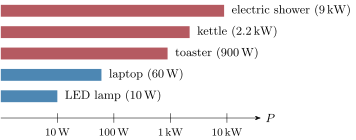
Appliance powers on a logarithmic axis: everything that heats (red) lives a factor of ten above everything that computes or shines (blue).
12.4 The Joule effect: from toaster to pylon
Definition 12.14(Joule effect)
The dissipation P=RI2 turning electrical energy into heat in every resistor is the Joule effect. Heaters, kettles, toasters and old-style bulbs are resistors by design; a fuse is a thin wire calibrated to melt — opening the circuit — when the current exceeds its rating.
Example 12.15(Why pylons run high)
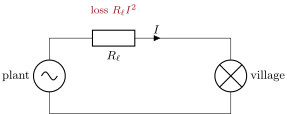
A village needs P=100kW through a line of resistanceRℓ=5.0Ω. Delivered at U=500V: I=P/U=200A and the line wastes RℓI2=200kW — twice the delivery: absurd. At U=20kV: I=5.0A and RℓI2=125W. Forty times less current, 1600 times less loss.
The delivery of Example 12.15: raising U at fixed P=UI shrinks I, and the loss falls with I2.
Remark 12.16(The grid’s iron rule)
At fixed delivered powerP=UI, the line loss RℓI2=RℓP2/U2 falls as the square of the transport voltage. Hence: transform up (400kV) to travel, down (230V) to live with.
Remark 12.17(Household safety)
A 230V line fused at 16A supplies at most 230×16≈3.7kW: two kettles at once melt the fuse — by design the thinnest, weakest link, far cheaper than a fire inside the wall.
12.5 Real batteries: electromotive force
Definition 12.18(EMF and internal resistance)
A battery converts chemical into electrical energy. Its electromotive force (EMF) E, in volts, is the energy it hands each coulomb crossing it; its internal resistancer accounts for the Joule effect inside its own chemistry. Model: an ideal source E in series with r (curly E: E is energy).
Proposition 12.19(Terminal voltage)
A battery delivering a current I shows at its terminals
U=E−rI.
Proof. The chemistry supplies EI, the internal resistance eats rI2, the circuit receives UI: energy conservation (Chapter 9) gives UI=EI−rI2. ∎
Example 12.20(A battery under load)
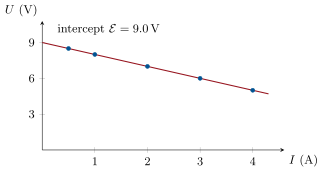
A battery (E=9.0V, r=1.0Ω) feeds a bulb of resistanceR=8.0Ω. The loop obeys E=rI+RI, so I=E/(R+r)=1.0A and U=9.0−1.0×1.0=8.0V: the bulb receives 8.0W while the battery wastes 1.0W warming itself.
Discharge characteristic of the battery of Example 12.20: measured points sit on the line U=E−rI, of slope −r=−1.0V/A.
Remark 12.21(Receivers)
A motor or a charging battery runs the conversion backwards: it absorbs under U=E′+r′I, converting E′I into motion or chemistry and losing r′I2. Sources push, receivers push back.
Example 12.22(Efficiency of a battery)
The efficiency (Definition 9.12) of the discharge above: useful UI=8.0W out of EI=9.0W, so η=U/E=8/9≈0.89 — dropping as the current climbs: hard-working batteries run hot.
12.6 Exercises
Exercise 12.1★
A phone battery charges at a steady 2.0A for 90min. What charge passes through the cable, in coulombs? How many elementary charges is that (e=1.6×10⁻¹⁹C)?
Solution
Solution of Exercise 12.1.
q=It=2.0×90×60=1.1×10⁴C. Number of elementary charges: q/e=1.08×104/1.6×10−19≈6.8×1022.
Exercise 12.2★
A 220Ω resistor across 12V: what current flows? A heating element draws 0.50A at 230V: what resistance?
Solution
Solution of Exercise 12.2.
I=U/R=12/220=0.055A=55mA; R=U/I=230/0.50=460Ω.
Exercise 12.3★
Compute the equivalent resistance of R1=120Ω and R2=60Ω in series, then in parallel. Which is smaller than both, and why?
Solution
Solution of Exercise 12.3.
Series: 120+60=180Ω. Parallel: 180120×60=40Ω — smaller than both: same voltage, but the current gets a second path, so more total current and less resistance.
Plugged (same resistance) into a 115V supply, what power does it deliver? Why not half?
Solution
Solution of Exercise 12.6.
1.R=U2/P=2302/1200=44Ω; I=P/U=1200/230=5.2A.
2.P′=U′2/R=1152/44.1=300W: a quarter, not half, because halving U also halves I, and P=UI∝U2.
Exercise 12.7★★
R1=40Ω and R2=20Ω in series across 12V. Compute the current, the voltage across each resistor, and the power dissipated in each; check the powers add up to UI.
Solution
Solution of Exercise 12.7.
Rs=60Ω, so I=12/60=0.20A. U1=R1I=8.0V, U2=4.0V (sum 12V); P1=U1I=1.6W, P2=0.8W: total 2.4W=UI=12×0.20, as it must.
Exercise 12.8★★
R1=60Ω and R2=30Ω in parallel across 12V. Compute each branch current, the total current, and the equivalent resistance two ways.
Solution
Solution of Exercise 12.8.
I1=12/60=0.20A, I2=12/30=0.40A, total I=0.60A. Equivalent: R=U/I=12/0.60=20Ω, and indeed 60+3060×30=20Ω.
Exercise 12.9★★
A battery delivers U=5.5V at I=0.50A, and U=4.0V at I=2.0A. Find its EMF E and internal resistancer, then the short-circuit current E/r.
Solution
Solution of Exercise 12.9.
E−0.50r=5.5 and E−2.0r=4.0; subtracting, 1.5r=1.5, so r=1.0Ω and E=6.0V. Short circuit: E/r=6.0A.
Exercise 12.10★★
A 230V kitchen line is protected by a 16Afuse. A 2.2kW kettle and a 1.0kW toaster run together: does the fuse hold? Someone adds a 1.5kW heater: show that it blows.
Solution
Solution of Exercise 12.10.
Kettle 2200/230=9.6A, toaster 1000/230=4.3A: total 13.9A<16A, the fuse holds. Heater 1500/230=6.5A: total 20.4A>16A, it blows (equivalently, 4.7kW>230×16≈3.7kW).
Exercise 12.11★★
A workshop needs 10kW through a feeder cable of resistance2.0Ω. Compute the current and the Joule loss if the power is delivered at 200V, then at 4.0kV. Compare the two losses and explain the ratio.
Solution
Solution of Exercise 12.11.
At 200V: I=104/200=50A, loss RI2=2.0×502=5.0kW — half the delivery. At 4.0kV: I=2.5A, loss 2.0×2.52=12.5W. Ratio 400=202: twenty times the voltage means twenty times less current, and the loss goes as I2.
Exercise 12.12★★★
Using all of three identical 60Ω resistors, list every distinct equivalent resistance (series, parallel, mixed); compute each.
Solution
Solution of Exercise 12.12.
Four layouts: all in series, 3×60=180Ω; all in parallel, 60/3=20Ω; one in series with two in parallel, 60+30=90Ω; one in parallel with two in series, 18060×120=40Ω.
Exercise 12.13★★★
A battery (E=4.5V, r=1.5Ω) feeds a resistor R=6.0Ω.
Show that the power received by a variable R, P=E2R/(R+r)2, is greatest when R=r (hint: (R+r)2/R=(R−r)2/R+4r), and compute that maximum.
Solution
Solution of Exercise 12.13.
1.I=E/(R+r)=4.5/7.5=0.60A; U=RI=3.6V; useful P=UI=2.2W; lost rI2=1.5×0.602=0.54W; η=U/E=3.6/4.5=0.80.
2. By the hint, P=E2/[(R−r)2/R+4r]; the bracket is least (=4r) exactly when R=r, so Pmax=E2/(4r)=4.52/6.0=3.4W.
Exercise 12.14★★★
A 2.2kW kettle of efficiency0.90 brings 1.0kg of water from 20∘C to the boil (heating water takes 4180J per kilogram per degree). Compute the heat required, the electrical energy drawn, the heating time, and the cost at 0.25 euros per kWh.
Solution
Solution of Exercise 12.14.
Heat: Q=1.0×4180×(100−20)=3.3×10⁵J. Electrical: E=Q/0.90=3.7×105J. Time: t=E/P=3.7×105/2200≈170s, under three minutes. Cost: 3.7×10⁵/3.6×106≈0.10kWh, about 2.6 cents.
2.U=12.7−0.020×150=9.7V; delivered UI=1.5kW; lost rI2=0.020×1502=450W.
3. The headlights sit across the terminals: while cranking, the terminal voltage drops from 12.7 to 9.7V, so they receive less power and dim.
12.7 Problem: From the dam to the toaster
Problem 12.1
Weekend problem — the thousand-kilometre journey of a kilowatt-hour, from falling water to browning bread, with the full bill of the trip
A mountain dam holds water 200m above its turbines, which swallow 50m3 — 5.0×10⁴kg — per second; turbine and alternator convert with efficiency0.90. Through a line of total resistanceRℓ=32Ω (1000km there and back) the plant feeds a city where your 900W toaster waits at 230V. The alternator outputs 20kV; transformers (efficiency0.99 each) convert voltages at will. Electricity sells at 0.25 euros per kWh; g=9.81N/kg.
Part I — At the dam.
How much potential energy does the falling water release each second? Deduce the power available to the turbines.
Evaluate the lost fraction RℓP/U2 of question 9 at U=20kV. What does a value above 1 mean?
The punchline — the price of distance: in two sentences, what does one toasted kilowatt-hour cost the mountain, what fraction dies en route, and which single trick makes it possible?
Solution
Solution of Problem 12.1.
1. Each second, Ep=mgh=5.0×104×9.81×200=9.8×10⁷J: available power98MW.
2.0.90×98=88MW.
3.I=P/U=8.8×107/2.0×104=4.4×103A.
4.RℓI2=32×(4.4×103)2≈6.2×10⁸W=620MW — seven times the plant’s output: transmitting at 20kV is impossible.
5. With P=UI fixed, only raising U shrinks I: a transformer.
6.I=8.8×10⁷/4.0×105=220A.
7.RℓI2=32×2202≈1.6MW.
8.1.6/88≈0.018: about 1.8%.
9. Fraction =RℓI2/P=Rℓ(P/U)2/P=RℓP/U2∝1/U2: from 20kV to 400kV it falls by 202=400, and indeed 620MW/400≈1.6MW.
10.RℓI=32×220≈7.1kV: 1.8% of 400kV, the same fraction as question 8, since RℓI/U=RℓI2/UI.
11.1kWh=3.6×10⁶J: the meter multiplies the power drawn by the time it is drawn, and adds up.
12.I=900/230=3.9A; R=U2/P=2302/900≈59Ω.
13.E=900×180=1.6×10⁵J=0.045kWh: about 1.1 cents.
14. The physics of RI2 is identical; only the purpose differs — on the line the heat is unwanted, in the toaster the heat is the product.
15.3.9+9.6=13.5A<16A: holds. Heater 2000/230=8.7A: total 22.2A>16A, the fuse blows.
16.0.05×13.52=9.1W: 9.1/3100≈0.3% of the delivered power — negligible over short wires.
17.η=0.90×0.99×0.982×0.99×0.997≈0.86.
18. One toasted kilowatt-hour needs 3.6×10⁶/0.86≈4.2×106J upstream: m=E/(gh)=4.2×106/(9.81×200)≈2.1×103kg, about 2.1m3 of water.
19.RℓP/U2=32×8.8×107/(2.0×104)2≈7. A “fraction” above 1 means the line would dissipate more than it carries: the delivery cannot happen at that voltage at all.
20. One toasted kilowatt-hour costs the mountain about two tonnes — 2.1m3 — of water falling 200m, and some 14% of the energy dies en route, mostly in turbines and transformers (under 2% in 1000km of line). The single trick that makes the journey possible is the transformer: stepping up to 400kV divides the current by 20 and the Joule loss by 400.