Definition 29.1University Physics — Year 1 · Chapter 29 — Electromagnetic Induction and Applications
Orient a closed circuit Γ (a sense of travel); its surface gets the normal n given by the right-hand rule. The magnetic flux through the circuit is Φ=∑B⋅ndS over any surface bounded by Γ (weber, 1Wb=1Tm2) — “any”, because the flux of B through a closed surface is zero. For a uniform field and a plane coil of N turns and area S, Φ=NBScosα, α the angle between B and n.
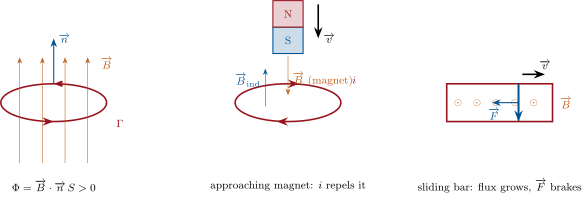
Orientation and Lenz’s law. Left: the circuit’s orientation fixes n and the sign of Φ. Middle: a magnet approaching a ring increases the flux; the induced current creates a field opposing the magnet’s and the ring repels it. Right: a bar sliding on rails in a field pointing toward the reader; the flux of the circuit grows, the induced current flows so that the Laplace force on the bar opposes its motion.
Examples
Example 29.4(Orders of magnitude)
A coil of 100 turns and 10cm2 in the Earth’s field, flipped in 0.1s: ΔΦ=2×100×10−3×5×10−5=1×10⁻⁵Wb, e∼0.1mV — measurable with a sensitive galvanometer, the way the Earth’s field was once mapped. The same coil in the 1T gap of a magnet, pulled out in 0.1s: 1V. A transformer coil of 1000 turns with 1T at 50Hz over 10cm2: emax=1000×10−3×314=314V — the mains.
 Coach
Coach