Physics · Glossary

What is Mass flow rate and volume flow rate?

Definition 2.7 University Physics — Year 2 · Chapter 2 — Fluid Kinematics

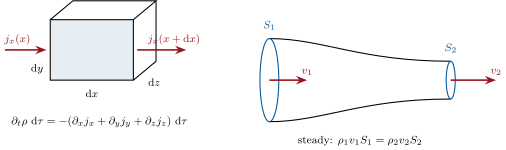
The mass flow rate through an oriented surface SS is the mass crossing it per unit time, Dm=ρvn ⁣dSD_m = \sum\rho\,\vect v\cdot\vect n\,\dd S — the flux of the mass current density j=ρv\vect j = \rho\vect v (unit kgm2s1\mathrm{kg}\,\mathrm{m}^{-2}\,\mathrm{s}^{-1}); the volume flow rate is DV=vn ⁣dSD_V = \sum\vect v \cdot\vect n\,\dd S (m3/s\mathrm{m}^{3}/\mathrm{s}). For a uniform velocity normal to a plane section of area SS, Dm=ρvSD_m = \rho vS and DV=vSD_V = vS.

Left: the mass balance of a fixed box — the net outflow through its six faces, per unit volume, is the divergence of v. Right: in a steady flow the mass flow rate is the same through every section of a stream tube.
Left: the mass balance of a fixed box — the net outflow through its six faces, per unit volume, is the divergence of ρv\rho\vect v. Right: in a steady flow the mass flow rate is the same through every section of a stream tube.

Examples

Example 2.11 (Blood)

The aorta (section 2.5cm22.5\,\mathrm{cm}^{2}) carries 5L/min5\,\mathrm{L}/\mathrm{min} =83cm3/s= 83\,\mathrm{cm}^{3}/\mathrm{s}: v=33cm/sv = 33\,\mathrm{cm}/\mathrm{s}. The same flow passes through some 101010^{10} capillaries of total section about 2500cm22500\,\mathrm{cm}^{2}: v=0.3mm/sv = 0.3\,\mathrm{mm}/\mathrm{s} — slow enough for exchanges through the walls, the point of the branching.

Read in context →