Stand on a bridge and watch the river. A leaf drifts past, speeds up between the piers, slows in the pool below, circles once in an eddy and moves on. You could describe the river by following that leaf — its position and velocity at every instant — or by standing still and recording, at every point of the river, how fast the water passes. The second description is the fluid physicist’s: a velocity field. This chapter sets up the two descriptions, learns to compute the acceleration of a particle from the field, writes the conservation of mass as a local law, and classifies flows by whether they swirl — the vocabulary that Euler’s and Navier’s equations will need.
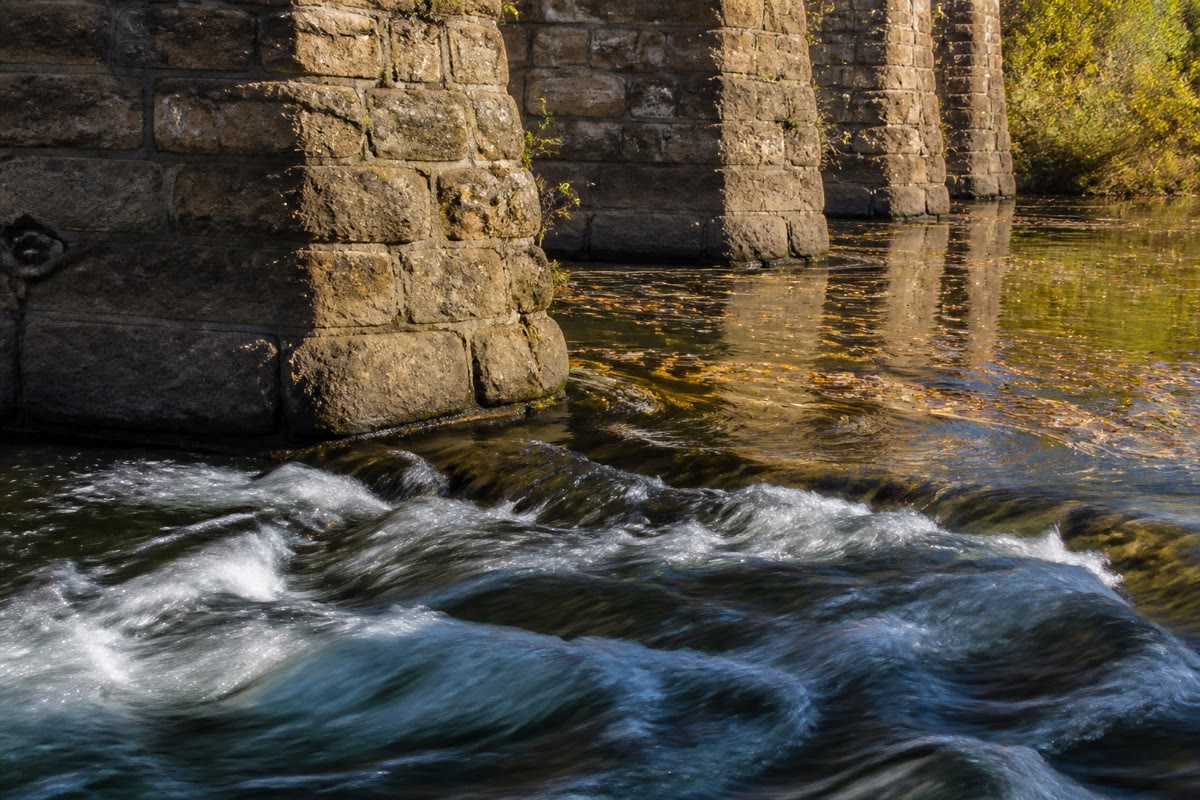
A river past a bridge: fast, smooth water between the piers, eddies in their lee — a velocity field to be read at fixed points, not a single trajectory to be followed.
2.1 The continuum description
Definition 2.1(Fluid particle; the continuum hypothesis)
A fluid particle is a volume of fluid small enough to be treated as a point on the scale of the flow, yet large enough to contain a huge number of molecules, so that its density ρ, pressure P, temperature T and mean velocity v are well-defined averages (the mesoscopic scale, typically a micrometre). The continuum hypothesis assumes such a scale exists: the mean free path ℓ of the molecules must be much smaller than the scale L of the flow, ℓ/L≪1. In air at atmospheric pressure ℓ≈70nm; in a liquid ℓ is the molecular size. The fluid is then described by fieldsρ(M,t), P(M,t), v(M,t) defined at every point.
Definition 2.2(Lagrangian and Eulerian descriptions)
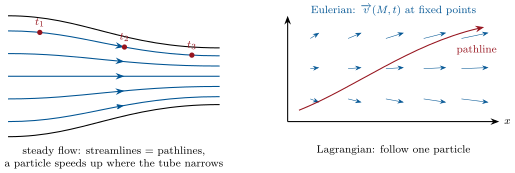
The Lagrangian description follows each fluid particle: its position r(t) and velocity dr/dt as functions of time and of its initial position. The Eulerian description gives, at each fixed point M and time t, the velocity v(M,t) of the particle that is passing through M at that instant. A pathline is the trajectory of a particle; a streamline at time t is a curve tangent at every point to v(M,t); a stream tube is the surface made of the streamlines through a closed curve. A flow is stationary (steady) when the Eulerian fields do not depend on time, ∂v/∂t=0; then streamlines and pathlines coincide and are fixed.
Example 2.3(Two descriptions of one flow)
Water in a garden hose of section S at flow rate Q moves at v=Q/S everywhere: the Eulerian field is uniform and the Lagrangian motion of each particle is uniform. In the tapering nozzle the Eulerian field is still steady but v increases along the axis: every particle accelerates as it passes through, though nothing at any fixed point changes with time. That is the first thing the Eulerian description must learn to express.
Left: a steady converging flow — the streamlines are fixed, a marked particle follows one of them and accelerates as the tube narrows. Right: the Eulerian description records the velocity vector at fixed points; the Lagrangian one follows a particle along its pathline.
2.2 The material derivative
Theorem 2.4(Material (particle) derivative)
The rate of change of a quantity G(M,t) (scalar or vector) for the fluid particle passing through M at time t is
where (v⋅grad)=vx∂x+vy∂y+vz∂z. The first term is the local rate of change (at a fixed point), the second the convective one (because the particle moves to where G is different). For the velocity, (v⋅grad)v=grad(v2/2)+(curlv)∧v.
Proof. In dt the particle moves from M to M+vdt, so dG=G(M+vdt,t+dt)−G(M,t)=∂tGdt+dt(vx∂x+vy∂y+vz∂z)G to first order (chain rule for a function of four variables). The vector identity is checked on the x component: [grad(v2/2)]x=vx∂xvx+vy∂xvy+vz∂xvz and [(curlv)∧v]x=vy(∂yvx−∂xvy)+vz(∂zvx−∂xvz) (with the components of curlv given below in Definition 2.12); their sum is vx∂xvx+vy∂yvx+vz∂zvx. ∎
Example 2.5(Acceleration in a steady nozzle)
A one-dimensional steady flow v(x)=v0(1+x/L) along a nozzle: the local term vanishes, and a=vdv/dx=v02(1+x/L)/L. A particle that enters at v0=2m/s and leaves at 2v0 over L=5cm feels a=80 to 160m/s2: eight to sixteen g, in a flow where nothing depends on time.
Example 2.6(Local versus convective)
Temperature at a weather station falls during the night (∂T/∂t<0: local), and falls for an air parcel carried northward by the wind (v⋅gradT<0: convective, or advective). A thermometer on a balloon drifting with the wind records the sum, DT/Dt; the weather station records only the first term.
2.3 Conservation of mass
Definition 2.7(Mass flow rate and volume flow rate)
The mass flow rate through an oriented surface S is the mass crossing it per unit time, Dm=∑ρv⋅ndS — the flux of the mass current densityj=ρv (unit kgm−2s−1); the volume flow rate is DV=∑v⋅ndS (m3/s). For a uniform velocity normal to a plane section of area S, Dm=ρvS and DV=vS.
Proof. In dt the fluid crossing the element dS is that contained in the oblique cylinder of base dS and generator vdt, of volume v⋅ndSdt and mass ρ times that. ∎
Theorem 2.8(Local conservation of mass)
At every point of a fluid,
∂t∂ρ+div(ρv)=0,wheredivA=∂x∂Ax+∂y∂Ay+∂z∂Az
is the divergence of a vector field: the net outgoing flux of A through the surface of a small volume, per unit volume. Equivalently Dρ/Dt+ρdivv=0.
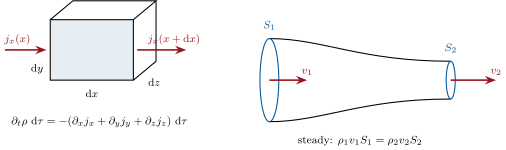
Proof. Take the fixed box [x,x+dx]×[y,y+dy]×[z,z+dz]. Its mass ρdxdydz changes at the rate ∂tρdxdydz. Mass enters through the face at x at the rate jx(x)dydz and leaves through the face at x+dx at jx(x+dx)dydz: net outflow ∂xjxdxdydz, and likewise for y and z. Conservation of mass — no mass is created — gives ∂tρ=−(∂xjx+∂yjy+∂zjz). The second form follows from div(ρv)=v⋅gradρ+ρdivv. ∎
Remark 2.9(The divergence, a first meeting)
The derivation shows what div measures: the flux leaving a small box per unit volume. Summing over the boxes that tile a finite volume V, the interior faces cancel pairwise and only the outer surface remains: ∬∂VA⋅ndS=∭VdivAdτ — the divergence (Ostrogradski) theorem, which we shall state properly in Chapter 11 and use throughout electromagnetism; it is proved in the Year 3 mathematics volume. Integrated over a fixed volume, the local law reads dmV/dt=−Dmout: the mass inside changes by what crosses the boundary.
Left: the mass balance of a fixed box — the net outflow through its six faces, per unit volume, is the divergence of ρv. Right: in a steady flow the mass flow rate is the same through every section of a stream tube.
Corollary 2.10(Incompressible flow; stream tubes)
A flow is incompressible when the density of each particle stays constant, Dρ/Dt=0, which is equivalent to
divv=0.
A homogeneous liquid flows incompressibly; so does a gas at speeds well below the speed of sound (see Chapter 7). In a steady flow the mass flow rateρvS is the same through every section of a stream tube; if moreover the flow is incompressible and ρ uniform, vS is constant: the fluid speeds up where the tube narrows.
Proof.Dρ/Dt=−ρdivv. For the tube, apply the integrated balance to the volume between two sections: no flux through the lateral surface (velocity tangent), steady state, so inflow equals outflow. ∎
Example 2.11(Blood)
The aorta (section 2.5cm2) carries 5L/min=83cm3/s: v=33cm/s. The same flow passes through some 1010 capillaries of total section about 2500cm2: v=0.3mm/s — slow enough for exchanges through the walls, the point of the branching.
Proposition 2.13(Vorticity measures local rotation)
A small fluid element centred at M rotates, as a whole, with the angular velocity Ω=21ω(M). In a solid-body rotation v=Ω∧OM the vorticity is uniform, ω=2Ω; in the plane shear flow v=kyex it is ω=−kez: a paddle wheel dropped in a shear flow turns although the streamlines are straight.
Proof. Near M, v(M+ϵ)=v(M)+Gϵ with G the matrix of ∂jvi; split it into its symmetric part (a pure strain, which stretches the element without turning it as a whole) and its antisymmetric part, whose matrix 21(∂jvi−∂ivj) is that of ϵ↦21ω∧ϵ (Theorem 1.2). Solid rotation about ez: v=Ω(−y,x,0), ωz=∂xvy−∂yvx=2Ω. Shear: ωz=−∂y(ky)=−k. ∎
Definition 2.14(Velocity potential; circulation)
In an irrotational flow the velocity derives from a velocity potential: v=gradφ (the circulation of v along a path then depends only on its ends, ∫ABv⋅dl=φ(B)−φ(A)). If the flow is also incompressible, Δφ=divgradφ=0: the potential obeys Laplace’s equation, exactly like the electrostatic potential in a charge-free region — a potential flow. The circulation of the velocity along a closed curve C is Γ=∮Cv⋅dl.
Proof. That a curl-free field on a simply connected region is a gradient, and that a gradient is curl-free (∂y∂zφ=∂z∂yφ), are the Year 2 mathematics volume’s; Laplace’s equation follows from divv=0. ∎
Example 2.15(Three plane flows)
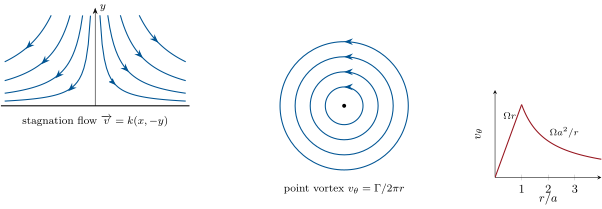
(i) Stagnation flowv=k(x,−y): divv=0, ω=0, φ=21k(x2−y2); streamlinesxy= const, hyperbolas — a jet hitting a wall, near the axis. (ii) Point vortexv=2πrΓeθ (plane polar coordinates): incompressible and irrotational everywhere except at r=0, φ=Γθ/2π (multivalued), and the circulation on any circle around the centre is Γ — the vorticity is concentrated on the axis. (iii) Rankine vortex: a core r<a in solid rotation vθ=Ωr (vorticity2Ω) matched to the point vortexvθ=Ωa2/r outside: the model of a tornado, a bathtub swirl or the eddy behind the bridge pier — the velocity peaks at the edge of the core.
For a small plane loop of area dS with normal n, the circulation is ∮v⋅dl=ω⋅ndS — the vorticity is the circulation per unit area, exactly as the divergence is the flux per unit volume. (Check it on the solid-body rotation: 2πr⋅Ωr=2Ω⋅πr2.) Summed over a surface, this gives Stokes’ theorem, ∮Cv⋅dl=∬Scurlv⋅ndS, stated in Chapter 11. A wing generates lift by carrying a circulation around itself; a vortex line persists in a perfect fluid (Kelvin’s theorem) — which is why the eddy behind the pier survives so long.
Method 2.17(Reading a velocity field)
Given v(M,t): (1) is it steady? (∂tv=0); (2) is it incompressible? (divv=0); (3) is it irrotational? (curlv=0; if so find φ); (4) find the streamlines from dx/vx=dy/vy=dz/vz at fixed t, and the pathlines from dr/dt=v(r,t); (5) compute the acceleration ∂tv+(v⋅grad)v. In plane polar coordinates (r,θ), divv=r1∂r∂(rvr)+r1∂θ∂vθ and ωz=r1∂r∂(rvθ)−r1∂θ∂vr (admitted here; derived in Chapter 11).
2.5 Exercises
Exercise 2.1★
The mean free path of air is 70nm at 1bar and varies as 1/P. Is the continuum description valid for (a) air around a car, (b) air in a 1µm microchannel at 1bar, (c) air at 100km altitude (P≈3×10⁻⁷bar) around a 1m satellite? Give ℓ/L in each case.
Solution
Solution of Exercise 2.1.
(a) ℓ/L∼7×10−8: continuum. (b) 0.07: marginal — the continuum laws start to fail (slip at the walls). (c) ℓ=70×10−9/3×10−7=0.23m, ℓ/L=0.23: no continuum; the gas is a rain of independent molecules (free-molecular regime).
Exercise 2.2★
Steady one-dimensional flow v(x)=v0(1+x/L) for 0≤x≤L. Acceleration of a particle at x; time it takes to cross from 0 to L; compare with L/v0 and L/2v0.
Solution
Solution of Exercise 2.2.
a=vdv/dx=v02(1+x/L)/L (from v02/L to 2v02/L). dx/dt=v0(1+x/L): t=(L/v0)ln2=0.69L/v0, between L/2v0 and L/v0.
Exercise 2.3★
In a pipe of radius R the velocity profile is v(r)=vmax(1−r2/R2) along the axis. Volume flow rate; mean speed ⟨v⟩=DV/πR2; numbers for R=5mm, vmax=0.4m/s.
For each field, say whether the flow is incompressible and whether it is irrotational; give the vorticity: (a) v=(ax,−ay,0); (b) v=(−Ωy,Ωx,0); (c) v=(ax,ay,0); (d) v=(ky,0,0); (e) v=(ax,−ay,bz) — for which b is it incompressible?
Solution
Solution of Exercise 2.4.
(a) div=0, ω=0: incompressible, irrotational. (b) div=0, ωz=2Ω: solid rotation. (c) div=2a=0, irrotational (a plane source). (d) div=0, ωz=−k: shear. (e) div=b: incompressible iff b=0; irrotational for every b.
Exercise 2.5★★
A garden hose of inner diameter 12mm fills a 10L bucket in 50s. Speed in the hose; speed in a 3mm nozzle; if the nozzle tapers over 4cm, estimate the mean acceleration of a particle crossing it (in g); time spent in the nozzle.
Solution
Solution of Exercise 2.5.
DV=0.20L/s. Hose S=1.13cm2: v=1.8m/s; nozzle S=7.1mm2: v=28m/s. Mean acceleration Δ(v2/2)/L=(282−1.82)/0.08≈1×104m/s2≈1000g. Time ≈∫dx/v: a few milliseconds (4ms for a linear speed profile).
Exercise 2.6★★
Unsteady plane flow v=(U,Vcosωt) with U, V, ω constant. (a) Streamlines at time t. (b) Pathline of the particle at the origin at t=0. (c) Sketch both for V=U at t=0 and at t=π/2ω; why do they differ? (d) Acceleration of a particle.
Solution
Solution of Exercise 2.6.
(a) dy/dx=(V/U)cosωt: straight lines of slope (V/U)cosωt, all parallel, tilting with time. (b) x=Ut, y=(V/ω)sinωt: the sinusoid y=(V/ω)sin(ωx/U). (c) At t=0 the streamlines are at 45∘ and the pathline leaves the origin at 45∘; at t=π/2ω the streamlines are horizontal while the pathline is a fixed sinusoid. They differ because the flow is unsteady: a streamline is a snapshot, a pathline a history. (d) a=∂tv=(0,−Vωsinωt) — the field is uniform, so the convective term vanishes.
Exercise 2.7★★
A river 50m wide and 2.0m deep flows at 1.2m/s. (a) Flow rate. (b) It enters a gorge 15m wide and 4.0m deep: speed. (c) A tributary adds 30m3/s; downstream the river is 60m wide and 2.5m deep: speed. (d) Hot gas flows steadily in a pipe of constant section; between two points its temperature doubles at constant pressure: what happens to its speed?
Solution
Solution of Exercise 2.7.
(a) DV=50×2×1.2=120m3/s. (b) 120/60=2.0m/s. (c) 150/150=1.0m/s. (d) ρ∝1/T at constant P halves; ρvS is conserved: the speed doubles.
Exercise 2.8★★
Rankine vortex.vθ=Ωr for r<a, vθ=Ωa2/r for r>a. (a) Vorticity in each region (use the polar formula). (b) Circulation on a circle of radius r centred on the axis, in both regions; relate to the vorticity flux. (c) A tornado: a=50m, vmax=70m/s: Ω, Γ, and the speed at 500m. (d) Is the core flow irrotational? The outside? Where is the "rotation" physically?
Solution
Solution of Exercise 2.8.
(a) ωz=r1drd(rvθ): 2Ω inside, 0 outside. (b) Inside Γ=2πr⋅Ωr=2Ω⋅πr2, the flux of the vorticity; outside Γ=2πΩa2, constant, the flux of the whole core. (c) Ω=vmax/a=1.4rad/s; Γ=2πavmax=2.2×10⁴m2/s; at 500m: Ωa2/r=7m/s. (d) The core rotates like a solid; outside, the flow is irrotational: particles go round the axis without spinning about themselves. The vorticity — the rotation — lives in the core.
Exercise 2.9★★
Stagnation flowv=k(x,−y). (a) Potential φ and check Δφ=0. (b) Streamlines; the function ψ=kxy is constant on them — show that vx=∂ψ/∂y, vy=−∂ψ/∂x (the stream function). (c) Acceleration field; show it is grad(v2/2) and interpret. (d) Pathline of a particle starting at (x0,y0): x=x0ekt, y=y0e−kt.
Solution
Solution of Exercise 2.9.
(a) φ=21k(x2−y2), Δφ=k−k=0. (b) dx/kx=dy/(−ky): xy= const; ∂yψ=kx=vx, −∂xψ=−ky=vy. (c) a=(vx∂x+vy∂y)v=k2(x,y)=grad(21k2(x2+y2))=grad(v2/2): in a steady irrotational flow the acceleration is the gradient of the kinetic energy per unit mass; it points away from the stagnation point — a particle decelerates as it approaches the wall along y and accelerates away along x. (d) x˙=kx, y˙=−ky: x=x0ekt, y=y0e−kt (xy constant).
Exercise 2.10★★★
An expanding flow. One-dimensional flow v(x,t)=x/(t+τ) for t>0, τ>0 constant. (a) Pathlines: show x(t)=x0(1+t/τ); acceleration of a particle, both from the pathline and from the material derivative. (b) The density is uniform at each time, ρ(t): use mass conservation to find ρ(t). (c) Check by following the mass between two particles. (d) Why is this field a one-dimensional model of a uniformly expanding universe?
Solution
Solution of Exercise 2.10.
(a) dx/dt=x/(t+τ) gives x=x0(1+t/τ), x¨=0; material derivative: ∂tv+v∂xv=−x/(t+τ)2+x/(t+τ)2=0. (b) ∂tρ+∂x(ρv)=ρ˙+ρ/(t+τ)=0: ρ=ρ0τ/(t+τ). (c) Two particles’ separation grows as (1+t/τ) and the mass between them is fixed: ρ∝1/(1+t/τ). (d) v=Hx with H=1/(t+τ): a Hubble law, free expansion (no acceleration), density falling as the inverse of the scale factor.
Exercise 2.11★★★
Source in a stream. Superpose a uniform flow v=Uex and a plane source v=2πrqer (q the volume flow rate per unit length along z). (a) Potential φ=Ux+(q/2π)lnr; check both flows are incompressible and irrotational (except at the origin). (b) Stagnation point. (c) Stream function ψ=Uy+qθ/2π; the streamline through the stagnation point is rsinθ=(q/2πU)(π−θ): sketch it. (d) Show that far downstream this streamline is at y=±q/2U: the flow outside it is the flow around a blunt half-body of width q/U.
Solution
Solution of Exercise 2.11.
(a) v=gradφ=(U+qx/2πr2,qy/2πr2); the source has vr=q/2πr, div=r1d(rvr)/dr=0 and no θ dependence, so ωz=0; sums of such fields are again incompressible and irrotational. (b) On the negative x axis, U−q/2πr=0: xs=−q/2πU. (c) At the stagnation point θ=π, y=0: ψ=q/2; the streamlineUrsinθ+qθ/2π=q/2, i.e. rsinθ=(q/2πU)(π−θ) — a curve leaving xs and opening downstream. (d) θ→0: y→q/2U; θ→2π (lower branch): y→−q/2U. The fluid inside that streamline comes from the source; outside it, the uniform stream flows around a half-body of asymptotic width q/U.
Exercise 2.12★★★
Vortex and sink. Plane flow v=−2πrqer+2πrΓeθ for r>a. (a) Show it is incompressible and irrotational. (b) Streamlines: logarithmic spirals r=r0e−qθ/Γ. (c) Acceleration of a particle: show it is purely radial, −v2/rer. (d) Time for a particle to spiral from r0 to a; number of turns it makes. (e) Numbers: q=1.5×10⁻³m2/s, Γ=3×10⁻²m2/s, r0=0.5m, a=2cm.
Weekend problem — the same kinematics at three scales: the swirl above a drain, a tornado, and a cyclone seen from a satellite
Part I — The bathtub. A bath is drained through a hole of radius a=2cm; the water, of depth h=20cm, leaves at the volume flow rateDV=0.30L/s. Away from the hole the flow is modelled as plane (independent of depth): v=vr(r)er+vθ(r)eθ.
Using mass conservation through a cylinder of radius r and height h, show that vr=−q/2πr with q=DV/h; value of q.
Before the plug was pulled the water had been stirred and turned at 1.0cm/s at r=50cm. Admitting that each ring of water keeps its angular momentum as it moves inward (rvθ constant), find vθ(r) and the circulation Γ.
Check that the flow is incompressible and irrotational for r>a.
Streamlines: show they are logarithmic spirals and find how many turns a particle makes between r=50cm and r=a.
Time for a particle to go from 50cm to the hole, and its azimuthal speed on arrival.
Acceleration of a particle at r; compare with g at r=a. (The free surface dips where the pressure must balance it — the funnel; next chapter.)
The Earth’s rotation gives any fluid at rest in the bath a "background" rotation at the local vertical rate Ω⊕sinλ≈5×10⁻⁵rad/s. Compare the azimuthal speed it would give at 50cm with the 1cm/s of the stirring, and say whether the sense of rotation of a draining bath is decided by the hemisphere.
Part II — The tornado as a Rankine vortex. Core radius a=60m, maximum wind vmax=80m/s, air density ρ=1.2kg/m3.
Write vθ(r) in both regions and give Ω and Γ.
Vorticity in the core and outside; sketch vθ and ωz against r.
Acceleration of an air particle at the edge of the core; compare with g.
Show that a small paddle wheel placed outside the core drifts around the tornado without spinning about its own axis, while one placed in the core turns once per revolution around the axis.
Kinetic energy of the core, per metre of height.
Kinetic energy of the outer flow per metre of height, between a and R=5km; why does it depend on R only logarithmically?
With a height of 1km, total kinetic energy; compare with the energy released by 1t of TNT (4.2GJ).
Air also flows inward and upward in a tornado. If the core is fed by a radial inflow at 5m/s through its lateral surface over the first 300m of height, what vertical speed must the air reach at the top of that layer (uniform over the core’s section)?
Part III — The cyclone. A tropical cyclone is modelled as a Rankine vortex of core radius a=40km and vmax=50m/s. The Earth’s rotation is felt through the planetary vorticityf=2Ω⊕sinλ≈5×10⁻⁵s−1 at latitude 20∘: a ring of air at rest relative to the ground already carries, in the inertial frame, the azimuthal speed fr/2 about any vertical axis.
Vorticity of the core and circulation Γ of the cyclone; compare the core vorticity with f.
A ring of air of radius r0=500km, initially at rest relative to the ground, is drawn in toward the centre by the low pressure. Admitting that its angular momentum per unit mass about the axis, r(vθ+fr/2), is conserved, find its velocity vθ relative to the ground at r=100km and at r=40km.
In which sense does the cyclone turn in the northern hemisphere, and why? Why is the sense fixed for a cyclone and not for a bath?
Why can air not be drawn all the way to the axis this way — what limits the wind and leaves an eye?
Air converges into the cyclone at 5m/s through a cylinder of radius 500km and height 1km: mass flow rate drawn in (ρ=1.2kg/m3).
The cyclone moves bodily westward at 6m/s. Write the Eulerian velocity field seen from the ground in terms of the field v0 of the vortex in its own frame; is the flow steady in the ground frame? Which side of the storm has the stronger winds?
Part IV — Flow rates and a summary.
Rain falls at 50mm/h over a catchment of 10km2 and all of it reaches a river of section 40m2: mean speed of the river in flood.
Blood: the aorta (2.5cm2) carries 5.0L/min; the capillaries have a total section of 0.25m2: speeds in each; time for blood to cross a 1mm capillary.
A tank of section S drains through a hole of section s at the bottom; the exit speed is 2gh (h the water level — admitted, derived in the next chapter). Write mass conservation and find h(t) and the emptying time for S=1m2, s=1cm2, h0=1m.
Give the three flows of Parts I–III in one table: radius, speed, vorticity of the core, circulation — and the quantity, conserved during the inflow, that makes them spin up.
Solution
Solution of Problem 2.1.
1. Through a cylinder of radius r: 2πrh∣vr∣=DV, so vr=−q/2πr, q=DV/h=1.5×10−3m2/s.
2.rvθ=0.5×0.01=5×10⁻³m2/s: vθ=Γ/2πr with Γ=3.1×10⁻²m2/s.
6.a=−(v2/r)er; at r=a: v2=0.252+0.0122, a=3.1m/s2≈0.3g.
7.Ω⊕sinλr=5×10−5×0.5=2.5×10⁻⁵m/s, four hundred times less than the stirring: the hemisphere decides nothing in an ordinary bath (it does in a tank left still for a day).
9.ωz=2Ω=2.7s−1 in the core, 0 outside; vθ rises linearly to 80m/s then falls as 1/r; ωz is a step.
10.a=vmax2/a=6400/60=107m/s2≈11g, inward.
11. Outside, the vorticity is zero: a small element translates along its circle without rotating about itself — the paddle wheel keeps its orientation. In the core (solid rotation) it turns with the fluid, once per revolution.
12.Ecore=∫0a21ρΩ2r22πrdr=41πρΩ2a4=2.2×10⁷J/m.
13.Eout=∫aR21ρ(Ωa2/r)22πrdr=πρΩ2a4ln(R/a)=8.7×107×4.4=3.8×108J/m; the integrand ρv2r∝1/r, hence the logarithm.
14.4.0×108J/m×1000m=4×1011J: about 100t of TNT.
15. Inflow 2πa×300×5=5.7×10⁵m3/s through πa2=1.1×10⁴m2: vz=50m/s.
17.r0⋅fr0/2=r(vθ+fr/2): vθ=f(r02−r2)/2r; 60m/s at 100km, 155m/s at 40km.
18.f>0 in the northern hemisphere gives vθ>0: counterclockwise seen from above (cyclonic). Over 500km the planetary rotation is the dominant initial rotation; in a bath the stirring is.
19. Friction with the sea removes angular momentum, and the pressure gradient cannot balance the centripetal acceleration of an ever faster ring: the air rises before reaching the axis, in the eye wall, leaving a calm eye.
20.ρ2πrHv=1.2×2π×5×105×103×5=1.9×10¹⁰kg/s.
21.v(M,t)=−Uex+v0(M+Utex): the pattern is advected, the field is unsteady in the ground frame. The translation adds to the swirl on the side where vθ points west — the north (right-hand) side of the westward track.
22.0.05×107/3600=139m3/s; v=139/40=3.5m/s.
23.DV=83cm3/s: aorta 0.33m/s; capillaries 0.33mm/s; 3s per millimetre.
24.Sdh/dt=−s2gh: h=h0−Ssg/2t, empty at T=(S/s)2h0/g=104×0.45=4500s≈75min.
25. Bath: r∼0.5m, v∼1cm/s, Γ=3×10⁻²m2/s; tornado: 60m, 80m/s, ω=2.7s−1, Γ=3×10⁴m2/s; cyclone: 40km, 50m/s, ω=2.5×10⁻³s−1, Γ=1.3×10⁷m2/s. In each, the angular momentum per unit mass rvθ of the converging fluid is conserved: inflow spins it up.