
Physics · Glossary

What is Nuclides, size, and density?

Definition 25.1 University Physics — Year 3 · Chapter 25 — Nuclear Physics

A nuclide ZAX^{A}_{Z}\text{X} holds ZZ protons and N=AZN = A - Z neutrons, bound by the strong interaction: intense (100×{\sim}100\,\times Coulomb at contact), short-ranged (1fm{\sim}1\,\mathrm{fm}, felt only by touching neighbours), and blind to charge (it grips protons and neutrons alike). Scattering experiments give every nucleus the same recipe: radius

R=r0A1/3,r01.2fm,R = r_0A^{1/3} , \qquad r_0 \approx 1.2\,\mathrm{fm} ,

so volume grows like AA and the density is a universal ρ2.3×10¹⁷kg/m3\rho \approx 2.3 \times 10^{17}\,\mathrm{kg}/\mathrm{m}^{3} — a raindrop of it would weigh like a fleet of tankers, and Chapter 27 will meet whole stars at this density. Isotopes share ZZ but differ in NN: same chemistry, different nuclear fates.
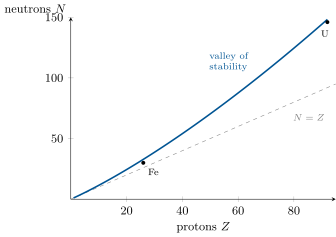
The valley of stability. Light nuclei balance their two Fermi ladders (N = Z); heavy ones dilute their Coulomb bill with extra neutrons. A nuclide off the valley floor -decays back toward it — and fission fragments, born far above the line, are furiously radioactive for exactly this reason.
The valley of stability. Light nuclei balance their two Fermi ladders (N=ZN = Z); heavy ones dilute their Coulomb bill with extra neutrons. A nuclide off the valley floor β\beta-decays back toward it — and fission fragments, born far above the line, are furiously radioactive for exactly this reason.
Read in context →