University Physics — Year 3 · Bachelor Year 3
27Astrophysics
Every chapter of this book has been rehearsing for this one. Stars are self-gravitating gas balls run by the hydrostatics of the Year 1 volume, fired by Chapter 25’s tunnelling, shining by Chapter 20’s Planck law; dead stars are Chapter 19’s degenerate Fermi gases the size of cities; and the universe itself is a cooling thermal system whose baby picture — the microwave background — is the most perfect blackbody ever measured. This closing chapter assembles the whole volume into the biggest possible laboratory: how stars live, how they die, what they leave behind, and how the expanding universe that contains them began as physics we have already done.
27.1 A star is a balance
Proposition 27.1 (Hydrostatic equilibrium)
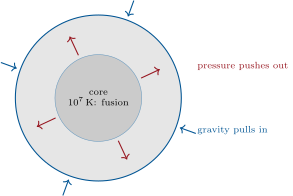
A star neither collapses nor disperses: at every radius, the pressure gradient carries the weight of the gas above. For the mass inside radius ,
Estimated across the whole Sun, and, via the ideal-gas law, (Exercise 27.1) — precisely the temperature at which Exercise 25.11’s protons begin to tunnel. That is no coincidence but a thermostat: a star must contract and heat until its core ignites, and fusion then holds the balance for millions to billions of years. Stars have negative heat capacity — lose energy, contract, get hotter (Exercise 27.5) — which is why gravity always wins in the end.
Proof. A shell of area feels pressure from below, from above, and weight with (only the interior mass pulls, by Gauss’s theorem for gravity). Equilibrium of the three gives the stated equation. ∎
27.2 The lives of stars
Definition 27.2 (The Hertzsprung–Russell diagram)
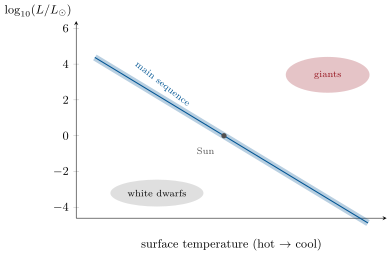
Plot stars by surface temperature (hot on the left, by convention) against luminosity, both from Chapter 20’s blackbody laws, and they refuse to scatter: ninety percent crowd onto the main sequence, the diagonal band of hydrogen-burners, ordered purely by mass — heavier means hotter and disproportionately brighter (), hence shorter-lived (: Exercise 27.4). Off the band live the plot’s exceptions and endings: cool but enormous giants (top right), and hot but tiny white dwarfs (bottom left) — because at fixed temperature, by , luminosity is a measure of size. The HR diagram is not a map of kinds but of ages: a star’s dot drifts across it as its fuel runs down.
Remark 27.3 (How stars age, and what they leave)
When the core’s hydrogen is spent, the thermostat logic replays: the core contracts and heats, helium ignites (fusing to carbon and oxygen), the envelope bloats a hundredfold — a red giant. A Sun-like star stops there: it sheds its envelope and retires as a white dwarf. A star above keeps igniting new fuels in onion shells until the core is iron — Proposition 25.2’s summit, from which no fusion returns energy. The dead core collapses in a second; the rebound and the neutrino flood blow the star apart: a supernova, briefly outshining its galaxy, forging the elements beyond iron by neutron capture and broadcasting the lot into the clouds that build the next generation of stars and planets. The calcium in your bones and the iron in your blood took this route (Problem 27.1): chemistry is recycled astrophysics.
27.3 The corpses: matter at its limits
Proposition 27.4 (White dwarfs and neutron stars)
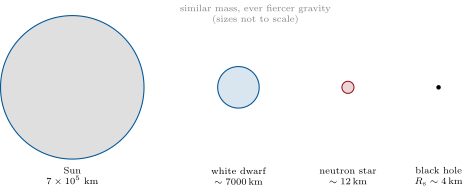
What holds a star that no longer burns? Quantum mechanics. A white dwarf is a solar mass of carbon and oxygen propped up by its electron degeneracy pressure — the Fermi pressure of Chapter 19 — at the size of the Earth and a tonne per teaspoon. Pauli’s support has a ceiling: above the Chandrasekhar mass , the electrons go relativistic and the pressure loses the race (a result we state, not derive). Beyond it, electrons are crushed into protons and a neutron star forms: neutron degeneracy plus nuclear repulsion holding in a dozen kilometres at Definition 25.1’s nuclear density — a city-sized nucleus, spinning up to milliseconds and beaming like a lighthouse (a pulsar). And beyond about nothing known resists: the star falls inside the radius at which escape needs light speed,
a black hole — gravity’s final word, and general relativity’s doorstep, one volume beyond this one.
Proof. Admitted at this level. ∎
27.4 The expanding universe
Definition 27.5 (Hubble’s law and the hot beginning)
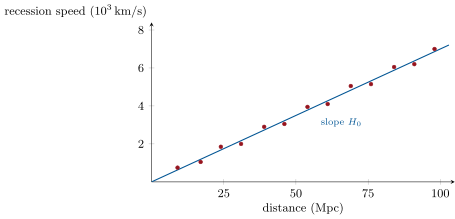
Every distant galaxy recedes, at speed proportional to distance:
This is not an explosion into space but an expansion of space — run it backwards and everything was once dense and hot: billion years ago (Exercise 27.9). The early universe is this book replayed at speed. At one second it is a particle soup (Chapter 26); in the first minutes, Chapter 25 runs wild and freezes out one quarter helium by mass — predicted by a Boltzmann factor, observed everywhere (Exercise 27.11). At 380 000 years and , Saha’s equation (Proposition 18.5) lets electrons finally settle onto protons; the fog clears, and that last-scattered light — stretched a thousandfold by expansion — arrives today as the cosmic microwave background: a Planck spectrum (Chapter 20), the oldest photograph there is. What the picture also shows: galaxies spin and cluster as if steered by dark matter no detector has caught, and the expansion accelerates under a dark energy nobody has explained — the ninety-five percent of the budget this book cannot yet write.
27.5 Exercises
Exercise 27.1 ★
The Sun, estimated. , . (a) Estimate . (b) With the mean density and the ideal-gas law (), estimate . (c) Compare with the ignition threshold of Exercise 25.11. (d) Why is this agreement a thermostat rather than a coincidence?
Solution
Solution of Exercise 27.1.
(a) — ten billion atmospheres. (b) : — crude, an order above the true , but the scale is right. (c) Just at the tunnelling threshold. (d) A protostar contracts and heats until the core ignites, then stops contracting: any gas ball massive enough must arrive at ignition — the star tunes itself to the nuclear thermostat.
Exercise 27.2 ★
Weighing light. (a) From the solar constant at , compute . (b) From , compute the surface temperature. (c) Check Wien’s peak against the Sun’s visible yellow-green. (d) Which chapter’s law did each step use?
Solution
Solution of Exercise 27.2.
(a) . (b) . (c) Wien: — the eye evolved onto the Sun’s peak. (d) Inverse-square flux (Year 1); Stefan–Boltzmann and Wien: Chapter 20’s blackbody, derived from photon statistics.
Exercise 27.3 ★
Reading the diagram. Sirius B: , ; Betelgeuse: , . (a) Place both on the HR diagram. (b) From , compute each radius in solar units. (c) Betelgeuse in the Solar System: which planets are inside it? (d) What must be holding Sirius B up?
Solution
Solution of Exercise 27.3.
(a) Sirius B: far left, far down; Betelgeuse: far right, far up. (b) : Sirius B an Earth radius; Betelgeuse . (c) Mercury, Venus, Earth and Mars would orbit inside it. (d) Earth-sized yet solar-massed: only electron degeneracy pressure (Chapter 19) — Sirius B is the classic white dwarf.
Exercise 27.4 ★
Live fast, die young. With and lifetime , and the Sun’s ten billion years: (a) lifetime of a star; (b) of a red dwarf — compare with the universe’s age; (c) why do heavier stars, with more fuel, die sooner? (d) What does the shortness of massive lives imply about where (in a galaxy) supernovae occur?
Solution
Solution of Exercise 27.4.
(a) . (b) : about 57 billion years — every red dwarf ever born is still burning. (c) Luminosity grows as but the tank only as : the rich burn their fortune faster than they bank it. (d) Massive stars die within a few million years of birth — before drifting anywhere: supernovae detonate inside the star-forming spiral arms that made them.
Exercise 27.5 ★★
Gravity’s strange thermodynamics. For a self-gravitating gas ball the virial theorem (Chapter 1) gives total energy (minus the kinetic/thermal energy). (a) Deduce: radiating energy away makes the star hotter — a negative heat capacity. (b) Estimate the gravitational energy of the Sun. (c) At today’s , how long could contraction alone have powered it (the Kelvin–Helmholtz time)? (d) Geology dates Earth at 4.5 billion years: state the nineteenth-century paradox and its nuclear resolution.
Solution
Solution of Exercise 27.5.
(a) : radiating makes more negative, so — i.e. the temperature — rises: gravity’s thermodynamic signature. (b) . (c) . (d) Kelvin’s Sun could not be older than tens of megayears, while Darwin’s worms and Lyell’s rocks demanded billions: the resolution was a fuel nobody knew — Chapter 25, seventy years early.
Exercise 27.6 ★★
Anatomy of a white dwarf. Take at . (a) Compute the mean density, and a teaspoon’s () mass. (b) Compute the surface gravity. (c) Chapter 19’s degeneracy pressure scales as , gravity’s need as : show this implies the bizarre — heavier dwarfs are smaller. (d) Explain physically why piling on mass shrinks the star, and what that portends at the Chandrasekhar mass.
Solution
Solution of Exercise 27.6.
(a) : a nine-tonne teaspoon. (b) — three hundred thousand Earth gravities. (c) : degeneracy supplies , gravity demands ; equating, . (d) More weight needs more Fermi pressure, which only compression provides — so mass shrinks the star; the spiral has a wall: once electrons go relativistic the pressure law softens to , the balance fails at any radius, and is the cliff edge.
Exercise 27.7 ★★
Anatomy of a neutron star. (a) At nuclear density , compute the radius holding . (b) The pre-collapse core spun once per 25 days at : use angular-momentum conservation to estimate the final spin period. (c) Compute the surface gravity. (d) Flux freezing amplifies the magnetic field as (Chapter 22): from a stellar , what surface field results, and why do pulsars beam?
Solution
Solution of Exercise 27.7.
(a) : — a nucleus with a skyline. (b) : spin-up by , so 25 days shrinks to : pulsar territory. (c) : a mountain here would be millimetres there. (d) — and the magnetic axis, misaligned with the spin axis, funnels radio emission along its poles: the beam sweeps like a lighthouse, and we call the flashes a pulsar.
Exercise 27.8 ★★
The point of no return. (a) Derive from the Newtonian escape-speed condition (the honest derivation needs general relativity; the answer, famously, agrees). (b) Evaluate for the Sun and for the Earth. (c) The Galaxy’s central black hole: — compute and compare with the Sun–Mercury distance (). (d) Show the mean density inside falls as — a big enough black hole is less dense than water: what does that say about “crushing” intuitions?
Solution
Solution of Exercise 27.8.
(a) gives . (b) Sun: ; Earth: — compress either inside that and light cannot leave. (c) : a fifth of Mercury’s orbit — and stars are observed whipping around it. (d) : a hole is less dense than water. Nothing need be “crushed” at the horizon — it is a point of no return, not a surface of rock.
Exercise 27.9 ★★★
Hubble arithmetic. per Mpc; . (a) Convert to SI. (b) Compute in years. (c) A galaxy at : its recession speed, and the factor by which its light’s wavelength has stretched (small- Doppler, Chapter 4). (d) Why is only approximately the universe’s age — what has the expansion rate been doing meanwhile?
Solution
Solution of Exercise 27.9.
(a) . (b) billion years. (c) ; : wavelengths arrive stretched 5 %. (d) The rate has not been constant — decelerated by matter early on, accelerated by dark energy since: that still lands within a gigayear of the true 13.8 is a minor cosmic coincidence.
Exercise 27.10 ★★★
The oldest light. The CMB is a blackbody. (a) Compute its peak wavelength (Chapter 20) and justify “microwave.” (b) It was emitted as light: what expansion factor has stretched it, and why (recall Saha, Proposition 18.5)? (c) Its photon density is : compare with the density of baryons, , and state the photon-to-baryon ratio. (d) A classic table-check: a few percent of an untuned analogue TV’s static was the CMB — why does an antenna, pointed anywhere, receive it?
Solution
Solution of Exercise 27.10.
(a) : microwaves, as advertised. (b) Stretched by — the universe is eleven hundred times larger in every direction since. Recombination waits at , far below , because Saha’s balance (Proposition 18.5) is tilted by two billion photons per baryon: the ionising tail keeps hydrogen broken up long after naive energetics says otherwise. (c) About photons per baryon — the universe is, by count, almost entirely light. (d) The CMB is not a place but the whole sky: every line of sight ends on the last-scattering fog, so every antenna, aimed anywhere, receives it.
Exercise 27.11 ★★★
A quarter helium, from a Boltzmann factor. Around , (), the weak reactions freezing out left the neutron-to-proton ratio at its Boltzmann value (Chapter 17). (a) With , compute at freeze-out. (b) Neutron decay during the first minutes trimmed it to : show that binding every survivor into He gives a helium mass fraction . (c) State why this number, measured in stars everywhere, is powerful evidence for the hot beginning. (d) Why did primordial cooking stop at helium (with traces of lithium), leaving carbon and everything else to Remark 27.3?
Solution
Solution of Exercise 27.11.
(a) . (b) With : 14 protons per 2 neutrons; the 2 neutrons grab 2 protons into one He (mass 4) leaving 12 lone protons: by mass. (c) No star has had time to make a quarter of everything helium; finding that floor in the oldest, most metal-poor gas is the hot early universe caught red-handed — a Boltzmann factor written across the sky. (d) There is no stable nucleus at or , and the density and temperature were falling within minutes: the bridge to carbon (three heliums at once) only opens in the dense, patient cores of red giants.
Exercise 27.12 ★★★
The missing matter. A spiral galaxy’s rotation speed stays flat at out to (), far beyond its visible edge. (a) For a circular orbit, show . (b) Evaluate at , in solar masses. (c) The visible stars and gas total : what fraction is accounted for? (d) Keplerian expectation past the visible edge is (the Solar System’s pattern): what does flatness imply about how the unseen mass is distributed?
Solution
Solution of Exercise 27.12.
(a) . (b) . (c) Roughly a tenth: ninety percent of the galaxy neither shines nor absorbs. (d) Flat means — the unseen mass keeps accumulating far beyond the visible disc, an extended dark halo (density ) in which the luminous galaxy is only the lit-up core.
27.6 Problem: The night the star died
Problem 27.1
The night the star died. On 23 February 1987, a blue supergiant in the Large Magellanic Cloud — — became SN 1987A, the nearest supernova in four centuries. Hours before any telescope saw it brighten, three underground detectors counted two dozen neutrinos. You are reconstructing that night from first principles.
Part I — The star that was.
- The progenitor weighed . Using Exercise 27.4’s scaling, estimate its lifetime and compare with the Sun’s.
- By its last day the star was an onion: H, He, C, O, Si shells around an iron core. Why does each successive fuel require a hotter core?
- Why does the sequence stop, permanently, at iron? (Proposition 25.2.)
- The inert iron core grows toward . What is special about that number, and what pressure fails there?
- Silicon burning sustains the star for about a day: what does that say about how a star’s clock accelerates toward the end?
- Once pressure support fails, roughly how long does free fall take, for a core of density ()?
Part II — The neutrino flash.
- The core () collapses to : compute the gravitational energy released, .
- Compare with the light of a billion suns shining for a month ( for ): show the photons are a rounding error — where do the 99 % go, and why can only neutrinos escape a collapsing core promptly?
- Spread over a sphere of radius : compute the energy fluence at Earth.
- With per neutrino, compute the number fluence (neutrinos per ).
- A detector holds of water: free protons. With an interaction probability per proton of per antineutrino (given), estimate the expected count — and compare with the eleven that one detector logged.
- The neutrinos beat the light by hours. Explain both clocks: what delays the photons (where is the brightening actually born?), and what does the near-simultaneity say about the neutrino’s mass and speed?
- Twenty-five counted neutrinos: state, in one sentence each, two things they confirmed about supernova theory.
Part III — What is left.
- Compute the mean density of the , remnant and compare with Definition 25.1’s nuclear density.
- The progenitor core spun once per 30 days at : estimate the remnant’s period.
- Its magnetic field, flux-frozen, is amplified by : from , compute the surface field.
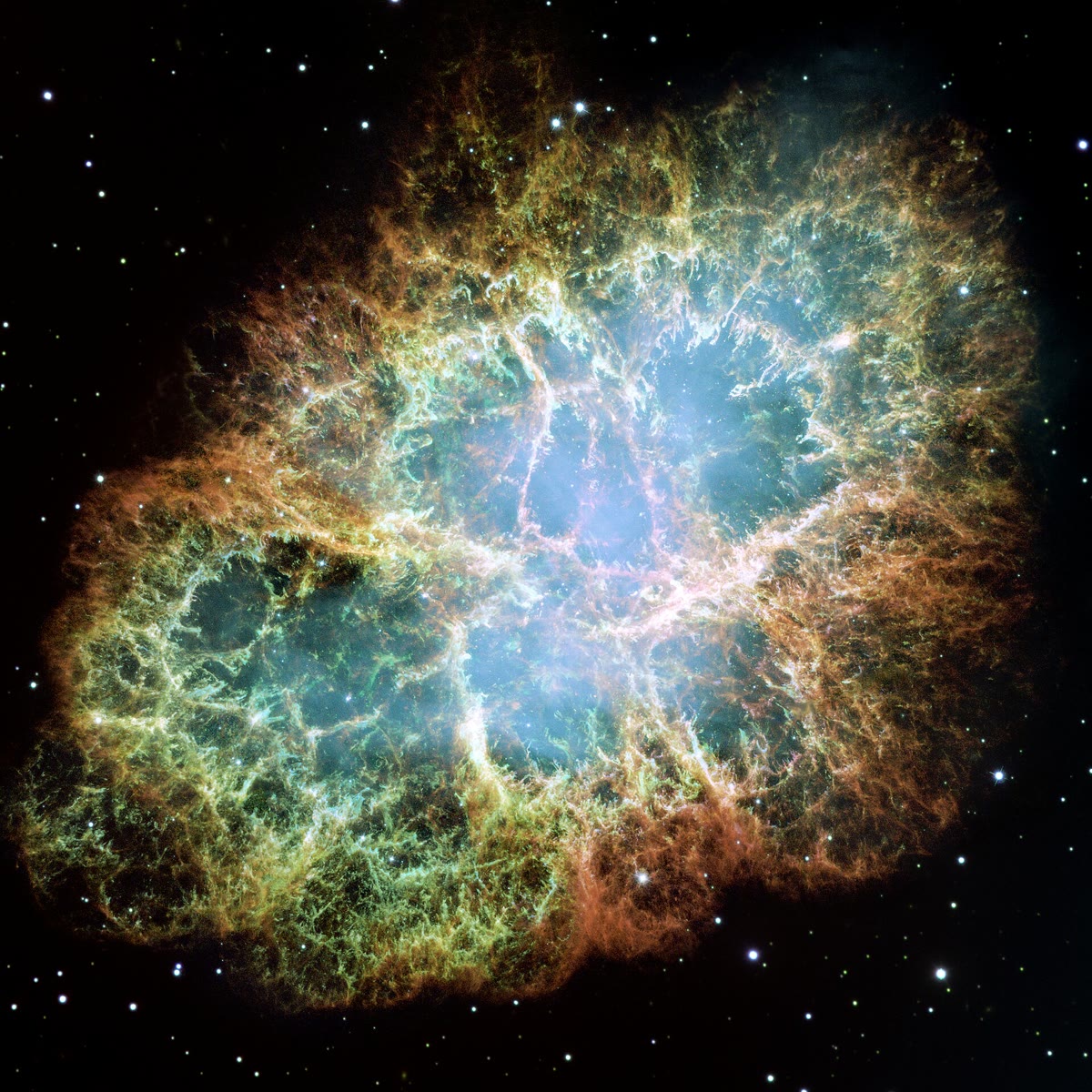
- Explain the lighthouse: what sweeps, what beams, and why the Crab pulsar (born 1054, chronicled as a daytime “guest star”) still flashes thirty times a second.
- Had the remnant exceeded : compute for and state its fate.
- Pulsar timing is stable to : name one physics use of a clock that good, spinning in the sky.
Part IV — What it means.
- The oxygen you breathe and the iron in your blood: trace each atom’s biography in two sentences, from big-bang hydrogen to your bloodstream.
- Type Ia supernovae (white dwarfs pushed past ) all detonate at the same mass, hence nearly the same brightness. Explain why that makes them standard candles, and how Definition 27.5’s diagram is built from them.
- In 1998, distant Ia supernovae came out dimmer than Hubble’s straight line predicts: state the conclusion that earned the 2011 Nobel Prize.
- Estimate how far SN 1987A’s light had travelled when it arrived, in years — and note what was happening on Earth when it set out.
- The LMC neutrinos passed through you too (everyone alive that day). Roughly how many crossed each human ()? Did anyone feel it (Exercise 26.10)?
- Close the book’s ledger in four lines: a star balanced for ten million years by tunnelling; a collapse paid out in neutrinos; a corpse held up by Pauli; and the debris — including the reader — still riding Hubble’s expansion.
Solution
Solution of Problem 27.1.
1. : the Sun will live two thousand of its lifetimes. 2. Heavier nuclei carry more charge: higher Coulomb barriers need hotter cores for the tunnelling odds (Exercise 25.8) to keep pace. 3. Iron sits atop the curve: fusing it costs energy — the furnace’s fuel ladder ends on ash. 4. The Chandrasekhar mass: the most electron degeneracy pressure can carry; the core is a white dwarf grown inside a living star, and at its support fails. 5. Hydrogen: megayears; helium: hundreds of millennia; silicon: a day — each stage pays less per kilogram while the star, ever hotter, spends (mostly into neutrinos) ever faster: the clock runs logarithmically mad. 6. : the core drops out from under the star in a tenth of a second. 7. . 8. The photon show is — one part in ten thousand. The rest leaves as neutrinos: collapsing nuclear matter is opaque to everything else, but (Chapter 26) almost transparent to the weak force’s own particles, which drain the energy in seconds. 9. . 10. At each: neutrinos per square metre — through every square metre of Earth. 11. : the detector logged eleven — an order-of-magnitude bullseye for a star that died 160 000 years ago. 12. The neutrinos leave the core at collapse; the light is born only when the shock bursts through the star’s envelope hours later. That both arrived the same night after 160 millennia in flight bounds the neutrino to light speed within parts in — and its mass to almost nothing. 13. The energy budget (, 99 % in neutrinos) and the -second burst duration — both matched theory’s collapsing core, promoting the supernova mechanism from blackboard to observation. 14. : nuclear density — Definition 25.1’s teaspoon, now the size of a city. 15. Spin-up : 30 days . 16. — a hundred million tesla-metres of flux, conserved into a postage stamp. 17. The magnetic axis, tilted off the spin axis, beams radio along its poles; the beam sweeps the sky like a lighthouse. The Crab’s remnant — the 1054 guest star — still turns thirty times a second, a millennium of spin-down barely begun. 18. — of the order of the star itself: with no pressure left to argue, collapse continues through the horizon and the remnant is a black hole. 19. Arrays of such clocks are gravitational-wave detectors of galactic aperture (and relativity’s best laboratories: binary-pulsar orbits decay exactly as gravitational radiation predicts). 20. Its oxygen was fused in a massive star’s shell and thrown out by a supernova; the iron was forged in the explosive end itself; both drifted the interstellar clouds, joined the solar nebula, the Earth, the sea, the food chain — and the reader. Big-bang hydrogen, though: that has been yours all along. 21. Same detonation mass same intrinsic brightness apparent brightness reads distance: a candle of known wattage visible across billions of light-years — the ruler that draws the Hubble diagram’s far end. 22. The expansion is accelerating: some “dark energy” pushes the universe apart — 2011’s Nobel, and physics’ largest open invoice. 23. light-years: the light left while Homo sapiens was first leaving Africa. 24. through every human alive — and, at Exercise 26.10’s odds, not one person in a million interacted with even one: the flash that outshone a galaxy passed through humanity unfelt. 25. A star balanced ten million years on tunnelling protons; a tenth-of-a-second collapse paid out joules in neutrinos; Pauli’s principle holds the corpse at nuclear density; and the scattered debris — oxygen, iron, reader — rides Hubble’s expansion still, in a universe whose baby picture is a Planck curve. Physics, complete for now: volume closed.