University Physics — Year 3 · Bachelor Year 3
25Nuclear Physics
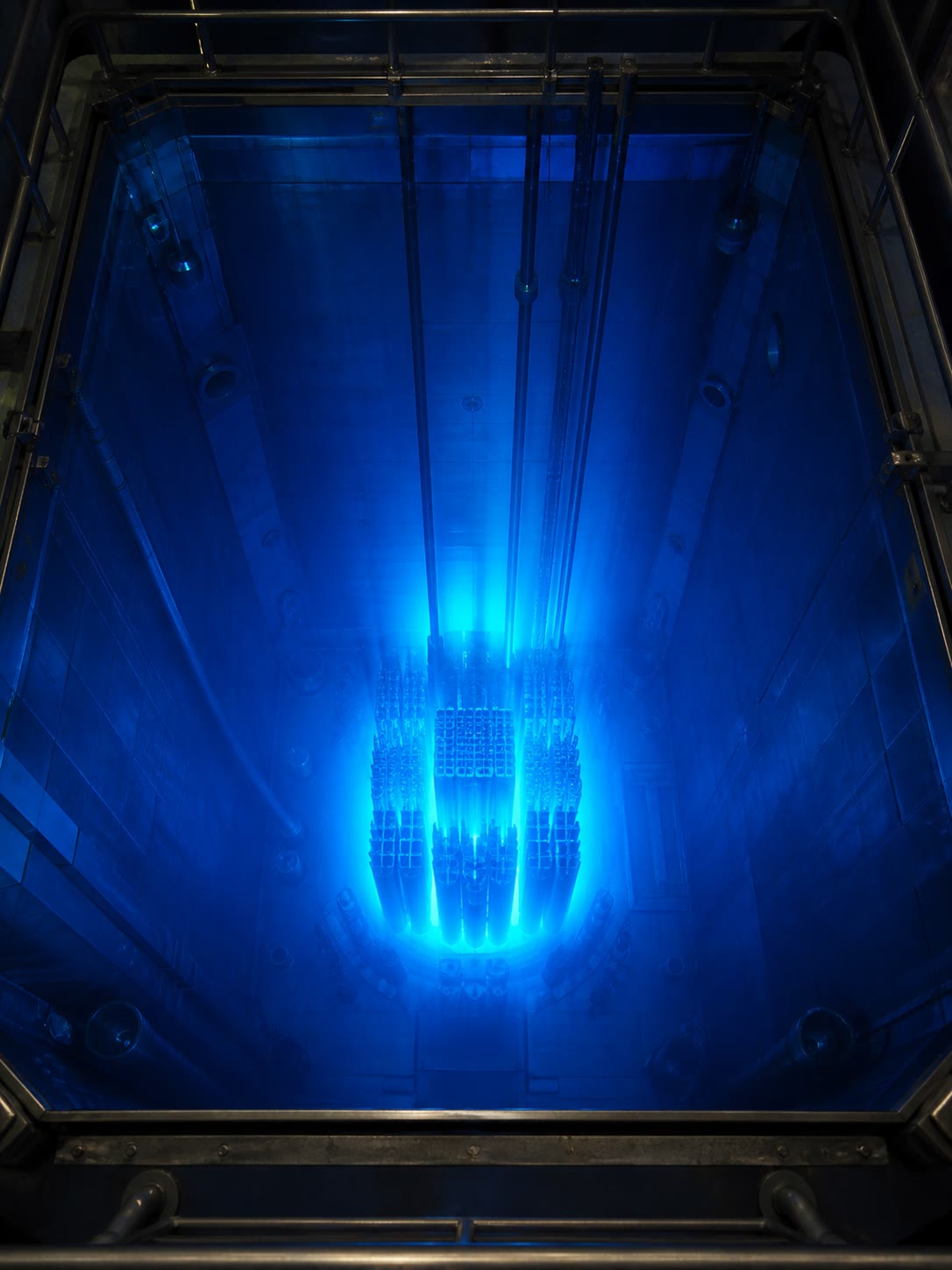
The high-school volume told the story’s outline: atoms have nuclei; some nuclei crumble, on schedules ranging from microseconds to billions of years; and grams of matter hide megatons of energy. This chapter reopens the nucleus with Year 3 tools. A droplet model with five terms predicts the binding of hundreds of nuclides to the percent; quantum tunnelling — the Year 2 volume’s barrier problem, promoted — explains how one formula spans twenty-five orders of magnitude in -decay lifetimes; and the binding-energy curve’s quiet maximum at iron divides all of nuclear technology into two camps: split the heavy (reactors) or join the light (stars, and someday power plants). The chapter ends beside a reactor pool, glowing Cherenkov blue.
25.1 The nucleus: a saturated drop
Definition 25.1 (Nuclides, size, and density)
A nuclide holds protons and neutrons, bound by the strong interaction: intense ( Coulomb at contact), short-ranged (, felt only by touching neighbours), and blind to charge (it grips protons and neutrons alike). Scattering experiments give every nucleus the same recipe: radius
so volume grows like and the density is a universal — a raindrop of it would weigh like a fleet of tankers, and Chapter 27 will meet whole stars at this density. Isotopes share but differ in : same chemistry, different nuclear fates.
Proposition 25.2 (Mass defect and binding energy)
A bound nucleus weighs less than its parts; by Chapter 5, the missing mass is the binding energy,
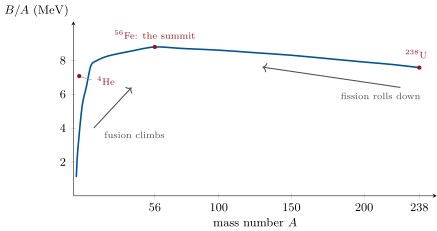
typically per nucleon — a million times chemistry. Plotted per nucleon, climbs steeply through the light nuclei (surface effects fade), peaks at near iron-56, then drifts down as Coulomb repulsion, long-ranged and unsaturating, taxes the heavyweights. Both slopes are energy mines: fusion climbs the left slope (the Sun’s business), fission rolls down the right (the reactor’s) — and iron, at the summit, is nuclear ash for both.
Proposition 25.3 (The semi-empirical mass formula)
Model the nucleus as a charged liquid drop and the whole curve follows from five terms:
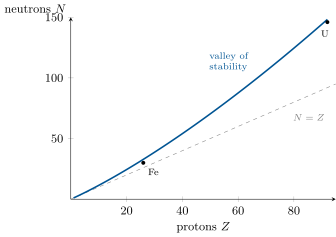
with (in ) (each nucleon bonds its neighbours: volume), (surface nucleons bond fewer: the drop’s “surface tension”), (Coulomb, the long-range saboteur), (asymmetry: by Chapter 19, protons and neutrons fill two separate Fermi ladders, cheapest when equally full), and a small pairing bonus for even numbers (Chapter 14). Minimising at fixed traces the valley of stability: for light nuclei, bending neutron-rich () as Coulomb punishes protons — and off-valley nuclides roll back in by decay.
Proof. Admitted at this level. ∎
25.2 Radioactivity, by the clock
Theorem 25.4 (The decay law)
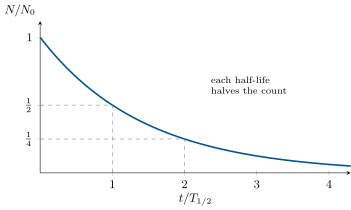
An unstable nucleus has no memory and no aging: in every second it lives, it decays with the same probability . For nuclei, , so
and the activity (decays per second, ) fades on the same exponential. Half-lives run from microseconds to billions of years; the statistics of Chapter 16 guarantee that while one nucleus is perfectly unpredictable, a mole of them keeps exponential time better than any clock — the foundation of radiometric dating.
Proof. Constant per-second probability means ; integrate. Setting gives . ∎
Remark 25.5 (Three doors out of a nucleus)
: a heavy nucleus emits a He cluster. Classically impossible — the Coulomb barrier tops and the leaves with – — it happens by tunnelling (the Year 2 volume’s barrier, curved): Gamow’s exponential sensitivity turns a factor two in energy into twenty orders of magnitude in lifetime, exactly the Geiger–Nuttall pattern (Exercise 25.8). : a neutron becomes a proton (or vice versa), emitting an electron (or positron) and a neutrino — the weak interaction at work, the valley-restoring force; the neutrino’s story waits for Chapter 26. : an excited nucleus sheds photons, the nuclear analogue of Chapter 11’s spectral lines. Decays chain until the valley floor is reached: uranium’s ladder ends, fourteen rungs later, at stable lead.
25.3 Down the slopes: fission and fusion
Proposition 25.6 (Fission and the chain reaction)
A slow neutron absorbed by U makes a wobbling drop that splits: two mid-mass fragments, two-to-three fresh neutrons, and — the gap between uranium’s and the fragments’ , times 235. The freed neutrons can fission further nuclei: with multiplication factor (neutrons per neutron, one generation later), a population grows as — subcritical () dies out, critical () holds steady, supercritical explodes. A reactor moderates neutrons to slow speeds (fission’s preferred diet), leans on the 0.7 % of neutrons that arrive seconds late from fragment decays — the delay that makes humanly adjustable — and lets control rods eat the surplus (Problem 25.1).
Proof. Admitted at this level. ∎

Remark 25.7 (Fusion: the harder, better slope)
Joining light nuclei pays more per kilogram than splitting heavy ones, with no long-lived fragments — but the reactants, both positive, must tunnel through their mutual Coulomb barrier, which demands temperatures of – (Exercise 25.11). Stars do it by being enormous (Chapter 27: the Sun turns million tonnes of hydrogen into helium each second); laboratories do it with magnetically bottled plasmas and, so far, an energy ledger still shy of its break-even ambitions.
25.4 Exercises
Exercise 25.1 ★
Bookkeeping. (a) Give , , for C, C, U, U. (b) Which pairs are isotopes? (c) Why do isotopes share chemistry but not nuclear stability? (d) C and N share : what are such nuclides called, and what decay connects them?
Solution
Solution of Exercise 25.1.
(a) C: ; C: ; U: ; U: . (b) The carbons; the uraniums. (c) Chemistry is the electron cloud, fixed by ; stability is the – balance inside. (d) Isobars — connected by decay: , the radiocarbon clock’s tick.
Exercise 25.2 ★
The universal density. (a) From , show the nuclear density is independent of and evaluate it. (b) Compute the mass of a teaspoon () of nuclear matter. (c) What fraction of an atom’s volume does its nucleus fill (take , )? (d) What does the law itself say about the strong force’s range?
Solution
Solution of Exercise 25.2.
(a) : cancels. (b) — a billion tonnes in a teaspoon. (c) : the atom is empty space with a heavy speck. (d) Volume means each nucleon claims fixed room and binds only its touching neighbours: the force saturates at range.
Exercise 25.3 ★
Weighing the glue. Nuclear masses: , , ; . (a) Compute He’s mass defect and binding energy. (b) Give . (c) Compare with the of Chapter 11: how many orders of magnitude separate nuclear from atomic glue? (d) Why does He’s exceptional binding (the figure’s spike) make it the currency of decay?
Solution
Solution of Exercise 25.3.
(a) : . (b) . (c) : six orders of magnitude — why nuclear fuel outclasses chemical by a million. (d) The is a pre-assembled, exceptionally cheap parcel: emitting it exports four nucleons at a bargain rebate, which no single nucleon can match.
Exercise 25.4 ★
The first curie. Radium-226: years, molar mass . For one gram: (a) count the nuclei; (b) compute ; (c) compute the activity and compare with the historic unit (defined as exactly this gram); (d) how much of the gram survives after 4800 years?
Solution
Solution of Exercise 25.4.
(a) . (b) . (c) : one curie, by construction — the Curies’ own gram. (d) Three half-lives: of radium (the rest now radon and its daughters, marching toward lead).
Exercise 25.5 ★★
The formula at work. With , , , () and pairing for even–even nuclei: (a) compute the four main terms of for Fe (). (b) Sum (with pairing) and compare with the measured . (c) Which two terms fight hardest, and what does their balance set? (d) Why must the Coulomb term, alone, grow faster than ?
Solution
Solution of Exercise 25.5.
(a) Volume ; surface ; Coulomb ; asymmetry (). (b) With pairing : , against the measured — three per mille from a liquid drop. (c) Volume against surfaceCoulomb: their crossover in growth rates is what carves the maximum at iron. (d) Coulomb is long-ranged: every proton repels every other, , while the saturating strong force only ever pays — the eventual defeat of the heavyweights.
Exercise 25.6 ★★
The valley floor. (a) Keeping only the -dependent terms, minimise the mass at fixed and derive . (b) Evaluate for and compare with ruthenium (). (c) Show the light- limit is and interpret with the two Fermi ladders. (d) A fission fragment has , : how far off the valley is it, and what sequence of decays follows?
Solution
Solution of Exercise 25.6.
(a) of the Coulomb and asymmetry terms gives ; solve. (b) : nature’s choice at is ruthenium, . (c) Without Coulomb, : two Fermi ladders (Chapter 19), cheapest filled to equal height. (d) The fragment’s valley seat is : five protons short — a cascade of five decays climbs it back, each converting a neutron and emitting an electron and antineutrino.
Exercise 25.7 ★★
Radiocarbon. Living matter keeps C ( years) topped up at 1 atom per carbons; death stops the refill. (a) A charcoal sample shows 30 % of the living activity: how old is the fire? (b) One gram of living carbon: compute its C activity ( expected). (c) Why is the method useless beyond years? (d) And why is it useless for dating rocks (which clocks take over)?
Solution
Solution of Exercise 25.7.
(a) years: an end-of-ice-age fire. (b) ; : — a dozen decays per minute per gram, the working count rate of every dating laboratory. (c) After nine half-lives the activity sinks below background: the clock still runs but can no longer be read. (d) Rocks never breathed atmospheric carbon; their clocks are the primordial ones — uranium–lead, potassium–argon — with half-lives of billions of years.
Exercise 25.8 ★★
Gamow’s cliff. Polonium-212 emits an ; its barrier tops . (a) Show classical escape is impossible, and classical entry too — yet it decays in . (b) Uranium-238’s carries and its half-life is years: compute the ratio of the two decay constants. (c) Explain, with the tunnelling exponential, how a factor two in energy buys in rate. (d) Why does the same physics set the Sun’s core temperature requirement?
Solution
Solution of Exercise 25.8.
(a) The ’s is far under the rim: classically it can neither leave nor have entered — yet the half-life is . (b) ; : ratio . (c) The tunnelling rate is with the Gamow exponent : halving raises by some fifty-five units, and — Geiger–Nuttall’s outrageous straight line, from one exponential. (d) Solar protons also tunnel: the core temperature must be just high enough for the Maxwell tail times the Gamow factor to sustain the burn — same cliff, climbed from the other side.
Exercise 25.9 ★★
Two hundred million electron-volts. (a) Justify the per fission from the curve. (b) Compute the energy in one kilogram of U fully fissioned, in joules and in tonnes of oil equivalent (). (c) A power plant at 33 % efficiency: how many kilograms of U per year? (d) Why do the fragments, not the neutrons, carry most of the , and into what form does it immediately go?
Solution
Solution of Exercise 25.9.
(a) The split moves nucleons from to of binding: . (b) nuclei: tonnes of oil — per kilogram. (c) Thermal for a year is : about of U. (d) The two positive fragments spring apart under their own Coulomb repulsion, carrying as kinetic energy that becomes heat within micrometres — a reactor is a kettle whose flame is electrostatic recoil.
Exercise 25.10 ★★★
Taming . In a reactor, prompt neutrons reproduce in . (a) With on prompt neutrons alone, compute the power multiplication in one second — and the verdict on mechanical control. (b) A fraction of neutrons is delayed by : explain why, for , the chain’s effective clock becomes seconds. (c) Compute the same one-second multiplication with the effective generation time . (d) State in one sentence what Chernobyl’s operators lost when their reactor went prompt-supercritical.
Solution
Solution of Exercise 25.10.
(a) generations: — megawatts to tens of gigawatts inside a second; no motor moves a rod that fast. (b) With the chain cannot reproduce on prompt neutrons alone: every growth step waits for the stragglers, so the effective generation time is a fraction of a second or more. (c) : half a percent per second — rod-and-operator territory. (d) Driving past put the reactor on the prompt clock: they lost the delayed-neutron grace period that makes reactors steerable.
Exercise 25.11 ★★★
The Sun’s arithmetic. Overall, converts of the mass to energy (, neutrinos included). (a) From , compute the mass converted per second, and the hydrogen consumed per second. (b) With of sun, a tenth of it burnable core hydrogen (take the hydrogen fraction ): estimate the lifetime. (c) Two protons at : compare with their Coulomb barrier at and conclude who does the crossing (Exercise 25.8). (d) Why does fusion, unlike fission, leave essentially no radioactive ash?
Solution
Solution of Exercise 25.11.
(a) of pure mass; hydrogen throughput — six hundred million tonnes a second. (b) Burnable hydrogen : billion years — the Sun is middle-aged. (c) Barrier against : a thousandfold deficit — only the Maxwell tail’s fastest protons, tunnelling (Exercise 25.8), ever fuse; hence the Sun burns for gigayears instead of exploding. (d) The ash is He — stable, doubly magic contentment; there are no neutron-rich fragments to -decay for centuries.
Exercise 25.12 ★★★
Nuclear medicine. (a) Technetium-99m (, of ) is medicine’s workhorse: compute the number of nuclei, and their mass, behind an injected . (b) Explain why a six-hour half-life and a pure are each exactly what a diagnostic wants. (c) PET: a positron from F annihilates with an electron — use Chapter 5 to give the energy and geometry of the two photons, and hence the detector’s principle. (d) Radiotherapy delivers () to a tumour: compare the energy with a sip of warm water, and reconcile the harmlessness of the joules with the lethality of the ionisation.
Solution
Solution of Exercise 25.12.
(a) : nuclei — . Medicine by the nanogram. (b) Six hours outlives the scan but not the weekend: the dose switches itself off; a pure leaves the body to the camera without the tissue-burning / toll. (c) Electron and positron at rest annihilate into two photons, back to back (energy and momentum, Chapter 5): each coincident pair defines a line through the tumour, and thousands of lines triangulate it — tomography by conservation law. (d) warms tissue half a millikelvin — thermally a sip of tepid water; but delivered as ionisations per kilogram, each snipping -scale chemical bonds, it is chemistry-lethal to a dividing cell. Joules measure heat; grays measure sabotage.
25.5 Problem: Open day at the research reactor
Problem 25.1
Open day at the research reactor. The national laboratory opens its pool-type research reactor to visitors, and you have talked your way onto the balcony: below, through eight metres of limpid water, the core glows an unearthly blue. The guide — a retiring reactor physicist — has agreed to let you do the arithmetic.
Part I — The energy ledger.
- Each fission of U releases about . Convert to joules, and compute the fissions per second sustaining .
- Convert to grams of U consumed per day.
- The same from coal (): tonnes per day? Form the mass ratio and connect it to the -versus- scales of this chapter and chemistry.
- The fragments are born at per nucleon binding, uranium at : verify is consistent.
- The fragments stop within micrometres of their birthplace. Into what does their convert, and on what timescale does it reach the cooling water?
- Why are the fragments (e.g. , ) inevitably radioactive? Use the valley of stability.
Part II — Keeping .
- Define the multiplication factor and state what , , mean for the neutron population.
- The pool water moderates. Explain in two sentences why slowing neutrons to thermal speeds helps fission U, and why hydrogen is the best moderator (recall elastic collisions from the Year 1 volume).
- Control rods are boron steel. What does boron do, and how does raising or lowering the rods steer ?
- With prompt neutrons alone () and , compute the power growth over one second and conclude.
- The 0.7 % delayed neutrons stretch the effective generation time to : recompute, and state the design rule that keeps safely below the delayed fraction.
- The water is also the coolant. Explain the intrinsic safety feature: what happens to moderation — and hence to — if the water boils away?
- Why does the reactor still need emergency cooling after shutdown? (Name the heat source that control rods cannot touch.)
Part III — The blue light.
- The glow is Cherenkov radiation: light’s speed in water is with . What must a charged particle do to emit it?
- Compute the threshold speed, and with Chapter 5 the threshold kinetic energy for an electron.
- Which reactor particles qualify? Trace the chain from fission fragment to fast electron in the water.
- The spectrum’s intensity grows toward short wavelengths: why does the pool glow blue rather than red?
- The guide says: “the glow is the shielding working.” Explain — what does eight metres of water do to the core’s radiation, and roughly why is the balcony safe?
- After shutdown the blue dims over minutes but does not vanish for days. Connect to Part I’s question 6.
Part IV — What the reactor is for.
- This reactor’s day job is making molybdenum-99 (), parent of medicine’s technetium-99m. Why must the world’s hospitals be resupplied weekly, and why can no warehouse stockpile it?
- A Mo-99 shipment leaves on Monday; the hospital elutes Tc-99m on Friday (96 hours later). What activity of the parent remains?
- Neutron beams from the core also feed the diffraction instruments of Chapter 23: why are reactor neutrons, once thermalised, born with the right wavelength?
- The guide’s parting problem: a fuel element spends five years in the pool before shipment. Using the fragments’ mix of half-lives, explain the logic — what has five years of pool time bought?
- Estimate the decay heat one hour after shutdown ( of ) and compare it with a household’s electric heater: is passive pool cooling plausible?
- Close the ledger in four lines: pays a split; delayed neutrons lend the seconds that make steerable; water moderates, cools, shields, and glows; and the day’s real product leaves in medical vials, not megawatts.
Solution
Solution of Problem 25.1.
1. : fissions per second. 2. fissions per day : about of U a day. 3. Coal: tonnes a day — a mass ratio of , which is the -to- ratio of nuclear to chemical bonds. 4. : consistent, the small change bookkept by neutrons and neutrinos. 5. Fragment kinetic energy ionisation heat, within micrometres and microseconds; conduction hands it to the water — the reactor is a fragment-stopping kettle. 6. They inherit uranium’s , far above the valley floor at their : each must run a chain of decays back down — built-in radioactivity, by geometry of the valley. 7. = neutrons begotten per neutron, one generation on: dies out, holds steady (an operating reactor), grows. 8. Slow neutrons linger near the nucleus and U’s fission appetite grows steeply at thermal energies. Elastic collisions shed energy fastest onto equal masses — and hydrogen matches the neutron’s mass: water is moderator made to order. 9. Boron-10 devours neutrons (): rods in, neutrons eaten, down; rods out, up — the throttle. 10. : powers of a hundred and fifty per second — hopeless for machinery. 11. On the delayed clock: , half a percent per second. Rule: keep well below , so the delayed neutrons always hold the casting vote. 12. Boiling removes the moderator: neutrons stay fast, fission starves, falls — the water-moderated design throttles itself (a negative feedback its graphite cousins lacked). 13. Decay heat: the fragments’ radioactivity — Part I question 6 — obeys half-lives, not control rods, and still yields megawatts just after shutdown. 14. Outrun light in the water: . 15. : , so . 16. electrons from fragment decays carry s, and core s Compton-kick electrons to similar energies: both sail past — the pool is full of qualifying electrons. 17. The Cherenkov spectrum strengthens toward short wavelengths ( in intensity): the eye is handed blue and violet — the colour is the spectrum’s slope. 18. Water attenuates s and neutrons exponentially; eight metres is dozens of halving-lengths, so the balcony sits at background dose. The glow is the water absorbing the radiation’s energy — visible proof the shield is eating it. 19. The short-lived fragments die within minutes (the dimming); the longer-lived tail — the same decay heat of question 13 — keeps a faint glow and a real heat load for days. 20. With the parent loses a factor per week: stockpiles decay themselves away, so hospitals live on a weekly “technetium cow” delivered from reactors like this one. 21. half-lives: — about remain. 22. Thermalised to room temperature, (Exercise 23.5): born matched to lattice spacings. 23. Five years kills every half-life up to months: activity and decay heat fall by orders of magnitude, until the element can ride in a shielded cask instead of a swimming pool. 24. — a hundred domestic heaters into a hundred-tonne pool: tens of kelvin per day at worst, comfortably removed by natural convection — passive safety by sheer heat capacity. 25. pays a split and a day; delayed neutrons lend the seconds that make steerable; the water moderates, cools, shields — and glows blue precisely because it is working; and the product that matters most leaves in vials for Monday’s hospitals.