
Physics · Glossary

What is Perfect fluid?

Definition 3.2 University Physics — Year 2 · Chapter 3 — Perfect Fluids: Euler and Bernoulli

A perfect fluid is one in which the only contact force between neighbouring particles is the pressure — normal to every surface, no tangential (viscous) stress. It is an idealization valid, as the next chapter explains, far from walls and at high Reynolds number: water in a pipe away from the wall, air around a wing outside the thin boundary layer, a wave on the sea.
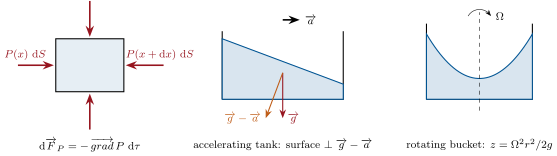
Left: the pressure forces on the faces of a fluid box do not cancel when P varies — their resultant is - gradP per unit volume. Middle and right: two fluids at rest in an accelerated frame; the free surface is everywhere perpendicular to the effective gravity.
Left: the pressure forces on the faces of a fluid box do not cancel when PP varies — their resultant is gradP-\operatorname{\vect{grad}}P per unit volume. Middle and right: two fluids at rest in an accelerated frame; the free surface is everywhere perpendicular to the effective gravity.
Read in context →