
সব বই

পেশাদার

1 Markets I: The Ecosystem and Exchange-Traded Marketsবাজার অনলাইন 2 Markets II: Rates, FX and Creditবাজার অনলাইন 3 Markets III: Commodities, Energy and Cryptoবাজার অনলাইন 4 Quantitative Methodsপদ্ধতি অনলাইন 5 Derivatives and Volatilityডেরিভেটিভস অনলাইন 6 Rates, Credit, XVA and Riskসুদহার, ঋণ ও ঝুঁকি অনলাইন 7 Research Craft: Predictors, Backtests, Measurement, Portfoliosগবেষণা অনলাইন 8 Strategies I: Equities and Futuresকৌশল অনলাইন 9 Strategies II: Volatility, Relative Value, Macro and the Bank Desksকৌশল অনলাইন 10 Microstructure and Executionএক্সিকিউশন অনলাইন 11 Market Making and High-Frequency Tradingমার্কেট মেকিং অনলাইন 12 Machine Learning for Marketsমেশিন লার্নিং অনলাইন 13 Low-Latency Softwareপ্রযুক্তি অনলাইন 14 Networks, Hardware and Trading Infrastructureপ্রযুক্তি অনলাইন 15 Research, Data and Risk Platformsপ্রযুক্তি অনলাইন 16 The Desk and the Firmপ্রতিষ্ঠান অনলাইন 17 The Industry: Firms, Roles and Careersক্যারিয়ার অনলাইন 18 Interviews I: Maths, Probability and Speedক্যারিয়ার অনলাইন 19 Interviews II: Markets, Trading Games and the Final Roundক্যারিয়ার অনলাইন 20 Interviews III: Codeক্যারিয়ার অনলাইন
অ্যাপ পরিচিতি Coach সাইন ইন পড়া শুরু করো

বইগুলো এখনো বাংলা ভাষায় পাওয়া যায় না — ইংরেজি সংস্করণ দেখানো হচ্ছে।

Physics · পরিভাষা

Perfect fluid কী?

Definition 3.2 University Physics — Year 2 · অধ্যায় 3 — Perfect Fluids: Euler and Bernoulli

A perfect fluid is one in which the only contact force between neighbouring particles is the pressure — normal to every surface, no tangential (viscous) stress. It is an idealization valid, as the next chapter explains, far from walls and at high Reynolds number: water in a pipe away from the wall, air around a wing outside the thin boundary layer, a wave on the sea.
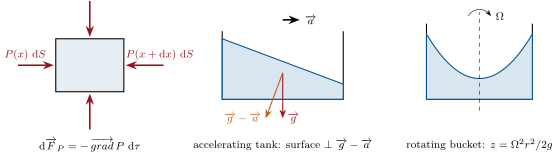
Left: the pressure forces on the faces of a fluid box do not cancel when P varies — their resultant is - gradP per unit volume. Middle and right: two fluids at rest in an accelerated frame; the free surface is everywhere perpendicular to the effective gravity.
Left: the pressure forces on the faces of a fluid box do not cancel when PP varies — their resultant is −grad→⁡P-\operatorname{\vect{grad}}P per unit volume. Middle and right: two fluids at rest in an accelerated frame; the free surface is everywhere perpendicular to the effective gravity.
প্রসঙ্গসহ পড়ো →