Physics · Glossary

What is Perfect gas, microscopic model?

Definition 20.5 University Physics — Year 1 · Chapter 20 — Kinetic Theory and the Perfect Gas

A perfect gas (ideal gas) is a collection of NN molecules, treated as points of mass mm, moving freely and at random — no interaction except brief collisions — in a container of volume VV. At equilibrium the velocity distribution is isotropic and stationary; n=N/Vn^* = N/V is the number density and v2\langle v^2\rangle the mean square speed.

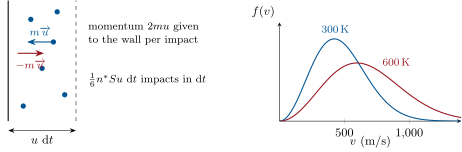
Left: the kinetic origin of pressure — molecules striking a wall and bouncing back deliver momentum to it; their number per second times 2mu is the force. Right: the actual speeds are spread (Maxwell’s distribution, here for nitrogen at two temperatures); the model’s single u is replaced by the root-mean-square speed.
Left: the kinetic origin of pressure — molecules striking a wall and bouncing back deliver momentum to it; their number per second times 2mu2mu is the force. Right: the actual speeds are spread (Maxwell’s distribution, here for nitrogen at two temperatures); the model’s single uu is replaced by the root-mean-square speed.
Read in context →