The air in a classroom weighs as much as a grown man, and contains more molecules than there are grains of sand on Earth, each flying at the speed of a rifle bullet and colliding ten billion times a second with its neighbors. Nobody can follow one of them; nobody needs to. A handful of averages — pressure, temperature, volume, amount — describe the air completely for every purpose of engineering, and a simple picture of molecules bouncing off walls explains where those averages come from and how they are related. This chapter opens the thermodynamics part of the volume by looking at matter from both ends: the microscopic chaos and the macroscopic calm, and the kinetic theory that connects them in the case of the perfect gas.
20.1 Two scales of description
Definition 20.1(Microscopic and macroscopic scales)
At the microscopic scale matter is made of molecules: 1mol contains NA=6.02×10²³ of them, each about 0.3nm across; in a gas at ordinary conditions they are 3nm apart, move at hundreds of meters per second and collide every 70nm or so. At the macroscopic scale a system is described by a few state variables — pressureP, volume V, temperatureT, amount of substance n — that are averages over enormous numbers of molecules. A variable is extensive if it doubles when the system is doubled (V, n, mass, energy), intensive if it does not (P, T, density).
Definition 20.2(Thermodynamic equilibrium)
A system is in thermodynamic equilibrium when its state variables are uniform and constant in time and no macroscopic flow of matter or energy crosses it. Only then are P and T defined for the system as a whole; the equation of state links them to V and n.
Definition 20.3(Pressure)
A fluid at rest pushes on every surface element dS of a wall with a force dF=PdSn normal to it, toward the wall; P is the pressure, in pascals (1Pa=1N/m2); 1bar=1×10⁵Pa, 1atm=1.013×10⁵Pa. At a given point it does not depend on the orientation of the surface (Chapter 21).
Definition 20.4(Temperature)
Two systems in contact through a wall that lets energy pass reach, in time, a common state: they are then at the same temperature, and two bodies each in equilibrium with a third are in equilibrium with each other (the zeroth law). The kelvin scale is fixed by kB=1.380649×10⁻²³J/K exactly; Celsius: θ=T−273.15. The kinetic theory below gives T its microscopic meaning.
20.2 The kinetic model of the perfect gas
Definition 20.5(Perfect gas, microscopic model)
A perfect gas (ideal gas) is a collection of N molecules, treated as points of mass m, moving freely and at random — no interaction except brief collisions — in a container of volume V. At equilibrium the velocity distribution is isotropic and stationary; n∗=N/V is the number density and ⟨v2⟩ the mean square speed.
where ⟨ϵk⟩=21m⟨v2⟩ is the mean kinetic energy of a molecule.
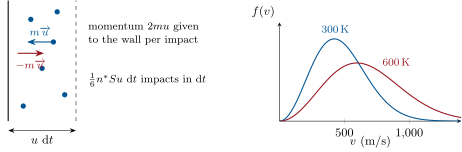
Partial proof. Take the simplified model in which the molecules all have speed u and move along the three axes, one sixth in each direction. A molecule hitting the wall x=0 head-on bounces back elastically and delivers the momentum 2mu to it. In time dt, the molecules moving toward the wall that reach an area S are those within the slab udt thick, one sixth of the n∗Sudt molecules there. Force = momentum per time =(n∗Sudt/6)(2mu)/dt=31n∗mu2S, so P=31n∗mu2. Averaging over the actual distribution of speeds and directions replaces u2 by ⟨v2⟩ (the isotropy gives ⟨vx2⟩=31⟨v2⟩); the Year 2 volume does it in full. ∎
Left: the kinetic origin of pressure — molecules striking a wall and bouncing back deliver momentum to it; their number per second times 2mu is the force. Right: the actual speeds are spread (Maxwell’s distribution, here for nitrogen at two temperatures); the model’s single u is replaced by the root-mean-square speed.
Definition 20.7(Kinetic temperature; equation of state)
the equation of state of the perfect gas. The root-mean-square speed is u=⟨v2⟩=3kBT/m=3RT/M, M the molar mass.
Example 20.8(Numbers for air)
Nitrogen at 300K: u=3×8.314×300/0.028=517m/s; hydrogen, 1930m/s; the heavier the slower, as 1/M. At 1bar and 300K, n∗=P/kBT=2.4×1025m−3: 24L per mole, 2.7×10²² molecules in a liter. A classroom of 200m3: 8300mol, 240kg of air.
Remark 20.9(Why the model works, and when it fails)
Between collisions a molecule of air flies a mean free pathλ≈1/(2πd2n∗)≈70nm — two hundred times its size: the gas is mostly empty, interactions are rare, and PV=nRT holds to better than a percent at ordinary pressures. At high pressure or low temperature the molecules’ own volume and their attraction matter: van der Waals’s equation (P+an2/V2)(V−nb)=nRT corrects for both, and below a critical temperature the gas liquefies (Chapter 25).
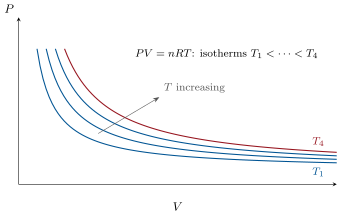
The Clapeyron diagram of a perfect gas: at each temperature the isotherm is a hyperbola P=nRT/V, higher for higher T. A transformation is a path in this plane; a cycle, a closed loop (Chapter 24).
20.3 Internal energy of the perfect gas
Definition 20.10(Internal energy)
The internal energyU of a system is the sum of the kinetic energies of its molecules in the frame where the system is at rest and of their mutual potential energies; it is an extensive state function.
Proposition 20.11(Internal energy of perfect gases)
For a perfect gasU depends on T alone (first Joule law):
U=23nRT(monatomic: He, Ne, Ar),U=25nRT(diatomic at ordinary temperatures: N2,O2,H2),
Partial proof. No mutual potential energy by hypothesis, so U=N⟨ϵk⟩=23NkBT for point molecules. A diatomic molecule also rotates: each of its two rotational degrees of freedom carries, at equilibrium, the same 21kBT as each translational one (the equipartition theorem, admitted; the Year 3 volume derives it and explains why the vibration joins in only above a thousand kelvins). ∎
Example 20.12(A room’s worth)
The 8300mol of air in the classroom at 300K: U=25×8300×8.314×300=5.2×10⁷J — the energy of a liter and a half of gasoline, held in molecular motion. Warming the room by 1 K costs 25nR=170kJ (at constant volume).
20.4 Condensed phases
Proposition 20.13(Model of the incompressible, indilatable phase)
Liquids and solids are modeled, at this level, as phases of fixed volume — neither compressible nor dilatable — whose internal energy depends on T alone: dU=CdT with C=mc, c the specific heat capacity (4180J/(kgK) for water, 450J/(kgK) for steel). The real, small deviations are measured by the thermal expansion coefficient α=(1/V)(∂V/∂T)P (∼1×10⁻⁵K−1 for metals, 2×10⁻⁴K−1 for liquids) and the isothermal compressibility χT=−(1/V)(∂V/∂P)T (∼5×10⁻¹⁰Pa−1 for water, against 1/P≈1×10−5Pa−1 for a gas).
Proof.Admitted at this level.∎
Example 20.14(How incompressible)
Water at the bottom of the Mariana trench (1100bar) is compressed by χTΔP≈5×10−10×1.1×108=5%; a 30m steel rail warmed by 50 K lengthens by αLΔT=18mm — the reason for expansion joints. Against a gas, whose volume halves under a doubled pressure, the model of a fixed volume is good to a few percent in most situations of this volume.
20.5 Exercises
Exercise 20.1★
Number of molecules in 1.0L of gas at 0∘C and 1atm; mean distance between neighbors; compare with the molecular size 0.3nm.
Solution
Solution of Exercise 20.1.
N=PV/kBT=1.013×105×10−3/(1.38×10−23×273)=2.7×1022; n∗−1/3=(3.7×10−26)1/3=3.3nm, ten times the molecular size.
Exercise 20.2★
Root-mean-square speeds of H2, N2, O2 and CO2 at 300K, and of N2 at 77K (boiling nitrogen).
Solution
Solution of Exercise 20.2.
u=3RT/M: H21930m/s, N2517m/s, O2484m/s, CO2412m/s; N2 at 77K: 262m/s.
Exercise 20.3★
A car tire of volume 30L is inflated to a gauge pressure of 2.5bar at 20∘C. Amount and mass of air inside; absolute pressure after a drive that heats it to 50∘C.
Solution
Solution of Exercise 20.3.
P=3.5bar absolute: n=PV/RT=3.5×105×0.030/(8.314×293)=4.3mol, 125g. At 323K, P∝T: 3.86bar (gauge 2.85bar).
Exercise 20.4★
Estimate the mean free path of air molecules at 1bar, 300K (d=0.37nm), and the collision frequency of one molecule. At what pressure does the mean free path reach 1m (a “vacuum”)?
Solution
Solution of Exercise 20.4.
n∗=P/kBT=2.4×1025m−3; λ=1/(2π×1.37×10−19×2.4×1025)=6.8×10−8m; frequency u/λ≈500/7×10−8=7×109s−1. λ∝1/P: 1m at P≈105×7×10−8=7×10⁻³Pa.
Exercise 20.5★★
Density of air at 1.013bar and 20∘C (M=29g/mol), then at 100∘C. Lift of a 2800m3 hot-air balloon (difference of the two weights of air).
Solution
Solution of Exercise 20.5.
ρ=PM/RT: 1.20kg/m3 at 293K, 0.946kg/m3 at 373K. Lift (1.20−0.95)×2800×9.81=7.0kN: about 720kg.
Exercise 20.6★★
Air is 21% O2 by molecules. Partial pressure of oxygen at sea level; at 5000m where P=0.54atm; at the summit of Everest (0.33atm). Why does the body struggle there?
Solution
Solution of Exercise 20.6.
PO2=0.21P: 0.21atm; 0.11atm at 5000m; 0.07atm on Everest — a third of sea level. Oxygen enters the blood in proportion to its partial pressure; at a third, the lungs cannot saturate the hemoglobin.
Exercise 20.7★★
One mole of CO2 at 300K in 1.0L: pressure from the perfect-gas law, then from van der Waals (a=0.364Pam6/mol2, b=4.27×10⁻⁵m3/mol). Which correction dominates here?
Solution
Solution of Exercise 20.7.
Perfect gas: P=RT/V=2494/10−3=24.9bar. Van der Waals: RT/(V−b)−a/V2=2494/9.57×10−4−0.364/10−6=26.1−3.6=22.4bar: the attraction (−3.6bar) outweighs the excluded volume (+1.2bar); real CO2 is 10% below the ideal value.
Exercise 20.8★★
Internal energy of the air in a 50m3 room at 1bar, 300K; energy to warm it by 5K at constant volume; time with a 2kW heater (no losses).
Solution
Solution of Exercise 20.8.
n=PV/RT=105×50/(8.314×300)=2000mol; U=25nRT=1.25×10⁷J; ΔU=25nR×5=208kJ; 104s at 2kW.
Exercise 20.9★★
A 30m steel rail (α=1.2×10⁻⁵K−1) between −10∘C and 40∘C: length change. A brass ring (α=1.9×10⁻⁵K−1) of inner diameter 49.95mm must slip over a 50.00mm shaft: by how much must it be heated?
Solution
Solution of Exercise 20.9.
ΔL=αLΔT=1.2×10−5×30×50=18mm. Ring: Δd/d=αΔT=0.05/49.95=10−3: ΔT=10−3/1.9×10−5=53K (the hole expands like the metal around it).
Exercise 20.10★★★
Energy per molecule at 300K (23kBT) in joules and eV; molar heat capacities CV,m of argon and of nitrogen; why is that of nitrogen larger though its molecules are lighter?
Solution
Solution of Exercise 20.10.
23kBT=6.2×10⁻²¹J=0.039eV. Argon 23R=12.5J/(molK); nitrogen 25R=20.8J/(molK): the diatomic molecule also stores energy in rotation (two extra degrees of freedom), whatever its mass.
Exercise 20.11★★★
Redo the derivation of the kinetic pressure in the six-direction model, then show that for an isotropic distribution of velocities ⟨vx2⟩=31⟨v2⟩ and that the pressure formula is unchanged.
Solution
Solution of Exercise 20.11.
Six-direction model: as in the text, P=31n∗mu2. Isotropy: ⟨vx2⟩=⟨vy2⟩=⟨vz2⟩ and their sum is ⟨v2⟩, so each is 31⟨v2⟩. The flux argument with a distribution gives P=n∗m⟨vx2⟩ (molecules with vx>0 hitting the wall, momentum 2mvx each, flux n∗vx/2 per speed class, averaged), i.e. 31n∗m⟨v2⟩ — the same.
Exercise 20.12★★★
Root-mean-square speeds of H2 and O2 at 300K compared with the Earth’s escape velocity, and with the Moon’s (2.4km/s). Knowing that the fraction of molecules faster than 3u is small but not zero, explain why the Earth has lost its hydrogen and the Moon its whole atmosphere.
Solution
Solution of Exercise 20.12.
H2: 1.9km/s, O2: 0.48km/s; Earth 11.2km/s, Moon 2.4km/s. For O2 on Earth, ve/u=23: the tail of the distribution beyond that is utterly negligible; for H2, ve/u≈6: a minute but steady fraction escapes each year, and over billions of years the hydrogen is gone. On the Moon, ve/u is 5 for O2 and 1.2 for H2: everything leaked away.
20.6 Problem: The air in the room
Problem 20.1
Weekend problem — a classroom of air: counting its molecules, weighing it, timing their flights, and recovering from the same model the lift of a balloon, the thinness of mountain air and the speed of sound
A classroom measures 10×8×2.5m; its air is at P=1.013×10⁵Pa, T=293K, molar mass M=29.0g/mol, 79% N2 and 21% O2 by molecules. R=8.314J/(molK), kB=1.38×10⁻²³J/K, NA=6.02×10²³, g=9.81m/s2.
Part I — Counting and weighing.
Amount of air (moles) and number of molecules in the room.
Mass of the air; compare with a person.
Number density n∗ and mean distance between molecules (n∗−1/3); compare with the molecular diameter 0.37nm.
Using the six-direction model with u=500m/s, compute the number of impacts per second on 1cm2 of wall.
Compute the momentum delivered per second, and check that it reproduces the atmospheric pressure.
Total force of the air on one wall of 8m by 2.5m; why does the wall not move?
The room is warmed to 303K with its windows closed and sealed: new pressure, and the net force on the wall now.
Same warming with a window open: what leaves, and how much?
Part III — Buoyancy.
Density of the room’s air, and of air at 373K at the same pressure.
A hot-air balloon of volume 2800m3 is filled with air at 373K: weight of the hot air, weight of the displaced cold air, and the available lift (Archimedes, Chapter 21).
The envelope, basket, burner and gas weigh 300kg: how many 75kg passengers can it lift?
To what temperature should the air be heated to double the lift, and why is that not done (the envelope is nylon)?
A helium balloon of the same volume at 293K (M=4g/mol): lift? Why do tourist balloons use hot air nonetheless?
At the summit of Everest P=0.33atm and T≈250K: number density of oxygen molecules compared with the room’s.
The atmosphere’s pressure falls with height roughly as P(z)=P0e−z/H with H=RT/Mg (Chapter 21): compute H for 260K and the height at which P=P0/2.
The speed of sound in a perfect gas is cs=γRT/M with γ=1.4 for air (Chapter 22): compute it at 293K and compare with the rms speed; interpret the closeness.
How does cs vary with T? Speed of sound in the room at 303K, and in helium at 293K (γ=5/3): why does a helium voice sound high?
At the top of Everest, is sound faster or slower than in the room? By how much?
The room’s air is replaced by argon at the same P and T: what changes in the count, the mass, the speeds, the internal energy?
Internal energy of the room’s air (U=25nRT) and the energy to warm it by 10K at constant volume.
Summarize in three lines what the kinetic model delivered: which macroscopic quantities it explained, and from which single microscopic average.
3.n∗=N/V=2.5×1025m−3; distance n∗−1/3=3.4nm, nine molecular diameters.
4. N2: 3×8.314×293/0.028=511m/s; O2: 478m/s. Same 23kBT per molecule: 21mu2 fixed, so u∝1/m.
5.23kBT=6.1×10⁻²¹J; total N×6.1×10−21=3.0×10⁷J; a 1000kg car at 100km/h: 3.9×10⁵J — the room’s molecular motion is eighty cars’ worth.
6.λ=1/(2π×1.37×10−19×2.5×1025)=66nm; time λ/u=66×10−9/500=1.3×10−10s.
7. Impacts per second on S: 61n∗Su=61×2.5×1025×10−4×500=2.1×10²³s−1.
8. Each gives 2mu=2×4.8×10−26×500=4.8×10⁻²³kgm/s (m=M/NA=4.8×10−26kg): force 2.1×1023×4.8×10−23=10N on 1cm2: 1.0×10⁵Pa. The model reproduces atmospheric pressure.
9.F=PS=1.013×105×20=2.0×10⁶N — two hundred tonnes; the same pressure acts on the other side.
10.P′=P×303/293=1.048×105Pa; net ΔPS=3.5×103×20=70kN outward: seven tonnes on the wall.
11. Air flows out until the pressure equalizes: n∝1/T at fixed P, V: 8320×(1−293/303)=275mol, 8kg leave.
12.ρ=PM/RT: 1.205kg/m3 at 293K; 0.946kg/m3 at 373K.
13. Hot air 0.946×2800×9.81=26.0kN; displaced cold air 1.205×2800×9.81=33.1kN; lift 7.1kN (725kg).
14.725−300=425kg: five passengers.
15. Lift ∝ρc−ρh=ρc(1−293/T): doubling 1−293/373=0.215 needs T=293/0.57=514K (240∘C), well above what nylon tolerates (about 120∘C).
16. Helium ρ=1.205×4/29=0.166kg/m3: lift (1.205−0.166)×2800×9.81=28.5kN (2.9t), four times more — but helium is expensive and lost at every landing, while hot air is free and its lift can be adjusted with the burner.
17.0.21×1.013×105=2.1×10⁴Pa.
18.nO2∗=PO2/kBT: room 2.1×10⁴/(1.38×10−23×293)=5.3×1024m−3; Everest 0.21×0.33×1.013×105/(1.38×10−23×250)=2.0×1024m−3: 38% of the room’s.
19.H=RT/Mg=8.314×260/(0.029×9.81)=7.6km; P0/2 at Hln2=5.3km.
20.cs=1.4×8.314×293/0.029=343m/s, against u=503m/s for the mixture: cs/u=γ/3=0.68. Sound is a disturbance carried by the molecules themselves, so it travels at a speed of the order of theirs — a little less, since only the component along the propagation matters.
21.cs∝T: 343303/293=349m/s. Helium: (5/3)×8.314×293/0.004=1010m/s: the resonances of the vocal tract scale with cs, so every formant is three times higher.
22. Colder: 343250/293=317m/s, 8% slower; the pressure does not enter.
23. Same N (same P, V, T); mass ×40/29=333kg; speeds ×29/40: u=428m/s; U=23nRT instead of 25: 60%.
25. One average, ⟨v2⟩, fixes the pressure (31n∗m⟨v2⟩), defines the temperature (21m⟨v2⟩=23kBT), gives the equation of state and the internal energy, and sets the scale of the speed of sound.