Physics · Glossary

What is Pressure?

Also known as: pascal

Definition 7.1 High School Physics · Chapter 7 — Pressure: From Sport to Diving

When a force of magnitude FF (in N\mathrm{N}) presses perpendicularly on a surface of area SS (in m2\mathrm{m}^{2}), the pressure exerted on that surface is

P=FS.P = \frac{F}{S}.

Its unit, the N/m2\mathrm{N}/\mathrm{m}^{2}, is the pascal (Pa\mathrm{Pa}) — a tiny unit, an apple’s weight spread over a square metre, so kPa\mathrm{kPa} and MPa\mathrm{MPa} are the working units.

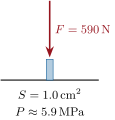
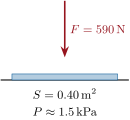
The same force on two areas: the pressure, not the force, decides whether the surface yields. The same force on two areas: the pressure, not the force, decides whether the surface yields.
The same force on two areas: the pressure, not the force, decides whether the surface yields.

Examples

Example 7.2 (Heel versus snowshoe)

A 60kg60\,\mathrm{kg} person weighs F=60×9.81590NF = 60 \times 9.81 \approx 590\,\mathrm{N}. On one stiletto heel of 1.0cm21.0\,\mathrm{cm}^{2} = 1.0×10⁴m21.0 \times 10^{-4}\,\mathrm{m}^{2}: P=590/1.0×1045.9×106Pa=5.9MPaP = 590/1.0 \times 10^{-4} \approx 5.9 \times 10^{6}\,\mathrm{Pa} = 5.9\,\mathrm{MPa}. On two snowshoes of 0.20m20.20\,\mathrm{m}^{2} each: P=590/0.401.5kPaP = 590/0.40 \approx 1.5\,\mathrm{kPa}. The same weight presses 40004000 times harder under the heel: heels pockmark wooden floors, snowshoes float on powder snow.

Read in context →
Definition 20.3 University Physics — Year 1 · Chapter 20 — Kinetic Theory and the Perfect Gas

A fluid at rest pushes on every surface element  ⁣dS\dd S of a wall with a force  ⁣dF=P ⁣dSn\dd\vect F = P\,\dd S\,\vect n normal to it, toward the wall; PP is the pressure, in pascals (1Pa=1N/m21\,\mathrm{Pa} = 1\,\mathrm{N}/\mathrm{m}^{2}); 1bar=1×10⁵Pa1\,\mathrm{bar} = 1 \times 10^{5}\,\mathrm{Pa}, 1atm=1.013×10⁵Pa1\,\mathrm{atm} = 1.013 \times 10^{5}\,\mathrm{Pa}. At a given point it does not depend on the orientation of the surface (Chapter 21).

Examples

Example 20.14 (How incompressible)

Water at the bottom of the Mariana trench (1100bar1100\,\mathrm{bar}) is compressed by χTΔP5×1010×1.1×108=5%\chi_T\Delta P \approx 5\times10^{-10} \times 1.1\times10^8 = 5\%; a 30m30\,\mathrm{m} steel rail warmed by 5050 K lengthens by αLΔT=18mm\alpha L\Delta T = 18\,\mathrm{mm} — the reason for expansion joints. Against a gas, whose volume halves under a doubled pressure, the model of a fixed volume is good to a few percent in most situations of this volume.

Read in context →