সব বই

পেশাদার

1 Markets I: The Ecosystem and Exchange-Traded Marketsবাজার অনলাইন 2 Markets II: Rates, FX and Creditবাজার অনলাইন 3 Markets III: Commodities, Energy and Cryptoবাজার অনলাইন 4 Quantitative Methodsপদ্ধতি অনলাইন 5 Derivatives and Volatilityডেরিভেটিভস অনলাইন 6 Rates, Credit, XVA and Riskসুদহার, ঋণ ও ঝুঁকি অনলাইন 7 Research Craft: Predictors, Backtests, Measurement, Portfoliosগবেষণা অনলাইন 8 Strategies I: Equities and Futuresকৌশল অনলাইন 9 Strategies II: Volatility, Relative Value, Macro and the Bank Desksকৌশল অনলাইন 10 Microstructure and Executionএক্সিকিউশন অনলাইন 11 Market Making and High-Frequency Tradingমার্কেট মেকিং অনলাইন 12 Machine Learning for Marketsমেশিন লার্নিং অনলাইন 13 Low-Latency Softwareপ্রযুক্তি অনলাইন 14 Networks, Hardware and Trading Infrastructureপ্রযুক্তি অনলাইন 15 Research, Data and Risk Platformsপ্রযুক্তি অনলাইন 16 The Desk and the Firmপ্রতিষ্ঠান অনলাইন 17 The Industry: Firms, Roles and Careersক্যারিয়ার অনলাইন 18 Interviews I: Maths, Probability and Speedক্যারিয়ার অনলাইন 19 Interviews II: Markets, Trading Games and the Final Roundক্যারিয়ার অনলাইন 20 Interviews III: Codeক্যারিয়ার অনলাইন
অ্যাপ পরিচিতি Coach সাইন ইন পড়া শুরু করো

বইগুলো এখনো বাংলা ভাষায় পাওয়া যায় না — ইংরেজি সংস্করণ দেখানো হচ্ছে।

Physics · পরিভাষা

Plasma; the free-electron model কী?

Definition 14.1 University Physics — Year 2 · অধ্যায় 14 — Electromagnetic Waves in Plasmas, Conductors and Dielectrics

A plasma is a globally neutral gas of free electrons (density nn, mass mm, charge −e-e) and positive ions, which, being thousands of times heavier, are taken as fixed. The upper atmosphere (ionosphere, n∼1011n \sim 10^{11}–101210^{12} m−3^{-3}), a discharge tube, the solar corona, and — at optical frequencies — the conduction electrons of a metal are plasmas. Collisions are neglected (the wave’s period is short compared with the time between collisions). Its characteristic frequency is the plasma frequency

ωp=ne2ε0m,fp=ωp2π≈9 Hz×n [m−3]:\omega_p = \sqrt{\frac{ne^2}{\varepsilon_0m}} , \qquad f_p = \frac{\omega_p}{2\pi} \approx 9\,\text{Hz}\times\sqrt{n\,[\text{m}^{-3}]} :

3 MHz3\,\mathrm{MHz} to 9 MHz9\,\mathrm{MHz} for the ionosphere, 2×10¹⁵ Hz2 \times 10^{15}\,\mathrm{Hz} (ultraviolet) for a metal.

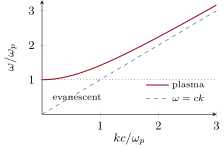
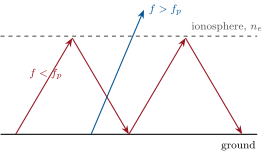
Left: the dispersion relation of a plasma — no propagation below _p, a hyperbola approaching the light line above. Right: shortwaves below the plasma frequency are reflected by the ionosphere and hop around the Earth; higher frequencies escape to space. Left: the dispersion relation of a plasma — no propagation below _p, a hyperbola approaching the light line above. Right: shortwaves below the plasma frequency are reflected by the ionosphere and hop around the Earth; higher frequencies escape to space.
Left: the dispersion relation of a plasma — no propagation below ωp\omega_p, a hyperbola approaching the light line above. Right: shortwaves below the plasma frequency are reflected by the ionosphere and hop around the Earth; higher frequencies escape to space.

উদাহরণ

Example 14.4 (The ionosphere and radio)

With n=1×10¹² m−3n = 1 \times 10^{12}\,\mathrm{m}^{-3} in the F layer, fp=9 MHzf_p = 9\,\mathrm{MHz}: shortwave broadcasts below that are reflected (and can hop around the Earth between the ionosphere and the ground), FM (100 MHz100\,\mathrm{MHz}), television and satellite links pass through. A wave at 3 MHz3\,\mathrm{MHz} penetrates only 1/κ=c/ωp2−ω2=6 m1/\kappa = c/\sqrt{\omega_p^2 - \omega^2} = 6\,\mathrm{m} into the layer before turning back. A spacecraft re-entering the atmosphere is sheathed in a plasma of n∼1018n \sim 10^{18} m−3^{-3}, fp∼10 GHzf_p \sim 10\,\mathrm{GHz}: radio contact is lost for minutes.

প্রসঙ্গসহ পড়ো →