University Physics — Year 2 · Bachelor Year 2
14Electromagnetic Waves in Plasmas, Conductors and Dielectrics
A shortwave broadcast crosses an ocean by bouncing off the upper atmosphere, which reflects it like a mirror — yet the same layer lets television and satellite signals through. A metal spoon is shiny, a metal mesh in the door of a microwave oven holds in the waves while you watch your food through it, and a sheet of glass is transparent to light but opaque to ultraviolet. In each case a wave enters a material, the material’s charges respond, and their response changes the wave: its speed, its attenuation, even whether it propagates at all. This chapter treats the three standard models of a medium — a gas of free electrons, an ohmic conductor, and bound electrons — with the one method that handles them all: add the induced current to Maxwell’s equations and read off the dispersion relation.
14.1 Waves in a plasma
Definition 14.1 (Plasma; the free-electron model)
A plasma is a globally neutral gas of free electrons (density , mass , charge ) and positive ions, which, being thousands of times heavier, are taken as fixed. The upper atmosphere (ionosphere, – m), a discharge tube, the solar corona, and — at optical frequencies — the conduction electrons of a metal are plasmas. Collisions are neglected (the wave’s period is short compared with the time between collisions). Its characteristic frequency is the plasma frequency
to for the ionosphere, (ultraviolet) for a metal.
Theorem 14.2 (Dispersion relation of a plasma)
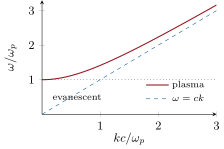
For a transverse PPH wave in a plasma, the electrons oscillate with and carry the current density with ; Maxwell’s equations then give
Above the wave propagates, with and , ; below , with : the wave is evanescent, penetrates over and is totally reflected (Chapter 15); the plasma is then a mirror. At the electrons cannot follow and the plasma is transparent.
Proof. Equation of motion (the magnetic force is negligible for , and the ions’ motion is times smaller): . Then . The plasma stays neutral for a transverse wave ( gives by Gauss), so Maxwell–Ampère reads and Maxwell–Faraday ; combining, , i.e. . The velocities follow as in Chapter 8. ∎
Remark 14.3 (Where the energy goes)
The conductivity is imaginary: , the electrons take energy from the wave during half a cycle and give it back during the next — a lossless medium, in which the wave’s energy is shared between the fields and the electrons’ kinetic energy, and travels at . Collisions add a small real part to and a small absorption: the ionosphere’s D layer absorbs medium waves by day, which is why distant AM stations come in at night.
Example 14.4 (The ionosphere and radio)
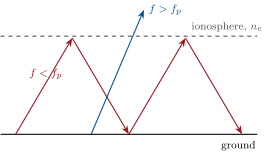
With in the F layer, : shortwave broadcasts below that are reflected (and can hop around the Earth between the ionosphere and the ground), FM (), television and satellite links pass through. A wave at penetrates only into the layer before turning back. A spacecraft re-entering the atmosphere is sheathed in a plasma of m, : radio contact is lost for minutes.
14.2 Waves in an ohmic conductor: the skin effect
Theorem 14.5 (Skin effect)
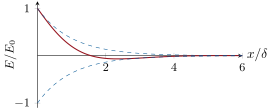
In an ohmic conductor (, real, at frequencies with and , i.e. below for copper) the displacement current is negligible and the fields obey the diffusion equation . A PPH wave entering the conductor at has
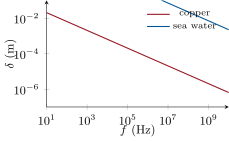
so that : it is damped over the skin depth , with a phase that also turns by one radian per — a wavelength , a phase velocity . The current is confined to a layer of thickness under the surface, and lags by with . For copper, at , at , at .
Proof. (displacement dropped) and : taking the curl of the second, (the conductor is neutral, ). For : , and gives (the root that decays into the conductor). Faraday: , of modulus and phase . ∎
Example 14.6 (Consequences of the skin effect)
(i) A wire of radius carries its current in a ring of thickness : its resistance rises from to about per metre — for a copper wire, four times the DC value at , a hundred times at . High-frequency coils use "Litz" wire (many insulated strands) or silver-plated tubes; the power grid’s conductors are stranded with an aluminium sheath. (ii) A metal box attenuates a wave by per thickness : a aluminium enclosure blocks by but hardly at all — low-frequency magnetic fields need iron. (iii) Submarines receive only very-long-wave radio ( at in sea water); mines are detected by the eddy currents a coil induces in them (Chapter 11, the diffusion time ).
14.3 Waves in a dielectric: the bound electron
Proposition 14.7 (Elastically bound electron; complex index)
In an insulator each electron is bound to its atom: a displacement from equilibrium calls the restoring force and a damping (the energy radiated or handed to the lattice). Driven by the wave, ; the displaced electrons give the medium the polarization (dipole moment per unit volume) with the susceptibility
and the bound current . Maxwell’s equations then give
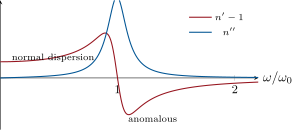
with the refractive index (phase velocity ) and the extinction (the intensity decays as ). Far below a resonance (, negligible), : the index rises with frequency — normal dispersion, Cauchy’s law — and absorption is negligible; near the medium absorbs, and just above it falls with (anomalous dispersion).
Proof. Complex amplitudes: ; . Then, as for the plasma, with , i.e. : . (The plasma is the case , .) Expansion: . ∎
Example 14.8 (Glass, water, air)
Glass has its electronic resonances in the ultraviolet ( rad/s): in the visible it is transparent and dispersive, at , at , enough for a prism to spread a rainbow and for a fibre’s pulses to spread (Chapter 8); in the ultraviolet it absorbs — you do not tan behind a window. Water has, besides, a rotational resonance of its polar molecules near (a Debye relaxation rather than a sharp line): it absorbs microwaves strongly, which heats the food and blinds radar in rain, and has in a narrow visible window — the window through which eyes evolved. Air, with , still bends the setting Sun by half a degree.
Remark 14.9 (One equation, three media)
Every linear medium enters Maxwell’s equations through its induced current , and the dispersion relation is always :
| medium | ||
|---|---|---|
| plasma | (imaginary) | : cut-off |
| ohmic conductor | (real) | : skin effect |
| dielectric | : index |
A metal is all three in turn: ohmic below , a plasma (reflecting) in the visible, transparent in the far ultraviolet.
Method 14.10 (Waves in a medium)
(1) Write the equation of motion of the charges and get . (2) Insert into Maxwell–Ampère with the PPH ansatz: . (3) Take the root with (decay in the direction of travel), split into real (propagation, ) and imaginary (attenuation) parts. (4) Identify the regimes in frequency — propagating, evanescent, absorbing — and the characteristic frequency (, , ). (5) Find from Faraday and, if needed, the Poynting flux and the dissipated power.
14.4 Exercises
Exercise 14.1 ★
Plasma frequencies for (ionosphere by night), (by day), (re-entry sheath), (copper), (interstellar space). For each, which of the following passes: a AM station, a FM station, a GPS signal, visible light?
Solution
Solution of Exercise 14.1.
Hz: , , , (), . AM at : only through interstellar space. FM: through the ionosphere, not the sheath. GPS: everything but the sheath. Light: everything but copper.
Exercise 14.2 ★
Skin depth of copper () at , , , ; of aluminium () at ; of sea water () at and ; of wet soil () at . Which radio frequencies reach a submarine at ?
Solution
Solution of Exercise 14.2.
Copper: , , , ; aluminium at : ; sea water: at , at ; soil: at . A submarine at needs : below about .
Exercise 14.3 ★
A glass obeys . Index at , , ; phase velocities; group index at ; angular spread of a white beam refracted at incidence into the glass.
Solution
Solution of Exercise 14.3.
, , ; , , ; . Refraction angles : and : a spread of .
Exercise 14.4 ★
A wave meets a layer with : is it reflected? Penetration depth; same at ; minimum frequency that crosses a layer of . Why do shortwave bands "open" and "close" with the hour and the solar cycle?
Solution
Solution of Exercise 14.4.
: passes; is reflected, penetrating . For : . The density follows the Sun’s ionizing flux — hour, season, and the eleven-year cycle — so the highest usable frequency moves with them.
Exercise 14.5 ★★
AC resistance. A copper wire of radius . (a) DC resistance per metre. (b) At : ; approximate resistance per metre with the current confined to a ring of thickness ; ratio to DC. (c) At . (d) Why does a coil of turns of this wire have a quality factor that stops improving with at high frequency, and what is Litz wire?
Solution
Solution of Exercise 14.5.
(a) . (b) ; , times DC. (c) , , times. (d) grows as fast as once the skin dominates, and every turn adds resistance; Litz wire bundles many insulated strands thinner than , so the whole copper conducts.
Exercise 14.6 ★★
Shielding. A box of aluminium () thick. Attenuation of the field amplitude crossing the wall, in dB, at , , (the factor , reflection at the surfaces neglected). Why is the mains’ magnetic field shielded with iron (high permeability) rather than copper?
Solution
Solution of Exercise 14.6.
, , : , , : , , . At the conductor is transparent; iron of high diverts the flux (magnetic shielding) and also shrinks by .
Exercise 14.7 ★★
Energy in a plasma. For the transverse wave of Theorem 14.2: (a) electron velocity amplitude and the kinetic energy density . (b) Mean electric and magnetic energy densities. (c) Show that the total energy density is — compute the bracket — and that divided by it equals . (d) What fraction of the energy is in the electrons at ?
Solution
Solution of Exercise 14.7.
(a) ; . (b) and . (c) The sum is (the bracket is ); , and the ratio is . (d) .
Exercise 14.8 ★★
Pulsar dispersion. Radio pulses from a pulsar cross a distance of interstellar plasma ( anything, ). (a) Show that the group delay is . (b) The delay between the arrivals at and is : compute the constant. (c) A pulsar at through : delay between and . (d) Astronomers measure and know : what do they get? (The dispersion measure, the standard distance gauge for pulsars.)
Solution
Solution of Exercise 14.8.
(a) . (b) with and : constant (SI). (c) , : . (d) The column (the dispersion measure), hence the distance for a model of .
Exercise 14.9 ★★
A spectral line. In a dilute gas () the Lorentz model gives . (a) Show that near , , a Lorentzian of full width . (b) Absorption coefficient at the centre. (c) Sodium vapour, , , : at the centre and the thickness that absorbs (ignore the Doppler broadening, which in fact widens the line a hundredfold). (d) Sketch across the line; where is the dispersion anomalous?
Solution
Solution of Exercise 14.9.
(a) with : is the stated Lorentzian. (b) , . (c) : ; . (d) : positive below, negative above, decreasing within of the line — anomalous there.
Exercise 14.10 ★★★
Joule heating in the skin. A wave (along ) enters a conductor filling . (a) Write and deduce (along ) from Faraday. (b) Mean Poynting vector at the surface: show . (c) Mean Joule power per unit area, : show it equals (b). (d) Express the result as with the surface magnetic field and the surface resistance; value for copper at , and the loss of a microwave cavity whose walls carry .
Solution
Solution of Exercise 14.10.
(a) , . (b) at . (c) using . (d) , so . Copper at : ; .
Exercise 14.11 ★★★
Why metals shine. Treat silver’s conduction electrons () as a collisionless plasma at optical frequencies. (a) and the corresponding wavelength. (b) At : is imaginary — penetration depth; the wave is totally reflected (no absorption in this model): silver is a mirror. (c) At ? Hence the "ultraviolet transparency" of alkali metals. (d) Real silver reflects , gold looks yellow: what does the model miss (think of collisions, and of bound electrons whose resonances lie in the visible for gold)?
Solution
Solution of Exercise 14.11.
(a) , . (b) : , total reflection. (c) Still below : reflecting; transparency only beyond (in sodium, ). (d) Collisions give a real part to and a few percent of absorption; bound-electron resonances in the visible (gold, copper) absorb the blue and colour the metal.
Exercise 14.12 ★★★
Water in the microwave. The orientation of water’s polar molecules gives a susceptibility (Debye relaxation), , , on top of a constant . (a) Real and imaginary parts of at and at . (b) Complex index and the absorption length of the intensity at : how deep does an oven cook? (c) Power absorbed per unit volume for a field amplitude in the water: ; value for . (d) Why is used rather than the of maximum absorption?
Solution
Solution of Exercise 14.12.
(a) : ; at , : . (b) ; : the oven cooks the outer two centimetres, conduction does the rest. (c) . (d) At the absorption length would be a millimetre: only the skin would cook; penetrates, and is a free band.
14.5 Problem: The ionosphere, the oven door and the prism
Problem 14.1
Weekend problem — three materials seen by a wave: the plasma that bends GPS signals, the metal that keeps microwaves in, and the glass that spreads white light
Part I — The ionosphere and GPS. Electron density in the F layer ; the total column of electrons along a vertical path is by day. GPS: , .
- Plasma frequency of the F layer; does GPS pass? Does a shortwave?
- Show that for the group velocity is and the phase velocity .
- Extra group delay of the GPS signal crossing the layer: show and compute it for ; the range error .
- The receiver uses both frequencies: from the two delays it removes the error. Express in terms of ; what precision on the delay difference gives to ?
- How many extra carrier cycles does the delay of question 3 represent at ?
- The phase of the carrier is advanced by the same amount as the group is delayed: why (signs of the two corrections)? Which one matters for a receiver that counts carrier cycles?
- At night falls tenfold: error for a single-frequency receiver by day and by night.
- A solar flare raises in the D layer () to with many collisions: which radio services are hit, and why does GPS only slightly degrade?
Part II — The oven door. The cavity walls and the door mesh are steel (); the mesh holes are wide in a sheet thick; , .
- Skin depth in the steel at ; is the wall "thick"?
- Surface resistance ; with a surface magnetic field of amplitude on the walls (), power lost in the walls, per unit area; fraction of .
- In a hole of width the field cannot propagate (the hole is a waveguide below cut-off, Chapter 16): it decays as across the thickness . Attenuation of the amplitude across the sheet, in dB.
- Why can you see through the mesh (wavelength of light against the hole size) while the microwaves cannot get out?
- The glass window is a dielectric with : index, and the intensity attenuation length in it; is the glass heated?
- A metal fork in the oven: the field at its tips is enhanced; with the skin depth of question 8, estimate the current density at the surface for (use at the surface) and the local heating — why sparks?
Part III — The wire at radio frequency. A copper wire of radius () in a induction heater coil carries rms.
- Skin depth; effective conducting section; AC resistance per metre against DC.
- Power dissipated per metre of coil wire; temperature the wire would reach with convective cooling .
- The coil induces currents in a steel workpiece (, when hot): skin depth there; why does induction heating heat only a surface layer, and how is that used for hardening gears?
- To reduce the coil’s loss the wire is replaced by a copper tube with water inside: new resistance per metre; does the inside of the tube carry current?
- At what frequency would the skin depth in copper equal the wire radius? Below it, what approximation replaces the "thick-wire" formula?
Part IV — The prism. A glass has , with its resonance at .
- Check that the Cauchy form follows from the Lorentz model far below resonance, and that : value of and of the effective for this glass.
- Index and phase velocity at and ; group index at ; delay between the two colours over of such glass in a fibre.
- A prism at minimum deviation for : deviation (use ); angular distance between and (differentiate); on a screen away, the width of the spectrum.
- Why is the glass opaque at , and what is its colour if a trace of iron adds a weak resonance at ?
- In the Lorentz picture, why is blue deviated more than red by the prism?
- In one table give, for the F layer, the steel, the copper and the glass at their working frequencies, the nature of and the fate of the wave.
Solution
Solution of Problem 14.1.
1. : GPS passes, the shortwave is reflected.
2. : , .
3. : .
4. ; the difference is : needs .
5. exceeds by as much as falls short: the carrier phase arrives early while the modulation arrives late. A carrier-phase receiver applies the correction with the opposite sign.
6. by day, by night.
7. with collisions: medium and short waves are absorbed (a radio blackout); GPS at feels an absorption , negligible.
8. cycles.
9. : a millimetre wall is a hundred skin depths.
10. ; : , .
11. : in amplitude, in power (and the tiny hole couples little to begin with).
12. Light, , is two thousand times smaller than the holes and passes; the microwave, , is a hundred times larger.
13. ; : the glass is hardly warmed.
14. , in a ten-micrometre layer: tips heat in milliseconds, emit electrons, ionize the air — sparks.
15. ; section against : , fourteen times DC.
16. ; surface per metre: — it would melt; such coils are water-cooled tubes.
17. : the induced current, and the heat, stay in a tenth of a millimetre; a short pulse followed by a quench hardens the surface of a gear while the core stays tough.
18. , three times less; the inside carries nothing — hence a tube, with the coolant where the copper would be wasted.
19. at ; below, the current is uniform and the DC formula holds.
20. : Cauchy’s form with for .
21. and , and ; ; : over a kilometre.
22. : ; : , at .
23. At the frequency approaches the resonance and grows: opaque. A weak resonance at absorbs the red: green glass.
24. Blue is closer to the ultraviolet resonance: the bound electrons respond more, is larger, and the deviation too.
25. F layer at : imaginary , propagation with a small group delay. Steel at : real , skin effect, reflection. Copper at : the same, a skin of . Glass in the visible: , a real index, a transparent dispersive medium.