Physics · Glossary

What is Dispersion relation; phase velocity?

Definition 8.1 University Physics — Year 2 · Chapter 8 — Dispersion and Wave Packets

A linear, homogeneous, time-invariant medium admits the plane monochromatic waves s=Aei(ωtkx)\underline s = A\,\eu^{\iu(\omega t - kx)} (complex notation; the physical signal is the real part) provided ω\omega and kk satisfy the dispersion relation of the medium, D(ω,k)=0\mathcal D(\omega, k) = 0, solved as k(ω)k(\omega) or ω(k)\omega(k). For real kk the wave travels without deforming at the phase velocity

vφ=ωk.v_\varphi = \frac\omega k .

The medium is non-dispersive when vφv_\varphi does not depend on ω\omega (then ω=ck\omega = ck and every signal propagates undeformed — the d’Alembert equation) and dispersive otherwise.
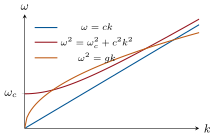
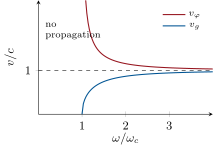
Left: three dispersion relations — a straight line for a non-dispersive medium, the Klein–Gordon hyperbola with its cut-off, the parabola of deep-water waves. Right: for the Klein–Gordon relation the phase velocity exceeds c and the group velocity stays below it, with v_ v_g = c2. Left: three dispersion relations — a straight line for a non-dispersive medium, the Klein–Gordon hyperbola with its cut-off, the parabola of deep-water waves. Right: for the Klein–Gordon relation the phase velocity exceeds c and the group velocity stays below it, with v_ v_g = c2.
Left: three dispersion relations — a straight line for a non-dispersive medium, the Klein–Gordon hyperbola with its cut-off, the parabola of deep-water waves. Right: for the Klein–Gordon relation the phase velocity exceeds cc and the group velocity stays below it, with vφvg=c2v_\varphi v_g = c^2.

Examples

Example 8.2 (Dispersive and non-dispersive)

(i) A string on an elastic bed (restoring force Ky-Ky per unit length, or a chain of pendulums), μt2y=Tx2yKy\mu\partial_t^2y = T\partial_x^2y - Ky: ω2=ωc2+c2k2\omega^2 = \omega_c^2 + c^2k^2 with ωc=K/μ\omega_c = \sqrt{K/\mu} — the Klein–Gordon relation, the same as a plasma’s and a waveguide’s (Chapters 14 and 16): vφ=c/1ωc2/ω2>cv_\varphi = c/\sqrt{1 - \omega_c^2/\omega^2} > c, and no real kk below the cut-off ωc\omega_c. (ii) Deep-water gravity waves: ω2=gk\omega^2 = gk (admitted), vφ=g/k=gλ/2πv_\varphi = \sqrt{g/k} = \sqrt{g\lambda/2\pi}: long waves are faster — 12.5m/s12.5\,\mathrm{m}/\mathrm{s} for 100m100\,\mathrm{m}, 40m/s40\,\mathrm{m}/\mathrm{s} for 1km1\,\mathrm{km}. (iii) The chain of atoms, ω=2ω0sin(ka/2)\omega = 2\omega_0|\sin(ka/2)| (Chapter 6). (iv) Light in glass, k=n(ω)ω/ck = n(\omega)\omega/c, which is why a prism spreads a spectrum.

Example 8.7 (Klein–Gordon: faster than light, and not)

For ω2=ωc2+c2k2\omega^2 = \omega_c^2 + c^2k^2: vφ=ω/kv_\varphi = \omega/k and vg=c2k/ωv_g = c^2k/\omega, so vφvg=c2v_\varphi v_g = c^2: the phase velocity exceeds cc (in the ionosphere, a 10MHz10\,\mathrm{MHz} wave’s crests move faster than light) but the group velocity, which carries the signal, stays below it. A phase velocity transports no energy and no information — the crests are like the spot of a lighthouse beam sweeping a distant cloud.

Read in context →