 Coach
CoachThe two special ends of a magnet — where its pull is strongest, where the paperclips cluster — are its poles. They are named the north pole (often painted red, marked N) and the south pole (marked S). Every magnet has both: one of each, always.
Examples
Example 25.3 (Reading old experiments)
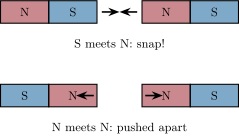
When your two magnets snapped together, an N was facing an S. When they refused springily, N faced N (or S faced S). And the paperclips always clustered at the ends because the poles are where a magnet’s power lives — its middle is the calm between them.
Example 25.4 (The greatest magnet of all)
Hang a bar magnet from a thread so it can turn freely, wait for it to settle — and something wonderful happens: it always comes to rest pointing the same way, one pole toward the far north of the world, the other toward the far south. Some giant, invisible magnet must be pulling its poles into line. That giant is the Earth itself: our whole planet is a magnet, with its magnetic poles near the top and bottom of the globe.
Example 25.7 (Make one yourself)
Stroke a steel sewing needle with one pole of a magnet, twenty times, always the same way, lifting the magnet away between strokes: the needle becomes a small magnet itself. Lay it gently on a slice of cork floating in a bowl of water — and watch the cork slowly turn until the needle points north–south. You have built the sailor’s compass of a thousand years ago.