University Physics — Year 1 · Bachelor Year 1
21Fluid Statics
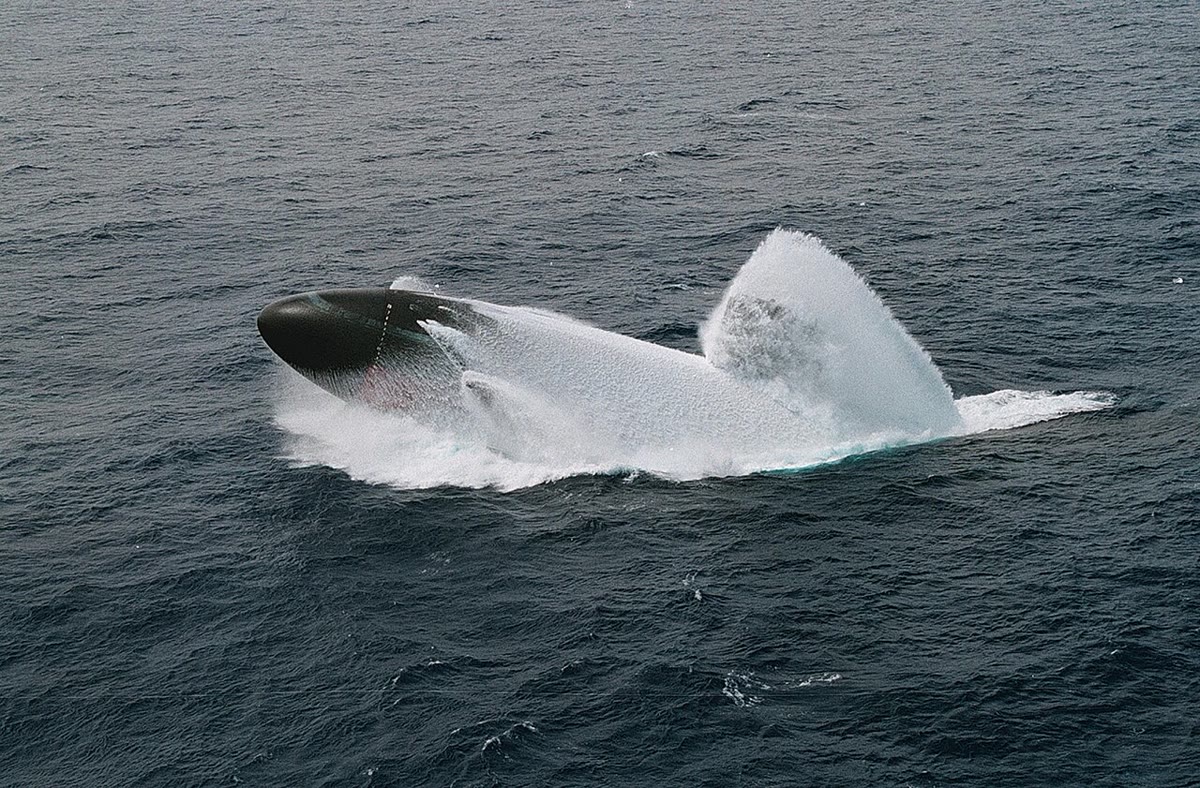
A submarine at three hundred meters carries, on each square meter of its hull, the weight of a loaded truck. A dam holds back a lake with a wall that is thick at the bottom and thin at the top, for a reason that has nothing to do with how long the lake is. A ship of a hundred thousand tonnes floats because it pushes aside a hundred thousand tonnes of water, and sinks a hand’s breadth deeper when it sails from the sea into a river. Every one of these is a consequence of a single relation — pressure increases downward in a fluid at rest at the rate — and this chapter derives it, applies it to liquids and to the atmosphere, and deduces from it the force on a wall and the law of Archimedes.
21.1 Pressure in a fluid at rest
Proposition 21.1 (Isotropy of pressure)
In a fluid at rest, the force exerted by the fluid on a small surface placed at a point is , normal to the surface and directed toward it, with a pressure that depends on the point but not on the orientation of the surface.
Partial proof. A fluid at rest transmits no tangential force (otherwise it would flow): the force is normal. Consider a tiny triangular prism of fluid at with faces of different orientations: it is in equilibrium under the pressure forces on its faces and its weight; the weight scales as the volume (third power of the size), the pressure forces as areas (second power), so for a small enough prism only the pressure forces count, and their balance in every direction requires the same on every face. ∎
Theorem 21.2 (Fundamental relation of fluid statics)
In a fluid at rest in the uniform gravity ( upward), the pressure depends only on and
being the fluid’s density at that level. Pressure increases downward; surfaces of equal pressure (isobars) are horizontal, and so is the free surface of a liquid.
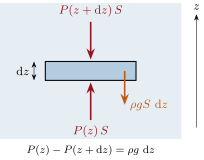
Proof. Take a horizontal slab of fluid of area between and : it is pushed up by from below, down by from above, and pulled down by its weight . At rest: . Horizontal slabs of fluid have no horizontal force from gravity, so horizontally is uniform. ∎
Corollary 21.3 (Incompressible fluid)
In a liquid of uniform density , the pressure at depth below a point where it is is
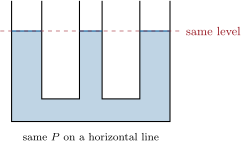
Water: more every . Two points of a connected liquid at the same level are at the same pressure; the free surfaces of communicating vessels stand at one level; a pressure applied anywhere to an enclosed liquid is transmitted undiminished to every point (Pascal’s principle).
Proof. Integrate with constant; the rest is the horizontality of isobars and the uniqueness of at a level. ∎
Example 21.4 (Manometers and presses)
A U-tube of mercury () whose columns differ by measures a pressure difference — the atmosphere, which holds a column of water. A hydraulic press: a force on a piston of area raises the pressure by throughout; on the large piston it yields — fifty times more for fifty times the area, at the price of fifty times less travel (energy is conserved: ).
21.2 The atmosphere
Proposition 21.5 (Isothermal atmosphere)
For a perfect gas of molar mass at uniform temperature in uniform gravity,
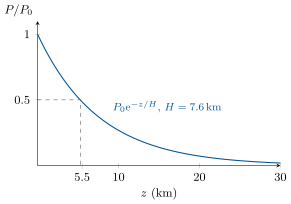
the scale height: about for air; the pressure halves every .
Proof. (equation of state), so : a first-order linear equation, . ∎
Example 21.6 (Thin air)
With (an average over the lower atmosphere), : at , at the summit of Everest — close to the measured and ; the real atmosphere cools with altitude, which the Year 2 volume takes into account. The model also tells why the sea is different: water is eight hundred times denser and nearly incompressible, so its pressure rises linearly, a bar per ten meters, with no scale height.
21.3 Forces on walls
Proposition 21.7 (Force on a vertical wall)
A liquid of depth against a vertical rectangular wall of width (atmospheric pressure acting on both faces and cancelling) exerts the horizontal force
equivalent to a single force applied at the center of pressure, at depth — the resultant acts low, where the pressure is greatest.
Proof. At depth the gauge pressure is ; on the strip of height the force is ; integrate from to . Its moment about the surface line is ; dividing by gives the lever arm . ∎
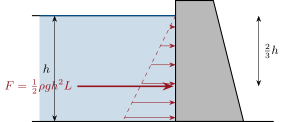
Example 21.8 (A dam)
, : — twenty thousand tonnes, applied below the surface, the same whether the lake behind is a pond or a fjord: the hydrostatic paradox.
21.4 Archimedes’ theorem
Theorem 21.9 (Archimedes)
A body immersed in a fluid at rest receives from the pressure forces a resultant — the buoyancy — equal and opposite to the weight of the fluid it displaces,
applied at the center of mass of the displaced fluid (the center of buoyancy).
Proof. The pressure forces on the body’s surface depend only on the shape of that surface and on the fluid outside. Replace the body, in thought, by fluid at rest filling the same volume: that fluid is in equilibrium under its weight and the same pressure forces, so the pressure forces balance its weight — they sum to , applied through its center of mass. Remove the thought experiment; the pressure forces are unchanged. ∎
Corollary 21.10 (Floating)
A body of density floats in a fluid of density with the fraction of its volume immersed; if it sinks, with an apparent weight .
Proof. Weight equals buoyancy . ∎
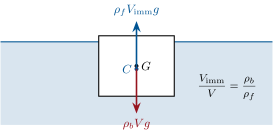
Example 21.11 (Three buoyancies)
A hydrometer is a weighted tube that sinks until it displaces its own weight: the denser the liquid, the less it sinks — a density gauge read on its stem. A balloon of hot air at displaces of cold air and weighs of hot air: of lift (Problem 20.1). A ship of displaces of sea water; in fresh water () it must displace more and sinks deeper — the Plimsoll marks on its hull.
Remark 21.12 (Stability)
A floating body tilted by a small angle is restored if the buoyancy, now applied at the shifted center of the new immersed volume, produces a righting moment — which happens when the metacenter (the point where the buoyancy’s line of action meets the body’s axis) lies above . Ballast low in the hull lowers and steadies the ship; a top-heavy boat capsizes.
21.5 Exercises
Exercise 21.1 ★
Absolute pressure at , and under the sea (); force on a porthole at .
Solution
Solution of Exercise 21.1.
: (), (), (). At : , force on (net, against inside: ).
Exercise 21.2 ★
Height of a mercury column balancing ; of a water column. Why can a suction pump not lift water more than about ?
Solution
Solution of Exercise 21.2.
: mercury ; water . A pump can at best create a vacuum above the water: the atmosphere then pushes the column up by , no more.
Exercise 21.3 ★
A hydraulic jack: on a piston, load on a piston; distances moved by each if the small piston travels .
Solution
Solution of Exercise 21.3.
(one tonne); (same volume displaced, same work).
Exercise 21.4 ★
A U-tube contains water; oil () is poured into one arm and forms a column. Height difference between the two free surfaces.
Solution
Solution of Exercise 21.4.
Same pressure at the oil–water interface level in both arms: , of water above that level in the other arm; the oil surface stands higher.
Exercise 21.5 ★★
Scale height of the atmosphere at ; pressure at and at ; height at which . Compare with the values quoted in Chapter 20.
Exercise 21.6 ★★
A rectangular dam wide holds of water. Total force, depth of the center of pressure, and the moment of the water about the base of the dam. Why is a dam curved toward the water?
Solution
Solution of Exercise 21.6.
; center of pressure at depth, i.e. above the base; moment about the base . Curving the dam toward the water turns the thrust into compression of the arch, carried to the valley sides.
Exercise 21.7 ★★
Fraction of an iceberg below the surface (ice , sea water ); of a log of density in fresh water; a raft of of that wood can carry how many people before its deck is awash?
Solution
Solution of Exercise 21.7.
; log . Raft: buoyancy at full immersion , own weight : spare, ten people… the tenth with wet feet: nine to stay dry ().
Exercise 21.8 ★★
A hydrometer of mass with a stem of cross-section floats in water with of stem emerging. How much stem emerges in brine of density ? Sensitivity (cm per unit of relative density)?
Solution
Solution of Exercise 21.8.
Immersed volume : water ; brine , less, i.e. more stem: emerge. Sensitivity per unit of relative density ( per ).
Exercise 21.9 ★★
A submarine of volume has a mass of with empty ballast tanks. Fraction emerging at the surface (sea water); mass of water to take in for neutral buoyancy; what if it then enters a fresh-water estuary?
Solution
Solution of Exercise 21.9.
Displaced volume : () emerge. Neutral: mass : take in . Fresh water: buoyancy drops to : heavy — it sinks unless are pumped out.
Exercise 21.10 ★★★
A child’s balloon holds of helium () at and ; the rubber weighs . Net lift; mass of string it can carry.
Solution
Solution of Exercise 21.10.
Air displaced: ; helium inside ; rubber : net lift — seven meters of light string.
Exercise 21.11 ★★★
Prove that the center of pressure on a vertical rectangular wall is at by computing the moment of the pressure forces about the surface line. Where is it for a wall that is only partly submerged, say from depth to ?
Solution
Solution of Exercise 21.11.
Moment , force : arm . From to : moment , force : depth .
Exercise 21.12 ★★★
A cylindrical hydrometer (mass , cross-section ) floating in a liquid of density is pushed down by and released. Show that it oscillates harmonically and give the period; compute it for , , water. (Example 14.3 revisited.)
Solution
Solution of Exercise 21.12.
Extra immersion adds the buoyancy upward: , , .

21.6 Problem: The submarine
Problem 21.1
Weekend problem — a steel hull three hundred meters down: the pressure on its plates, the water it must swallow to sink and spit out to rise, the diver who leaves it, and the tanker that passes overhead
Sea water: ; fresh water ; ; . The submarine’s hull encloses ; with empty ballast tanks its mass is .
Part I — Pressure on the hull.
- Absolute pressure at , in pascals and in bars.
- Force on a circular hatch of diameter at that depth; compare with the weight of a truck.
- Force on one square meter of hull at the keel if the hull is tall and the top is at : how different from the top?
- Water is slightly compressible (): by what fraction is sea water denser at than at the surface? Does it matter for the pressure computed above?
- The crew inside breathes air at : why does the hull need to be a thick cylinder, and why does a cylinder resist better than a flat box?
- A thin cylindrical shell of radius and wall thickness under an external overpressure carries a compressive stress in its wall. For and at , compute it and compare with the yield stress of the steel, about .
Part II — Sinking and floating.
- At the surface with empty tanks, what volume of the hull emerges?
- What mass of sea water must the ballast tanks take in for the submarine to hover (neutral buoyancy)?
- Once neutrally buoyant at , the hull is compressed by by the pressure. Compute the resulting net force and say whether the equilibrium is stable with respect to depth.
- The boat sails neutrally buoyant from the sea into a fresh-water estuary. Net force? Which way does it go, and what must the crew do?
- A torpedo is fired. What must the ballast system do immediately, and by how much?
- Why does a submarine use compressed air to empty its tanks, and why is the air’s pressure the limit on how deep it can blow them?
- Estimate the volume of air at needed to empty of tanks at (Boyle’s law, constant).
Part III — The diver. A diver leaves the surface with of air in her lungs.
- Absolute pressure at and .
- If she descends holding her breath, what is her lung volume at ?
- A scuba diver breathes air at the ambient pressure at and ascends while holding her breath: volume her lungs would need at the surface, and the lesson.
- A snorkel long: pressure difference between the water on the diver’s chest and the air in her lungs; force on a chest of ; can she inhale?
- The air tank holds at : how many liters of air at does that make, and for how long at per minute?
Part IV — The tanker overhead.
- A tanker of floats in sea water: volume of water displaced.
- Its waterline area is : by how much does it rise or sink when it enters fresh water?
- Loading of oil: change of draught.
- The empty tanker has a high center of mass; it carries sea water as ballast when empty. Why, in terms of the metacenter?
- The tanker’s hull at its keel ( draught): pressure and force per square meter, compared with the submarine at .
- The tanker passes directly over the submarine. Does the submarine feel its ? Explain with the pressure field.
- Summarize: the one relation that fixed every number in this problem, and the theorem that followed from it.
Solution
Solution of Problem 21.1.
1. .
2. : net force — 155 tonnes, a loaded truck on a hatch.
3. Keel deeper: more, : the hull is loaded almost uniformly.
4. : negligible for the pressure (a few kilopascals out of three million).
5. Thirty bars outside, one inside: the hull is a pressure vessel loaded inward; a cylinder (or sphere) turns the pressure into compression along its wall, which steel resists well, whereas a flat plate would bend.
6. : close to the yield stress — is near the limit for this hull, and deeper boats need thicker or stronger steel (or titanium).
7. Displaced volume : emerge ().
8. Neutral: : take in .
9. Buoyancy falls by of : downward (three tonnes). Deeper more compression heavier: unstable — a submarine must trim continuously (and a steel hull compresses less than water, which helps; a too-flexible hull would sink without return).
10. Buoyancy against weight : down (); pump out .
11. Immediately light: take in of water () into compensating tanks.
12. Water can only be expelled by something at higher pressure than the sea outside; compressed air in bottles pushes it out — only as long as the bottle pressure exceeds the ambient pressure at that depth.
13. constant: at needs of air at — stored at in of bottles.
14. at ; at .
15. constant: — the ribcage is crushed in; free divers feel it.
16. Air taken at expands fourfold: in lungs that hold : rupture. Never hold your breath on ascent; exhale continuously.
17. ; force on the chest: the breathing muscles cannot lift fifty kilograms — a snorkel works only in the first decimeters.
18. at , i.e. at : .
19. .
20. In fresh water it must displace : more, i.e. deeper.
21. more: deeper.
22. Empty, the ship’s sits high and little hull is immersed: the metacenter may fall below and the ship capsize in a swell. Sea water low in the hull lowers and deepens the draught.
23. , : fifteen times less than the submarine’s .
24. No: the pressure at the submarine’s depth is , fixed by the depth alone. The tanker’s weight is borne by the water it displaces, which raises the sea level everywhere by an immeasurable amount; no extra load reaches the submarine.
25. — hence for every depth, force and lung volume here — and Archimedes’ theorem, which is that relation integrated over a closed surface.