High School Physics · Grades 10–12
7Pressure: From Sport to Diving
A skier glides over snow that a walker sinks into; a push drives a needle through leather a fist cannot dent. Same forces, wildly different effects: the missing quantity is pressure, force divided by the area receiving it. This chapter defines it, follows it down a pool, up a barometer, into a squeezed syringe — and ends forty metres under the sea, where it turns vital.
7.1 Pressure: force spread over an area
Definition 7.1 (Pressure)
When a force of magnitude (in ) presses perpendicularly on a surface of area (in ), the pressure exerted on that surface is
Its unit, the , is the pascal () — a tiny unit, an apple’s weight spread over a square metre, so and are the working units.
Example 7.2 (Heel versus snowshoe)
A person weighs . On one stiletto heel of = : . On two snowshoes of each: . The same weight presses times harder under the heel: heels pockmark wooden floors, snowshoes float on powder snow.
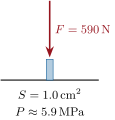
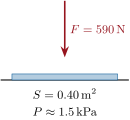
Remark 7.3 (Concentrate or spread)
A sewing needle pushed with on a tip of = exerts — enough to part leather fibres. Piercing tools concentrate force; load-bearing designs (skis, caterpillar tracks, foundations) spread it. Sport is applied pressure management: skates bite into ice, skis glide on snow.
7.2 Pressure in a liquid at rest
Why does water press harder lower down? Isolate an imaginary vertical column of water of cross-section , from the surface to depth : volume , mass ( the liquid’s density, in ), weight . The bottom of the column supports that weight plus the atmosphere’s push on the top. Dividing the total force by : the pressure at depth should be — and it is, everywhere in the liquid.
Theorem 7.4 (Pressure at depth)
In a liquid of density at rest, open to the air, the pressure at depth below the surface is
where is the atmospheric pressure at the surface. The pressure depends only on the depth, not on the container’s shape, and at a given point the liquid presses equally hard in all directions.
Proof. Admitted at this level. ∎
Remark 7.5
The column argument only makes the law plausible; the honest derivation (any shape, all directions) is in the Year 1 volume. The water’s own term is the gauge pressure — what a diver’s pressure gauge displays.
Example 7.6 (Ten metres of water)
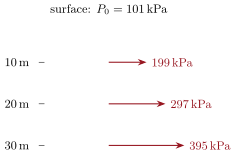
In fresh water (), at : , so . Ten metres of water add almost exactly one atmosphere: the diver’s rule of thumb, one extra atmosphere per ten metres.
7.3 The ocean of air
Definition 7.7 (Atmospheric pressure)
We live at the bottom of an ocean of air, whose weight creates the atmospheric pressure, at sea level
On each square centimetre this is : the weight of a one-kilogram mass on every of your skin, your desk, everything.
Example 7.8 (The invisible load)
An A4 sheet of paper ( , so ) receives from the air above it — the weight of a small car. Nothing tears: the air below pushes up just as hard. We notice the atmosphere only when one side loses it — a suction cup, a straw, an aircraft cabin.
Remark 7.9 (Torricelli’s barometer)
In 1643 Torricelli inverted a sealed tube of mercury over a mercury bath. The column fell to the height at which : , leaving above it the first vacuum ever made. The height tracks the weather and shrinks with altitude: a barometer weighs the air above you (water would need : Exercise 7.9).
7.4 Gases: bombardment and Boyle’s law
A gas too presses on its container: it is a swarm of molecules in ceaseless random motion, each collision gives the wall a tiny outward push, and billions of billions of impacts per second blur into the steady force we measure as gas pressure. Squeeze the gas into half the volume: the molecules strike twice as often, so the pressure should double. It does.
Proposition 7.10 (Boyle’s law)
For a fixed amount of gas held at constant temperature, pressure and volume are inversely proportional:
Proof. Admitted at this level. ∎
Remark 7.11
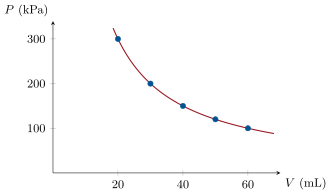
An experimental fact at this level — the Year 1 volume derives it from the collision picture. The experiment (a sealed syringe of air, a pressure sensor, ):
| () | 60 | 50 | 40 | 30 | 20 |
| () | 100 | 120 | 150 | 200 | 300 |
| () | 6000 | 6000 | 6000 | 6000 | 6000 |
Example 7.12 (A squeezed syringe)
Air occupies at ; compressed slowly (so the temperature stays constant) to , it occupies .
7.5 Diving: pressure put to work
Method 7.13 (Absolute pressure at depth)
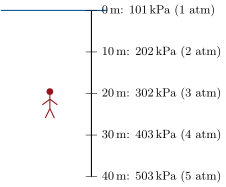
For a diver at depth in the sea (, so per ), compute — and in Boyle’s law always use this absolute pressure, never the gauge term alone. A diver sits under atmospheres at , at , at .
Remark 7.14 (Never hold your breath)
A regulator delivers air at ambient pressure: lungs fill normally at any depth. But fill at (), hold that breath and surface: Boyle demands — three times what a chest holds, and lungs tear well before that, even on a few metres of ascent. Hence scuba’s first rule: never hold your breath while ascending — keep breathing and the expanding air simply flows out. A free diver is safe: her air was taken at the surface, so on the way up it only re-expands to its original volume.
Remark 7.15 (Decompression)
Breathing high-pressure air also dissolves extra nitrogen in the blood, like gas in a capped soda bottle; surface too fast and it fizzes into bubbles inside the body — decompression sickness. Hence the slow ascent (about per minute) and shallow stops, which let the gas leave quietly through the lungs. The theory waits for the Year 1 volume; the rule of conduct belongs to every diver.
7.6 Exercises
Exercise 7.1 ★
A crate weighing rests on a face of , then on a face of . Compute both pressures on the ground. Which orientation is better on soft sand?
Solution
Solution of Exercise 7.1.
Large face: , . Small face: , . On sand, the large face: lower pressure, less sinking.
Exercise 7.2 ★
Express in and in . Which presses harder: on , or on ?
Exercise 7.3 ★
Compute the gauge pressure and the absolute pressure at the bottom of a deep swimming pool (, ).
Solution
Solution of Exercise 7.3.
; absolute .
Exercise 7.4 ★
Air occupies at , temperature constant. Its volume at ? At ?
Solution
Solution of Exercise 7.4.
; at , .
Exercise 7.5 ★
A skater glides on one blade of contact area , then stands on soles totalling . Compute both pressures and their ratio.
Solution
Solution of Exercise 7.5.
. Blade: . Soles: . Ratio : the blade bites into the ice, the soles do not.
Exercise 7.6 ★★
A thumb pushes a drawing pin with . The head has area , the tip . Compute the pressures on thumb and wall; why is only the wall pierced?
Solution
Solution of Exercise 7.6.
Thumb: . Wall: . The same acts on an area times smaller at the tip, so only there does the pressure exceed what the material can withstand.
Exercise 7.7 ★★
A submarine hatch of area sits at depth in sea water (); inside, the air is at atmospheric pressure. Compute the net force holding it shut, and the mass whose weight equals it.
Solution
Solution of Exercise 7.7.
, so — the weight of , fifteen tonnes. No crew opens that outward against the sea.
Exercise 7.8 ★★
A sensor deep in an unknown liquid reads a gauge pressure of . Find the density. Is it fresh water?
Solution
Solution of Exercise 7.8.
. Not fresh water (): a markedly denser liquid, e.g. a concentrated brine.
Exercise 7.9 ★★
How tall would Torricelli’s barometer be with water () instead of mercury ()? Recover both heights from ; why did mercury win?
Solution
Solution of Exercise 7.9.
: water ; mercury . A tube fits on a desk; a water barometer needs a stairwell — mercury’s density won.
Exercise 7.10 ★★
Using the syringe data of Proposition 7.10 (), predict the volume at and the pressure at . What curve is against ? And against ?
Solution
Solution of Exercise 7.10.
; . against is a hyperbola; against is a straight line through the origin, of slope .
Exercise 7.11 ★★
A diver at releases a bubble of volume . What is its volume just below the surface? (Constant temperature; sea water adds per .)
Solution
Solution of Exercise 7.11.
At : , three atmospheres. At the surface, : the bubble triples.
Exercise 7.12 ★★★
A suction cup of area is pressed flat against a ceiling.
- Perfect vacuum inside: what force does the atmosphere exert on the cup, and what hanging mass can it hold?
- A real cup keeps of air inside. What mass now?
Solution
Solution of Exercise 7.12.
1. , holding .
2. : , about .
Exercise 7.13 ★★★
A scuba tank holds of air at ( = atmosphere); must stay as reserve. A diver breathes per minute at ambient pressure. How many litres of surface-pressure air are usable? How long does the tank last at (absolute pressure )? And at ?
Solution
Solution of Exercise 7.13.
Boyle: of surface-pressure air is usable. At each breath is drawn at , so at ambient pressure costs of surface air: . At (): , so . Depth is paid for in air.
Exercise 7.14 ★★★
A free diver’s lungs hold at the surface and cannot shrink below the residual volume . At what sea depth () is that limit reached? (Once declared the limit of free diving; records now pass , blood shifting into the chest taking up the missing volume.)
Solution
Solution of Exercise 7.14.
. With , .
Exercise 7.15 ★★★
In a hydraulic lift, a liquid transmits pressure unchanged from a small piston () to a large one () carrying a car.
7.7 Problem: One breath down, one breath up
Problem 7.1
Weekend problem — one breath down, one breath up: the physics of a free dive and a scuba ascent, from mask squeeze to the rule that the last ten metres are the most dangerous
Lena free-dives: one surface breath, down to and back. Marco scuba-dives beside her, breathing from a tank. Same sea (, , ), same lungs, opposite dangers — all governed by and = constant (temperature constant throughout).
Part I — The weight of water.
- Compute for sea water in per metre, and check the rule of thumb: one atmosphere per .
- Compute the absolute pressure at , , and .
- Express each as a multiple of the surface pressure.
- Lena’s mask covers . At , if the air inside it were still at surface pressure, what net force would the water exert? (Divers exhale into the mask through the nose to prevent this mask squeeze.)
- An eardrum has area about . Compute the net force on it at if the middle ear stays at surface pressure; why do ears hurt in a mere pool, and what must “equalizing” achieve?
Part II — One breath down. Lena leaves the surface with of air in her lungs.
- Using Boyle’s law with absolute pressures, compute her lung volume at , and .
- At what depth is her lung volume halved?
- Is lung volume proportional to depth? Describe the curve of against absolute pressure .
- Her residual volume is : lungs cannot shrink further. Show that this limit is reached near .
- Free-diving records nonetheless exceed : what fills the missing volume? (What else can flow into the chest?)
Part III — One breath up. At , Marco’s regulator fills his lungs.
- At what pressure does the regulator deliver that air? How many times denser is it than surface air?
- Marco panics, holds his breath, and rises to : what volume does his trapped air demand there?
- What volume at the surface — how many times his capacity?
- State the scuba diver’s first rule, and why breathing normally removes the danger.
- Lena also holds her breath from to the surface, yet her lungs are perfectly safe. Explain the asymmetry.
Part IV — Bubbles, and the last ten metres.
- Marco releases a bubble at . Compute its volume at , , and just below the surface.
- For each stage of the rise, compute the factor by which the bubble grows. Where is the growth fastest?
- Divers ascend at most per minute: how long from , and in which minute does any trapped or dissolved gas expand the most?
- At depth Marco’s blood dissolves extra nitrogen, like gas in a capped soda bottle. What does a too-fast ascent do, and how do the slow ascent and a safety stop prevent it?
- Punchline: in one sentence each, give the free diver’s verdict, the scuba diver’s verdict, and the quantified reason the last ten metres of any ascent deserve the most respect.
Solution
Solution of Problem 7.1.
1. per metre, so of sea water add : one atmosphere per ten metres, almost exactly.
2. : at , at , at , at .
3. , , and times .
4. over : — the weight of nearly half a tonne on the face.
5. ; — a finger pressed on the eardrum, at pool depth already. Equalizing pushes air into the middle ear until the inside pressure matches the water’s.
6. : ; ; .
7. Halved when , i.e. at — in the very first stretch of the dive.
8. No: is a hyperbola in the absolute pressure (and , not , is what Boyle’s law sees); each extra removes less volume than the previous one.
9. requires , i.e. (Exercise 7.14).
10. Blood: plasma shifts into the vessels of the chest, incompressible, and occupies the volume the air no longer fills.
11. At ambient pressure, . By Boyle the same air at would fill times the volume: it is times denser than surface air.
12. — double, after only of rise.
13. : four times his lung capacity.
14. Never hold your breath while ascending. With the airway open, the expanding air flows out through the regulator, and lung volume never exceeds .
15. Lena’s at is her surface compressed: on the way up it re-expands to exactly , never beyond. Marco’s were taken at : they have of surface air in them.
16. : at , at , at , at the surface.
17. Stage factors: , then , , and for the last ten metres — growth accelerates as the surface nears.
18. . The last minute: from to the surface the absolute pressure halves, the biggest relative drop of the whole ascent.
19. A fast ascent lets the dissolved nitrogen fizz into bubbles inside blood and joints (decompression sickness); ascending slowly and pausing near keeps the gas dissolved long enough to leave quietly through the lungs.
20. Free diver: her air only returns to its original volume — Boyle protects her. Scuba diver: air taken at depth multiplies on the way up — breathe, never hold. And the last ten metres double every trapped volume (, against down at ): the closer the surface, the slower you should approach it.