
Physics · Glossary

What is Pure substance, phase, phase change?

Definition 25.1 University Physics — Year 1 · Chapter 25 — Phase Changes of a Pure Substance

A pure substance is a body of a single chemical species. A phase is a part of it that is homogeneous in its physical properties: solid, liquid, gas (vapour when it coexists with its liquid). A phase change (melting/solidification, vaporization/ condensation, sublimation/deposition) is the passage from one phase to another; at fixed pressure it occurs at a fixed temperature, with heat exchanged but no temperature change: the latent heat.
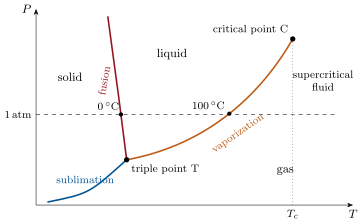
The phase diagram of water (not to scale). Heating at atmospheric pressure follows the dashed isobar: ice melts where it crosses the fusion curve, water boils where it crosses the vaporization curve. The fusion curve of water leans left: pressure lowers its melting point.

Examples

Example 25.8 (Where the heat of vaporization goes)

For water at 100C100{}^{\circ}\mathrm{C}: Ps(vvvl)=1.013×105×1.67=169kJ/kgP_s(v_v - v_l) = 1.013 \times 10^5 \times 1.67 = 169\,\mathrm{kJ}/\mathrm{kg}, so uvul=2257169=2088kJ/kgu_v - u_l = 2257 - 169 = 2088\,\mathrm{kJ}/\mathrm{kg}: 93%93\% of the latent heat goes into tearing the molecules apart, 7%7\% into pushing the atmosphere back. The entropy of vaporization, 2257/373=6.05kJ/(kgK)2257/373 = 6.05\,\mathrm{kJ}/(\mathrm{kg}\,\mathrm{K}), dwarfs that of fusion, 334/273=1.22kJ/(kgK)334/273 = 1.22\,\mathrm{kJ}/(\mathrm{kg}\,\mathrm{K}): melting loosens the molecules, boiling frees them.

Read in context →