Water is the one substance everybody has seen in all three states, and it is the working fluid of most of the world’s power stations, the refrigerant of the first ice machines, and the engine of the weather. Ice melts at a temperature that does not budge while the heat pours in; a kettle boils at 100∘C at the seaside and at 70∘C on Everest; a sealed bottle of very cold water freezes solid at a tap. This chapter draws the map of the phases of a pure substance — the (T,P) and (v,P) diagrams — and gives the three tools that go with it: the lever rule (how much of each phase), the latent heat (what a change costs, in energy and in entropy) and the Clausius–Clapeyron relation (how the boundary lines slope). It ends where the map fails: metastable states, which are where the weather and the pressure cooker’s surprises come from.
A pure substance is a body of a single chemical species. A phase is a part of it that is homogeneous in its physical properties: solid, liquid, gas (vapour when it coexists with its liquid). A phase change (melting/solidification, vaporization/ condensation, sublimation/deposition) is the passage from one phase to another; at fixed pressure it occurs at a fixed temperature, with heat exchanged but no temperature change: the latent heat.
Proposition 25.2(Equilibrium diagram)
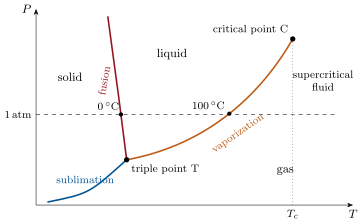
In the (T,P) plane each phase occupies a region; two phases coexist only along a curve (sublimation, fusion, vaporization), all three only at one point, the triple point. The vaporization curve P=Ps(T) — the saturation vapour pressure — ends at the critical point(Tc,Pc), beyond which liquid and gas are no longer distinct. For water: triple point273.16K, 611Pa; critical point647K, 221bar. The fusion curve of water leans to the left (ice is less dense than water); for almost every other substance it leans to the right.
Proof.Admitted at this level.∎
The phase diagram of water (not to scale). Heating at atmospheric pressure follows the dashed isobar: ice melts where it crosses the fusion curve, water boils where it crosses the vaporization curve. The fusion curve of water leans left: pressure lowers its melting point.
Remark 25.3(Boiling, evaporation and the pressure cooker)
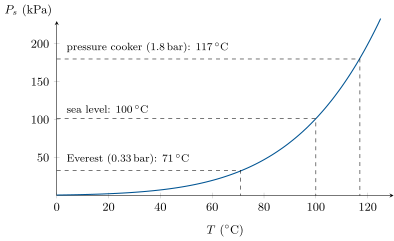
A liquid evaporates at any temperature from its surface, as long as the partial pressure of its vapour above it is below Ps(T); it boils when Ps(T) reaches the ambient pressure, so that bubbles of vapour can grow inside it. Water boils at 100∘C because Ps(100∘C)=1.013bar; at 0.33bar on Everest it boils near 70∘C, in a pressure cooker at 1.8bar near 117∘C. The temperature of a boiling liquid is pinned by the pressure — a fact used to define the Celsius scale for two centuries.
25.2 The (v,P) diagram and the lever rule
Proposition 25.4(Andrews isotherms)
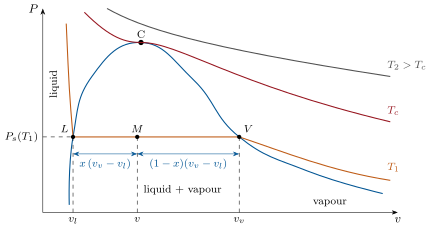
In the Clapeyron plane (v,P) of the specific volume, an isotherm T<Tc has three parts: a steep branch (liquid, almost incompressible), a horizontal plateau at P=Ps(T) where liquid and vapour coexist, and a hyperbola-like branch (vapour). The plateau ends are the specific volumes vl(T) and vv(T) of the saturated liquid and vapour; their locus is the saturation curve (the dome), whose summit is the critical point, where the isotherm Tc has a horizontal inflection. Above Tc no plateau exists.
Proof.Admitted at this level.∎
Theorem 25.5(Lever rule)
A mass m of specific volume v on the plateau at T splits into a vapour mass fraction x=mv/m (the quality) and a liquid fraction 1−x with
v=(1−x)vl+xvv,i.e.x=vv−vlv−vl=LVLM,
the ratio of the segments cut on the plateau by the state point M. The same rule holds for every extensive quantity per unit mass (u, h, s): h=(1−x)hl+xhv.
Proof. Volumes add: V=mlvl+mvvv; divide by m. Energy, enthalpy and entropy are extensive as well. ∎
Andrews isotherms in the Clapeyron diagram. Under the dome the isotherm T1 is a plateau at Ps(T1); a state M on it is a mixture whose vapour fraction x is the ratio LM/LV. The critical isotherm touches the dome at its summit with a horizontal inflection; above Tc there is no plateau and no distinction between liquid and gas.
Example 25.6(A kettle and a boiler)
Water at 100∘C, 1atm: vl=1.04×10⁻³m3/kg, vv=1.67m3/kg — a ratio of 1600. A closed 1.0L vessel holding 0.50kg of water at that temperature has v=2.0×10⁻³m3/kg and x=(2.0−1.04)×10−3/1.67=5.8×10−4: 0.29g of vapour occupying half the vessel. Doubling the vapour mass in a sealed vessel barely moves the state point; the pressure is fixed by the temperature alone.
25.3 Energetics of a phase change
Proposition 25.7(Latent heat, enthalpy and entropy of transition)
At the temperature T and pressure Ps(T) of coexistence, the transition of unit mass from phase 1 to phase 2 is reversible, isothermal and isobaric, and
L12>0 when going toward the less ordered phase (fusion, vaporization, sublimation), and L21=−L12. For water at 1atm: Lf=334kJ/kg at 0∘C, Lv=2257kJ/kg at 100∘C.
Proof. At constant pressure the heat received is ΔH (Proposition 22.7); reversible and isothermal, it is TΔS (Proposition 23.3); and U=H−PV. ∎
Example 25.8(Where the heat of vaporization goes)
For water at 100∘C: Ps(vv−vl)=1.013×105×1.67=169kJ/kg, so uv−ul=2257−169=2088kJ/kg: 93% of the latent heat goes into tearing the molecules apart, 7% into pushing the atmosphere back. The entropy of vaporization, 2257/373=6.05kJ/(kgK), dwarfs that of fusion, 334/273=1.22kJ/(kgK): melting loosens the molecules, boiling frees them.
Method 25.9(Calorimetry with phase changes)
In an insulated vessel at constant pressure, ∑ΔHi=0. Guess the final state (which phases are present, at what temperature); write each body’s ΔH as sensible heats mcΔT plus latent heats±mL for the changes it undergoes; solve; check the guess: a body ending above its boiling point or below its melting point, or a negative mass of a phase, means the guess was wrong — the final state is then a mixture at the transition temperature, and the unknown becomes the mass transformed (Example 22.13).
Example 25.10(Steam burns)
10g of steam at 100∘C condensing on skin gives 0.010×2257=22.6kJ before it has cooled one degree — as much as 10g of boiling water gives in cooling by 540K. This is why steam scalds so much worse than water at the same temperature, and why a steam radiator needs so little mass flow.
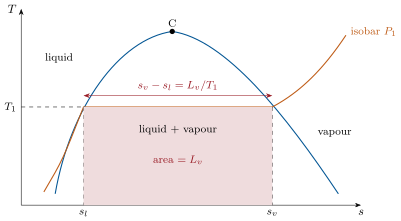
The same dome in the entropy diagram. An isobar crosses it as a horizontal segment of length Lv/T; the area under the segment is the latent heat. Power-station cycles are drawn in this plane, and the quality at the turbine exit is read off the segment by the lever rule.
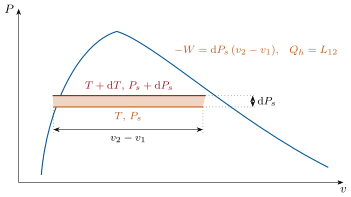
Proof. Take unit mass round an infinitesimal Carnot cycle inside the dome: complete transition 1→2 along the plateau at T+dT, pressure Ps+dPs (heat received L12 to first order); an infinitesimal adiabatic step down to T; the reverse transition along the plateau at T, Ps; an adiabatic step back. The cycle is reversible, ditherm between T+dT and T, so its efficiency is dT/T (Theorem 24.5); its work, the area of the thin rectangle, is dPs(v2−v1). Hence dPs(v2−v1)/L12=dT/T. ∎
The infinitesimal Carnot cycle that proves the Clausius–Clapeyron relation: two plateaus dT apart, joined by adiabatic steps too short to draw; Carnot’s theorem equates the ratio of its area to the heat received with dT/T.
Corollary 25.12(Saturation vapour pressure of a liquid)
If the vapour is a perfect gas and vv≫vl, so that vv−vl≈RT/(MPs), and if Lv varies little,
the vapour pressure rises roughly exponentially with temperature. For water near 100∘C, MLv/R=0.018×2.257×106/8.314=4890K and dPs/dT=2.257×106/(373×1.67)=3.6kPa/K: each kelvin of extra boiling temperature costs 36mbar of extra pressure.
Proof. Substitute vv−vl≈RT/(MPs) in the theorem and separate variables; integrate with Lv constant. ∎
The saturation vapour pressure of water. The curve is close to an exponential in −1/T; the boiling temperature is where it crosses the ambient pressure.
Example 25.13(Ice under a skate)
For ice–water, Lf=334kJ/kg and vl−vs=(1.000−1.091)×10−3=−9.1×10⁻⁵m3/kg: dP/dT=3.34×105/(273×(−9.1×10−5))=−1.3×107Pa/K=−130bar/K. A 70kg skater on one blade of 30cm by 3mm (9cm2) exerts about 8bar, lowering the melting point by 0.06K — pressure melting is not why skates glide (a thin surface layer of ice is liquid-like on its own, and friction heats); but the negative slope is real, and it is why a wire loaded with weights cuts through a block of ice that refreezes behind it.
25.5 Metastable states
Definition 25.14(Supercooling, superheating)
A phase can persist beyond its equilibrium boundary: liquid water cooled below 0∘C without freezing (supercooling), heated above its boiling point without boiling (superheating), vapour compressed beyond Ps without condensing (supersaturation). Such metastable states require the absence of nucleation sites — dust, scratches, dissolved gas, ice crystals — on which the new phase can start; a disturbance tips them suddenly and irreversibly to equilibrium.
Example 25.15(The supercooled bottle)
Still water at −8∘C in a clean bottle, knocked: ice crystals shoot through it and the temperature jumps to 0∘C. The process is adiabatic and fast, so the sensible heat cΔT freezes a fraction x=cΔT/Lf=4.18×8/334=0.10 of the water; the entropy created, cln(273/265)−xLf/273=124−122=+2J/(kgK), is positive as it must be. Clouds are full of supercooled droplets down to −40∘C; aircraft icing and the seeding of clouds both exploit that.
Remark 25.16(Boiling chips and bubble chambers)
A bubble of radius r in a liquid at pressure P holds vapour at P+2σ/r (surface tension σ, Year 2 volume); it can only grow if Ps(T)>P+2σ/r, so a clean liquid at its boiling point has no bubble small enough to start and superheats by several kelvin before erupting — the “bumping” that boiling chips prevent by offering cavities full of trapped gas. The bubble chamber of particle physics ran on the same instability in reverse: a superheated liquid boils first along the track of an ionizing particle.
Example 25.17(Humidity and dew)
Air holds water vapour at a partial pressure Pv≤Ps(T); the relative humidity is Pv/Ps(T), the dew point the temperature at which Ps falls to Pv. Air at 25∘C (Ps=3.17kPa) and 60% humidity has Pv=1.9kPa, ρv=PvM/(RT)=14g/m3, and dews on any surface below about 17∘C — the grass at dawn, the cold bottle, the bathroom mirror. Lifted, the same air cools adiabatically at 9.8K/km (Problem 25.1) and reaches its dew point a kilometre or so up: that is where the flat bottoms of the cumulus are.
25.6 Exercises
Exercise 25.1★
Using the diagram of the course, give the phase of water (a) at 20∘C under 0.5kPa; (b) at −5∘C under 1bar; (c) at 400∘C under 200bar; (d) at 0.01∘C under 611Pa. Why does a puddle dry at 20∘C although water “boils at 100”?
Solution
Solution of Exercise 25.1.
(a) Vapour: 0.5kPa is below Ps(20∘C)=2.3kPa. (b) Solid. (c) Above Tc=374∘C: supercritical fluid, no liquid–gas distinction. (d) The triple point: all three. The puddle evaporates from its surface as long as the vapour pressure in the air is below Ps(20∘C); boiling is only the case where bubbles can form inside the liquid.
Exercise 25.2★
100g of steam at 100∘C are bubbled into 1.0kg of water at 20∘C in an insulated vessel. Final temperature (Lv=2257kJ/kg, c=4.18kJ/(kgK)). Compare with adding 100g of water at 100∘C.
Solution
Solution of Exercise 25.2.
0.1×2257+0.1×4.18(100−Tf)=1.0×4.18(Tf−20): 351.1=4.60Tf, Tf=76∘C. With hot water instead: 100−Tf=10(Tf−20), Tf=27∘C — the latent heat is worth 540K of sensible heat.
Exercise 25.3★
A rigid 2.0L vessel contains 1.0kg of water at 150∘C in liquid–vapour equilibrium (Ps=4.76bar, vl=1.09×10⁻³m3/kg, vv=0.393m3/kg). Quality, mass of vapour, volume occupied by the liquid.
Solution
Solution of Exercise 25.3.
v=2.0×10⁻³m3/kg; x=(2.0−1.09)×10−3/0.392=2.3×10−3: 2.3g of vapour filling 0.91L; the 0.998kg of liquid occupy 0.998×1.09=1.09L.
Exercise 25.4★
Entropy of vaporization of water at 100∘C, per kilogram and per mole; entropy of fusion per mole at 0∘C. Many ordinary liquids have a molar entropy of vaporization near 88J/(molK) (Trouton’s rule): is water ordinary?
Solution
Solution of Exercise 25.4.
2257/373=6.05kJ/(kgK), i.e. ×0.018=109J/(molK); fusion 334/273×0.018=22J/(molK). Water’s 109 is well above Trouton’s 88: hydrogen bonds make liquid water more ordered than an ordinary liquid, so vaporizing it gains more disorder.
Exercise 25.5★★
Boiling temperature of water on the summit of Everest, P=0.33bar, from Corollary 25.12 with MLv/R=4890K; and at 2000m (P=0.80bar). What becomes of a 3min egg?
Solution
Solution of Exercise 25.5.
1/T=1/373.15−ln(P/P0)/4890. Everest: ln(0.33/1.013)=−1.12, 1/T=2.680×10−3+2.29×10−4, T=344K=71∘C. At 0.80bar: ln=−0.236, T=366K=93∘C. At 71∘C the white sets slowly and the yolk hardly at all: the 3min egg becomes a 10min egg or more.
Exercise 25.6★★
Temperature inside a pressure cooker whose valve opens at 1.8bar absolute; the same if its valve were set at 2.5bar. Steam at 1.8bar has vv=0.98m3/kg: how many grams of steam does a 6L cooker contain above 4L of water?
Solution
Solution of Exercise 25.6.
ln(1.8/1.013)=0.575: 1/T=2.680×10−3−1.18×10−4, T=390K=117∘C; at 2.5bar: ln=0.903, T=401K=128∘C. Steam: 2L/0.98=2.0g — the cooker holds almost nothing but water and a little steam.
Exercise 25.7★★
Slope of the fusion curve of water at 0∘C (Lf=334kJ/kg, vs=1.091×10⁻³m3/kg, vl=1.000×10⁻³m3/kg). At what pressure does ice melt at −1∘C? Ice at the bottom of a 3km ice sheet (ρ=917kg/m3): melting temperature there, and a consequence for glacier flow.
Solution
Solution of Exercise 25.7.
dP/dT=3.34×105/[273×(−9.1×10−5)]=−1.3×107Pa/K=−130bar/K: ice melts at −1∘C under about 130bar. Under 3km of ice, P=917×9.8×3000=270bar: melting at −2∘C; a glacier bed can be at its melting point while the surface is far colder, and the film of meltwater lets the ice sheet slide.
Exercise 25.8★★
One kilogram of water boils away at 100∘C under 1atm (vv=1.673m3/kg, vl=1.04×10⁻³m3/kg). Work received, heat received, ΔU, ΔH, ΔS of the water; entropy created if the heat comes from a flame at 1500K.
Solution
Solution of Exercise 25.8.
W=−P(vv−vl)=−1.013×105×1.672=−169kJ (the water pushes the atmosphere back); Q=Lv=2257kJ; ΔU=2257−169=2088kJ; ΔH=2257kJ; ΔS=2257/373=6.05kJ/K. From a flame at 1500K: Sexch=2257/1500=1.50kJ/K, created 4.5kJ/K — most of the flame’s quality is wasted heating water.
Exercise 25.9★★
Saturation pressures: 1.23kPa (10∘C), 1.70kPa (15∘C), 2.34kPa (20∘C), 3.17kPa (25∘C), 4.24kPa (30∘C). A room at 22∘C has a relative humidity of 70%: vapour pressure, dew point (interpolate), mass of water vapour in 50m3. A window pane at 12∘C: does it fog? Heating the room to 25∘C without adding water: new humidity.
Solution
Solution of Exercise 25.9.
Ps(22∘C)≈2.34+0.4×0.83=2.67kPa, Pv=0.70×2.67=1.87kPa; dew point where Ps=1.87: 15+5×0.17/0.64=16∘C. Mass: ρv=1870×0.018/(8.314×295)=13.7g/m3, 0.69kg in the room. Pane at 12∘C: Ps≈1.42kPa<1.87, it fogs. At 25∘C the humidity falls to 1.87/3.17=59%.
Exercise 25.10★★★
The triple point. (a) Show from the state-function character of h that, at the triple point, Ls=Lf+Lv (sublimation = fusion + vaporization). (b) Show with Clausius–Clapeyron that the sublimation curve is steeper than the vaporization curve at the triple point (neglect vs, vl before vv). (c) Water: Lf=334kJ/kg, Lv=2500kJ/kg, T=273.16K, P=611Pa, vapour a perfect gas: both slopes in Pa/K. (d) Why does snow disappear on a dry cold day without ever melting?
Solution
Solution of Exercise 25.10.
(a) h is a state function: going solid → liquid → vapour at the triple point or solid → vapour directly gives the same Δh: Ls=Lf+Lv. (b) With vs,vl≪vv both slopes are L/(Tvv) at the same T and vv: their ratio is Ls/Lv>1. (c) vv=RT/(MP)=8.314×273.16/(0.018×611)=206m3/kg; vaporization 2.50×10⁶/(273.16×206)=44Pa/K, sublimation 2.83×10⁶/(273.16×206)=50Pa/K. (d) Below 0∘C at 1bar no liquid exists; if the air’s vapour pressure is below Ps over ice (260Pa at −10∘C) the snow sublimates — the dry cold wind eats it.
Exercise 25.11★★★
Superheated water. A bubble of radius r in water at pressure P0 contains vapour at P0+2σ/r with σ=0.059N/m (admitted). (a) Minimum radius of a bubble that can grow in water at 105∘C under 1.013bar, using dPs/dT=3.6kPa/K. (b) Same at 101∘C. (c) A cup of water superheated to 105∘C in a microwave oven is disturbed by a spoon: fraction of the water that flashes to steam, and the volume of steam produced per litre of water — comment on the danger. (d) Why do boiling chips prevent this?
Solution
Solution of Exercise 25.11.
(a) Ps(105∘C)≈1.013+5×0.036=1.19bar: ΔP=0.18bar, r∗=2×0.059/(1.8×104)=6.6µm. (b) ΔP=3.6kPa, r∗=33µm. (c) x=cΔT/Lv=4.18×5/2257=0.93%: 9.3g per litre, i.e. 9.3×10−3×1.67=16L of steam produced in a fraction of a second inside a cup — the water is blown out, boiling. (d) Chips hold air in their pores: bubbles of tens of micrometres already exist, so boiling starts as soon as Ps reaches P0.
Exercise 25.12★★★
A refrigerant’s cycle. A heat pump runs R-134a round Definition 24.16: evaporation at −10∘C (2.0bar; hl=187kJ/kg, hv=392kJ/kg), condensation at 40∘C (10.2bar; hl=256kJ/kg, hv=419kJ/kg). The fluid leaves the condenser as saturated liquid and the evaporator as saturated vapour; the compressor delivers it at h=430kJ/kg. Admit that in the valve h is conserved and that the compressor’s work per kilogram is Δh (steady-flow balances, Year 2 volume); in the exchangers, isobaric, q=Δh (Proposition 22.7). (a) Quality at the evaporator inlet. (b) Heat taken per kilogram in the evaporator, heat given in the condenser, work of compression; check the first law. (c) ep and ef; compare with the Carnot values between the two saturation temperatures. (d) Mass flow rate for 6kW of heating.
Solution
Solution of Exercise 25.12.
(a) After the valve h=256kJ/kg at −10∘C: x=(256−187)/(392−187)=0.34. (b) Evaporator qc=392−256=136kJ/kg; compressor w=430−392=38kJ/kg; condenser qh=256−430=−174kJ/kg; 136+38−174=0. (c) ep=174/38=4.6, ef=136/38=3.6; Carnot 313/50=6.3 and 263/50=5.3: about 0.7 of the ideal. (d) m˙=6000/174000=34g/s, 2.1kg a minute.
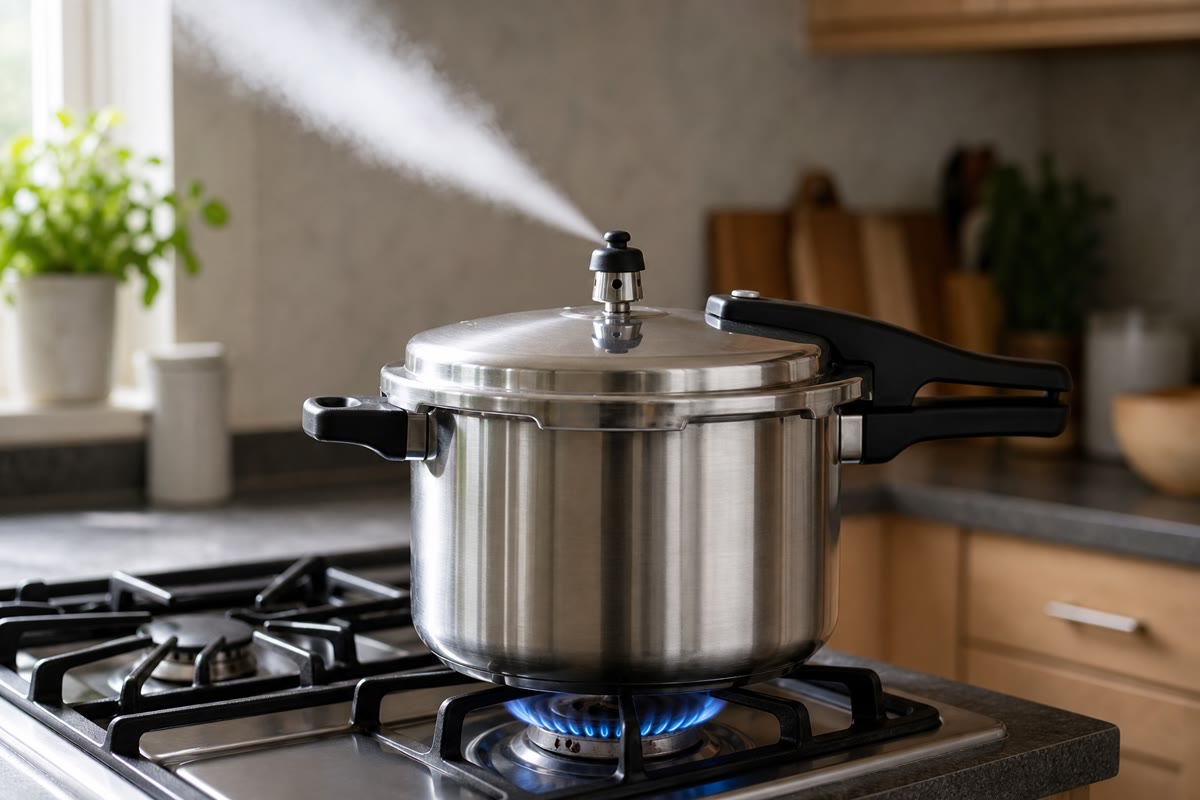
A pressure cooker: at 1.8bar water boils at 117∘C, and the weighted valve is what sets the pressure.
25.7 Problem: Water in four scenes
Problem 25.1
Weekend problem — the pressure cooker, the cloud, the sealed vessel and the supercooled bottle: one substance, four uses of its phase diagram
Data for water: Lv=2257kJ/kg at 100∘C and about 2.2MJ/kg at 117∘C, 2.45MJ/kg near 20∘C; Lf=334kJ/kg; c=4.18kJ/(kgK) (liquid); M=18g/mol; MLv/R=4890K near 100∘C. Saturation pressures: 0.61kPa (0∘C), 1.23kPa (10∘C), 1.70kPa (15∘C), 2.34kPa (20∘C), 3.17kPa (25∘C), 4.24kPa (30∘C), 101.3kPa (100∘C). Saturated specific volumes: vl=1.0×10⁻³m3/kg (cold water), 1.9×10⁻³m3/kg at 360∘C; vv=0.0217m3/kg at 300∘C, 0.0108 at 340∘C, 0.0088 at 350∘C; critical point374∘C, 221bar, vc=3.1×10⁻³m3/kg. Air: M=29g/mol, cp=1.0kJ/(kgK), γ=1.4; g=9.8m/s2; R=8.314J/(molK).
Part I — The pressure cooker.
Why can water in an open pan at sea level not be heated above 100∘C, however strong the flame?
Starting from the Clausius–Clapeyron relation, derive ln[Ps(T)/Ps(T0)]=(MLv/R)(1/T0−1/T), stating the approximations.
Temperature in a cooker whose valve opens at 1.8bar absolute.
The valve is a weight resting on an orifice of 20mm2; atmospheric pressure 1.0bar: mass of the weight.
2.0L of water are brought from 20∘C to the working temperature by a 2.0kW plate (neglect the pot): heat and time.
Once there, the plate is left at 2.0kW: mass of steam leaving the valve per minute. What should the cook do?
Cooking reactions roughly double in rate for every 10K: by what factor does the cooker shorten a 30min sea-level recipe? And how long would the recipe take on Everest, where water boils at 70∘C?
Part II — The cloud.
Define relative humidity. Air at 25∘C and 60%: partial pressure of vapour, and mass of vapour per cubic metre (perfect gas).
Dew point of that air (interpolate the table). Explain the dew on the grass at dawn and the drops on a cold bottle.
A parcel of dry air rises without exchanging heat. From the reversible adiabatic law and the hydrostatic relationdP/dz=−ρg, show that dT/dz=−g/cp and evaluate it.
The dew point of the rising parcel itself falls by about 2K/km as the pressure drops. Height at which the parcel of question 8 becomes saturated — the base of the cloud.
Above the base, the vapour that condenses releases its latent heat into the parcel. By how much does condensing 1g of water per kilogram of air warm that air? What does this do to the cooling rate of the parcel as it keeps rising, and why does it matter for thunderstorms?
A cumulus of 1km3 holds 1g of liquid water per cubic metre: mass of water, and the energy released by its condensation, in joules and in GWh.
A bathroom mirror at 18∘C, air at 25∘C and 80%: does it fog? At what humidity would it stop?
Part III — The sealed vessel. A rigid steel vessel of 1.0L is filled with a mass m of water and sealed with no air, then heated slowly.
m=0.50kg at 20∘C: pressure inside, specific volume, mass of vapour (use the perfect gas for vv), fraction of the volume filled by liquid.
Heated: does the liquid level rise or fall? At roughly what temperature does the liquid fill the vessel, and what happens to the pressure after that? (Use vl at 360∘C.)
m=0.10kg: does the liquid level rise or fall on heating? At roughly what temperature does the last drop evaporate (use the vv table)?
m=0.31kg: describe what an observer sees at the meniscus as the temperature approaches 374∘C.
Sketch the three heating paths in the (v,P) diagram with the saturation dome, and say which side of the critical point each passes.
The same 1.0L vessel with 0.50kg of water is now sealed with the air it contained at 20∘C, 1.0bar, and heated to 100∘C: total pressure inside (Dalton), and the force on a lid of 100cm2.
Part IV — The supercooled bottle.
A clean, still bottle of water has cooled to −8∘C without freezing. What is this state called, why is it possible, and what happens when the bottle is knocked? Why does the temperature then settle at exactly 0∘C?
Fraction of the water that freezes (the process is fast, hence adiabatic).
Entropy created per kilogram; sign check.
The reverse surprise: a cup of water heated to 105∘C in a microwave oven without boiling, then disturbed. Fraction of the water that flashes to steam, volume of steam produced per litre (vv=1.67m3/kg), and why the cup erupts.
Lost work: the supercooled litre could have driven a reversible engine with the 0∘C surroundings; taking T0=273K, the work thrown away by letting it freeze on a knock is T0Screated. Evaluate it per litre and compare with lifting the bottle by one metre. Conclude: what does a metastable state store?
Solution
Solution of Problem 25.1.
1. At 1atm water boils at 100∘C; while liquid remains, any heat supplied makes vapour at that temperature (latent heat) instead of warming the liquid: the temperature is pinned by the pressure.
2.dPs/dT=Lv/[T(vv−vl)] with vl≪vv=RT/(MPs) (perfect-gas vapour): dPs/Ps=(MLv/R)dT/T2; with Lv taken constant, integrate: ln(Ps/P0)=(MLv/R)(1/T0−1/T).
6.2000/(2.2×106)=0.91g/s=55g/min — two litres gone in 37min. Turn the plate down to the least that keeps the valve hissing: the temperature is set by the pressure, not by the flame.
7.+17K: 21.7=3.2 times faster, 30min→9min. Everest, −30K: 2−3, four hours.
9.Ps(Td)=1.90kPa: between 15∘C (1.70kPa) and 20∘C (2.34kPa): Td=15+5×0.20/0.64=16.6∘C. Grass radiating to the night sky, or a bottle from the refrigerator, falls below Td: the vapour in contact with it is then above saturation and condenses.
10.TP(1−γ)/γ=const: dT/T=γγ−1dP/P; dP=−ρgdz with ρ=PM/(RT): dT/T=−γγ−1RTMgdz, so dT/dz=−γγ−1RMg=−g/cp since cp=γR/[(γ−1)M]. Value 9.8/1000=9.8K/km.
11.T−Td closes at 9.8−2=7.8K/km: z=(25−16.6)/7.8=1.1km.
12.1×2.45=2.45kJ per kilogram of air: ΔT=2.45K. The release offsets part of the adiabatic cooling: a saturated parcel cools at only 5 to 6K/km, stays warmer and lighter than its surroundings and keeps rising — the latent heat is the fuel of the thunderstorm.
13.109×1g=1000t; 106×2.45×106=2.5×10¹²J=0.68GWh — forty minutes of a large power plant.
14.Pv=0.80×3.17=2.54kPa; Ps(18∘C)≈1.70+0.6×0.64=2.08kPa<2.54: it fogs, until the humidity drops below 2.08/3.17=66%.
15.P=Ps(20∘C)=2.3kPa; v=2.0×10⁻³m3/kg; vv=RT/(MPs)=8.314×293/(0.018×2340)=58m3/kg; x=(2.0−1.0)×10−3/58=1.7×10−5: 9mg of vapour; liquid 0.50×10−3=0.50L, half the vessel.
16.v=2.0×10⁻³m3/kg<vc: the isochore meets the liquid branch of the dome — the liquid expands faster than it evaporates, the level rises, and the vessel is full of liquid when vl(T)=2.0×10⁻³m3/kg, a little above 360∘C (about 190bar). Beyond, a nearly incompressible liquid heated at constant volume: the pressure climbs by tens of bar per kelvin — the vessel bursts. Never seal a vessel full of liquid.
17.v=1.0×10⁻²m3/kg>vc: the level falls; the last drop goes when vv(T)=0.010, between 340∘C (0.0108) and 350∘C (0.0088): about 344∘C, 150bar.
18.v=3.2×10⁻³m3/kg≈vc: the meniscus stays near mid-height, grows flatter and fainter as the two densities converge, the fluid turns milky (critical opalescence), and at 374∘C, 221bar the meniscus vanishes: one phase.
19. Three vertical lines: v=2.0×10⁻³ leaves the dome through the liquid branch, left of C; 10−2 through the vapour branch, right of C; 3.2×10⁻³ through the summit.
20. Air: 0.5L at 1.0bar, 293K, same volume at 373K: Pair=1.0×373/293=1.27bar; plus Ps=1.01bar: 2.3bar inside, 1.3bar above the outside: 1.3×105×10−2=1.3kN on the lid — the weight of 130kg.
21. Supercooled, metastable: no nucleation site (clean water, no dust, no motion) for the first crystal. A knock nucleates ice, which grows through the bottle releasing Lf; the temperature rises to 0∘C and stops there, the only temperature at which ice and water coexist at 1atm: the freezing halts as soon as the released heat has brought the mixture to it.
22.x=cΔT/Lf=4.18×8/334=0.10.
23.Δs=cln(273/265)−xLf/273=124.3−122.3=+2.0J/(kgK): adiabatic, hence all created; positive, as a spontaneous process must be.
24.x=4.18×5/2257=0.93%: 9.3g of steam per litre, 9.3×10−3×1.67=16L of vapour born in the bulk in a fraction of a second: the cup erupts.
25.T0Screated=273×2.0=550J per litre, against mgh=9.8J: fifty-six times more. A metastable state stores work — what a reversible path could have extracted — and a knock turns it all into entropy.