সব বই

পেশাদার

1 Markets I: The Ecosystem and Exchange-Traded Marketsবাজার অনলাইন 2 Markets II: Rates, FX and Creditবাজার অনলাইন 3 Markets III: Commodities, Energy and Cryptoবাজার অনলাইন 4 Quantitative Methodsপদ্ধতি অনলাইন 5 Derivatives and Volatilityডেরিভেটিভস অনলাইন 6 Rates, Credit, XVA and Riskসুদহার, ঋণ ও ঝুঁকি অনলাইন 7 Research Craft: Predictors, Backtests, Measurement, Portfoliosগবেষণা অনলাইন 8 Strategies I: Equities and Futuresকৌশল অনলাইন 9 Strategies II: Volatility, Relative Value, Macro and the Bank Desksকৌশল অনলাইন 10 Microstructure and Executionএক্সিকিউশন অনলাইন 11 Market Making and High-Frequency Tradingমার্কেট মেকিং অনলাইন 12 Machine Learning for Marketsমেশিন লার্নিং অনলাইন 13 Low-Latency Softwareপ্রযুক্তি অনলাইন 14 Networks, Hardware and Trading Infrastructureপ্রযুক্তি অনলাইন 15 Research, Data and Risk Platformsপ্রযুক্তি অনলাইন 16 The Desk and the Firmপ্রতিষ্ঠান অনলাইন 17 The Industry: Firms, Roles and Careersক্যারিয়ার অনলাইন 18 Interviews I: Maths, Probability and Speedক্যারিয়ার অনলাইন 19 Interviews II: Markets, Trading Games and the Final Roundক্যারিয়ার অনলাইন 20 Interviews III: Codeক্যারিয়ার অনলাইন
অ্যাপ পরিচিতি Coach সাইন ইন পড়া শুরু করো

বইগুলো এখনো বাংলা ভাষায় পাওয়া যায় না — ইংরেজি সংস্করণ দেখানো হচ্ছে।

Physics · পরিভাষা

Sound level কী?

অন্য নাম: decibel

Definition 21.9 High School Physics · অধ্যায় 21 — Sound and Acoustics

The ear spans twelve powers of ten, so intensities are quoted logarithmically. The sound level of II is

L=10log⁡10(I/I0),I0=1.0×10−12 W/m2,L = 10 \log_{10}(I/I_0), \qquad I_0 = 1.0 \times 10^{-12}\,\mathrm{W}/\mathrm{m}^{2},

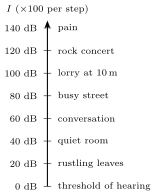
in decibels (dB\mathrm{dB}): hearing threshold 0 dB0\,\mathrm{dB}, pain near 120 dB120\,\mathrm{dB}.

A ladder of everyday levels: each 20\, dB step is a hundredfold intensity jump; beyond 85\, dB (red zone) exposure damages hearing.
A ladder of everyday levels: each 20 dB20\,\mathrm{dB} step is a hundredfold intensity jump; beyond 85 dB85\,\mathrm{dB} (red zone) exposure damages hearing.
প্রসঙ্গসহ পড়ো →
Definition 7.5 University Physics — Year 2 · অধ্যায় 7 — Sound Waves in Fluids

The sound level of a wave of mean intensity II is

L=10log⁡10II0 dB,I0=1×10⁻¹² W/m2L = 10\log_{10}\frac I{I_0} \ \text{dB} , \qquad I_0 = 1 \times 10^{-12}\,\mathrm{W}/\mathrm{m}^{2}

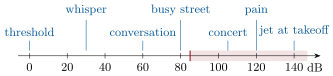
— the threshold of hearing at 1 kHz1\,\mathrm{kHz}, corresponding in air to the pressure amplitude p0≈2×10⁻⁵ Pap_0 \approx 2 \times 10^{-5}\,\mathrm{Pa} (rms) =2×10−10= 2 \times 10^{-10} atmospheres. Doubling the intensity adds 3 dB3\,\mathrm{dB}; ten times, 10 dB10\,\mathrm{dB}; a hundred times the pressure amplitude, 40 dB40\,\mathrm{dB}. Quiet room 30 dB30\,\mathrm{dB}, conversation 60 dB60\,\mathrm{dB}, busy street 80 dB80\,\mathrm{dB}, rock concert 110 dB110\,\mathrm{dB}, pain 120 dB120\,\mathrm{dB} (I=1 W/m2I = 1\,\mathrm{W}/\mathrm{m}^{2}, pm=29 Pap_m = 29\,\mathrm{Pa}).

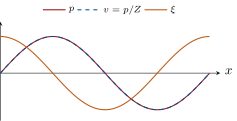
Left: in a plane progressive sound wave the overpressure and the fluid velocity are in phase, and the displacement lags by a quarter period. Right: the decibel scale — each 20\, dB step multiplies the intensity by a hundred and the pressure amplitude by ten. Left: in a plane progressive sound wave the overpressure and the fluid velocity are in phase, and the displacement lags by a quarter period. Right: the decibel scale — each 20\, dB step multiplies the intensity by a hundred and the pressure amplitude by ten.
Left: in a plane progressive sound wave the overpressure and the fluid velocity are in phase, and the displacement lags by a quarter period. Right: the decibel scale — each 20 dB20\,\mathrm{dB} step multiplies the intensity by a hundred and the pressure amplitude by ten.

উদাহরণ

Example 7.6 (How small a sound is)

At the threshold, 1 kHz1\,\mathrm{kHz}: pm=2.8×10⁻⁵ Pap_m = 2.8 \times 10^{-5}\,\mathrm{Pa}, vm=pm/Z=7×10−8 m/sv_m = p_m/Z = 7 \times 10^{-8}\,\mathrm{m}/\mathrm{s}, and the displacement amplitude ξm=vm/ω=1×10−11 m\xi_m = v_m/\omega = 1 \times 10^{-11}\,\mathrm{m} — a tenth of an atomic diameter: the eardrum detects motions smaller than an atom. At 120 dB120\,\mathrm{dB}, ξm=11 µm\xi_m = 11\,\text{µ}\mathrm{m}, still invisible, and pm/P0=3×10−4p_m/P_0 = 3 \times 10^{-4}: even the loudest sounds are tiny perturbations, which is why the linear theory works so well.

Example 7.8 (A siren, a conversation)

A 10 W10\,\mathrm{W} siren: I=10/4πr2I = 10/4\pi r^2, 0.8 W/m20.8\,\mathrm{W}/\mathrm{m}^{2} at 1 m1\,\mathrm{m} (119 dB119\,\mathrm{dB}, pain), 79 dB79\,\mathrm{dB} at 100 m100\,\mathrm{m}, 59 dB59\,\mathrm{dB} at 1 km1\,\mathrm{km} — still audible over the city. A voice radiates about 10 µW10\,\text{µ}\mathrm{W}: 60 dB60\,\mathrm{dB} at 1 m1\,\mathrm{m}, and 40 dB40\,\mathrm{dB} at 10 m10\,\mathrm{m}. Air absorbs sound too (more at high frequency, a few decibels per hundred metres at 10 kHz10\,\mathrm{kHz}), which is why distant thunder rumbles low.

প্রসঙ্গসহ পড়ো →