High School Physics · Grades 10–12
21Sound and Acoustics
Pluck a guitar’s low string: the room fills with a low A, yet nothing traveled to your ear but squeezed and stretched air. This chapter follows that pattern — its speed, how frequency becomes pitch and power loudness, and why one note differs on every instrument.
21.1 Sound is a pressure wave
Definition 21.1 (Sound wave)
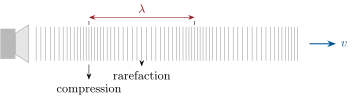
A sound wave is a mechanical pressure wave (Chapter 20): a vibrating surface creates traveling compressions (slight overpressure) and rarefactions (underpressure). Air parcels oscillate along the travel direction (sound is longitudinal), and a medium is needed: a bell under a vacuum jar falls silent (Chapter 8).
Proposition 21.2 (Speed of sound)
Sound travels at about in air at , in water and in steel: the stiffer the medium, the faster.
Proof. Admitted at this level. ∎
Remark 21.3 (Warm air is faster)
These are measured values; predicting them is done in the Year 1 volume. Sound speeds up in warmer air ( at ) — why winds drift out of tune as the hall warms.
Example 21.4 (The sizes of sounds)
The relation sizes any sound: in air a rumble spans — a building — and a hiss fits in ; the metre-sized ones bend easily around doors and corners.
21.2 Pitch, loudness and the ear
Definition 21.5 (Pitch and loudness)
Pitch is the perception of frequency: the higher , the higher the note; concert A is , and doubling raises the note one octave. Loudness is the perception of amplitude: the stronger the pressure oscillation, the louder; amplification changes loudness, not pitch.
Remark 21.6 (The ear’s window)
Hearing spans about to (Chapter 8); below lies infrasound, above lies ultrasound — bats at , medical probes at megahertz. A piano only samples the middle: .
21.3 Sound intensity and the decibel scale
Definition 21.7 (Sound intensity)
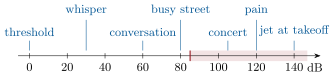
The sound intensity is the acoustic power crossing one square metre facing the wave: , in . The quietest audible sound is about ; pain begins near .
Proposition 21.8 (Inverse-square attenuation)
A small source radiating a power equally in all directions gives, at distance , : doubling the distance divides the intensity by four.
Proof. The whole power crosses the sphere of area ; divide. ∎
Definition 21.9 (Sound level)
The ear spans twelve powers of ten, so intensities are quoted logarithmically. The sound level of is
in decibels (): hearing threshold , pain near .
Proposition 21.10 (Decibel arithmetic)
Multiplying by adds decibels. In particular adds ; adds ; incoherent identical sources add intensities, never levels, giving ; doubling the distance to a small source ( divided by four) removes about .
Proof. ; distance: Proposition 21.8, . ∎
Method 21.11 (Working in decibels)
- ; back: .
- Never add levels: convert to intensities, add, convert back — or per doubling, per tenfold.
- Each doubling of distance to a small source costs .
Remark 21.12 (Hearing damage)
Hearing loss is a dose: is safe for eight hours, and every more — a doubling of intensity — halves the safe time; lost hair cells do not grow back.
21.4 Timbre and harmonics
Definition 21.13 (Harmonics)
A periodic sound of frequency — the fundamental — is in general a sum of sines at the frequencies , , its harmonics. A sound reduced to its fundamental is a pure tone, like a tuning fork’s.
Definition 21.14 (Spectrum and timbre)
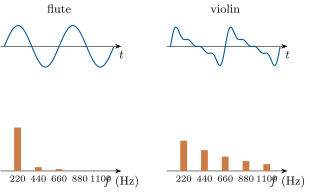
The spectrum of a sound is the bar chart of its harmonics: one bar per , the height that harmonic’s strength. The ear hears as the pitch and the mix of strengths as the timbre — the sound’s color: instruments playing the same note share , differing only in their spectra.
Example 21.15 (Why you recognize the caller)
A flute’s A is nearly a pure tone; a violin bowing the same adds strong harmonics at . Same pitch and loudness, yet no one confuses them: a voice, too, is a spectrum you know by heart.
21.5 The vibrating string
Definition 21.16 (Standing wave)
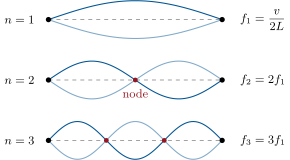
A wave confined between the fixed ends of a string can settle into a standing wave: an oscillation in place, motionless points — nodes — alternating with points of maximal swing — antinodes. Nothing travels any more; the string vibrates in a fixed pattern.
Proposition 21.17 (Modes of a string)
A string of length , fixed at both ends, carrying waves of speed , vibrates steadily only in patterns fitting a whole number of half-wavelengths between the imposed end nodes:
The lowest mode is the fundamental; the others are exactly its harmonics.
Proof. Admitted at this level. ∎
Remark 21.18 (Where the honest proof lives)
That confined waves pick exactly these modes follows from superposing the wave with its reflections, a calculus carried out in the Year 1 volume. The geometry convinces: both ends must stay still, so a whole number of half-wavelengths must fit.
Example 21.19 (A violin’s A string)
A violin’s A string has and sounds : waves run along it at — set by tension and mass, tuned by the peg. Pressing a finger shortens and raises every at once: the spectrum slides up.
Remark 21.20 (Why instruments differ)
How the string is excited — plucked, bowed, struck — sets how much of each mode is present, and the body amplifies some harmonics more than others; excitation plus body fix the spectrum, so the same leaves a guitar, a violin and a piano each sounding like itself.
21.6 Exercises
Exercise 21.1 ★
In air (), find the wavelength of (a) a bass note; (b) a beep; (c) a whine. Compare the largest to the smallest.
Solution
Solution of Exercise 21.1.
: (a) ; (b) ; (c) . Ratio .
Exercise 21.2 ★
Classify as infrasound, audible sound or ultrasound: ; ; ; ; . Of the audible ones, which sounds lower in pitch?
Solution
Solution of Exercise 21.2.
Infrasound: . Audible: and . Ultrasound: and . Lower pitch: (lower frequency).
Exercise 21.3 ★
A worker strikes a rail away. Compute the travel times in the steel and in the air. What does a listener with one ear pressed to the rail hear?
Solution
Solution of Exercise 21.3.
Steel: ; air: . Two clicks, apart — the rail first.
Exercise 21.4 ★
(a) The sound level for ? (b) The intensity at ? (c) Name an everyday sound near each level.
Solution
Solution of Exercise 21.4.
(a) . (b) . (c) : a vacuum cleaner; : a conversation.
Exercise 21.5 ★
A violin G string sounds : give its next three harmonics. Why does a whistle, however rich at the source, reach the ear as a pure tone?
Solution
Solution of Exercise 21.5.
. Its higher harmonics () start at , above the audible ceiling: only the fundamental is heard.
Exercise 21.6 ★★
A siren radiates equally in all directions. Compute the intensity and the sound level away.
Solution
Solution of Exercise 21.6.
; .
Exercise 21.7 ★★
One violin gives at your seat. What level do two give? Four? How many violins would it take to reach ?
Solution
Solution of Exercise 21.7.
Two: ; four: . needs in intensity: violins.
Exercise 21.8 ★★
The level is at from a small loudspeaker. Predict the level at : below the mark?
Solution
Solution of Exercise 21.8.
: , so : . Yes — just below the mark.
Exercise 21.9 ★★
A note passes from air into water. Compute its wavelength in each medium. The diver hears the same pitch: which quantity is fixed by the source, and which one adjusts?
Solution
Solution of Exercise 21.9.
Air: ; water: . The source fixes the frequency; the wavelength adjusts to the medium.
Exercise 21.10 ★★
A spectrum shows peaks at of decreasing heights: what is the fundamental? Another instrument plays the same note at the same loudness: what is the same in its spectrum, what differs?
Exercise 21.11 ★★
A guitar string of length sounds . Find the wave speed, then the vibrating lengths giving the octave () and the fifth ().
Solution
Solution of Exercise 21.11.
. Octave: ; fifth: .
Exercise 21.12 ★★★
A medical probe sends ultrasound into soft tissue (): the wavelength? Echoes return after and from an organ’s two walls: find their depths and the organ’s thickness.
Solution
Solution of Exercise 21.12.
. Depth : and ; thickness .
Exercise 21.13 ★★★
An outdoor stage produces at . Treating it as a small source, at what distance does the level fall to ? Give two reasons the real distance differs.
Solution
Solution of Exercise 21.13.
means , so : . Real halls differ: reflections from ground and walls add intensity, while air and the crowd absorb it (and the stage is not an isotropic point source).
Exercise 21.14 ★★★
Find the ratio of the pain threshold () to . Taking the eardrum as , compute the power received at each threshold; comment on the ear as a detector.
Exercise 21.15 ★★★
Each identical festival loudspeaker alone gives at the mixing desk. What level do give? ? ? What does each extra cost — what does this say of loudness races?
Solution
Solution of Exercise 21.15.
: ; : ; : . Each extra costs a tenfold in loudspeakers: loudness races are exponentially expensive (and dangerous long before they are won).
21.7 Problem: The Luthier’s Workshop
Problem 21.1
Weekend problem — the luthier’s workshop: a guitar string laid out fret by fret, its harmonics tuned into a timbre, a recital kept below the danger line, and an ultrasound hunt for a flaw in the wood
A luthier is finishing a guitar. Its A string has vibrating length and must sound . Take for sound in air, and admit (Proposition 21.17), being the wave speed on the string.
Part I — Laying out the fretboard.
- Compute the wave speed on the string.
- Compute the fundamental’s wavelength on the string, then the wavelength of the sound in the air. Why do they differ at the same frequency?
- The octave (): what vibrating length gives it? Where must the twelfth fret sit, as a fraction of ?
- The fifth (): what vibrating length gives it?
- Each fret raises the note one semitone, a factor . Check with logarithms how many semitones separate from ; length at the first fret?
Part II — Harmonics and timbre.
- List the first five harmonics of the open A string.
- A violinist’s A sounds . Which harmonic of the guitar string is that, and what musical interval separates it from the fundamental? And ?
- The luthier plucks near the bridge, then over the fingerboard: same pitch, different color. Explain with spectra.
- A light touch at the midpoint while plucking forces a node there. Which harmonics survive, and what pitch is heard?
- How many harmonics of the open string lie, in principle, within the audible range?
Part III — The recital. At the guitar’s first concert, each instrument radiates an acoustic power as a small source, equally in all directions.
- Compute the intensity at from one instrument.
- Deduce the sound level there.
- A quartet plays: what level do four such instruments give at the same spot? Why is it not four times the level?
- Twelve instruments play: what is the level at ?
- How far back must a listener sit for the ensemble to fall to ?
- Safety rule: is safe for eight hours, and every halves the safe time. How long may the front-row listener of question 14 safely stay?
Part IV — The flaw in the wood. Before varnishing, the luthier probes a thick neck blank with a tester; in this wood take .
- Compute the ultrasound wavelength in the wood. Why must a flaw-hunting wave be ultrasonic rather than audible?
- Compute the echo delay from the back face of the blank.
- An echo arrives after : how deep is the flaw?
- Write the workshop card: wave speed on the string, twelfth- and first-fret lengths, safe listening distance, flaw depth.
Solution
Solution of Problem 21.1.
1. .
2. On the string ; in air . Same , but and the wave speeds differ.
3. : the twelfth fret sits at the midpoint, from the bridge.
4. .
5. semitones — twelve frets to the octave. First fret: .
6. .
7. : the fourth harmonic, two octaves up. : the third harmonic, an octave plus a fifth.
8. The pluck position sets the mode mix: near the bridge the high harmonics are strong (bright spectrum), over the fingerboard the fundamental dominates (mellow). Same , so same pitch — different spectrum, different timbre.
9. Only harmonics with a node at the midpoint survive: the even ones, , …The pitch jumps an octave, to .
10. : , so harmonics.
11. .
12. .
13. : . Levels are logarithms: intensities add, levels do not.
14. .
15. Target with : .
16. is over the eight-hour limit: the safe time halves once — four hours. The recital fits.
17. . A wave only reflects off flaws at least about a wavelength across: audible sound in wood has of tens of centimetres and diffracts around any small defect.
18. .
19. .
20. The card: on the string; frets at (twelfth) and (first); ensemble safe beyond ; flaw deep — four numbers, one chapter.