Count the seconds between the flash and the thunder and divide by three: that is the distance in kilometres. Sound crosses air at a third of a kilometre per second, water at a kilometre and a half, and an ultrasound scanner times the echoes from inside the body to a millionth of a second to draw its picture. This chapter applies the fluid mechanics of Chapters 3 and 2 to a fluid at rest disturbed by a small pressure ripple, and finds the d’Alembert equation again: the speed of sound, what carries the energy, how loud is loud, how sound spreads in space, and why a siren changes pitch as it passes.
7.1 The acoustic approximation
Definition 7.1(Acoustic perturbation)
A fluid at rest, of uniform pressure P0 and density ρ0, is disturbed: P=P0+p(M,t), ρ=ρ0+ρ1(M,t), velocity v(M,t). The acoustic approximation keeps only the first order in the small quantities p (the overpressure, or acoustic pressure), ρ1 and v: ∣p∣≪P0, ∣ρ1∣≪ρ0, v≪c, and the transformation undergone by each fluid particle is so fast that it exchanges no heat: it is isentropic, with the compressibility χS=ρ1(∂P∂ρ)S. Gravity is neglected.
Theorem 7.2(Sound waves)
To first order, Euler’s equation, mass conservation and the isentropic law read
(the same for ρ1 and for v). For a perfect gas, χS=1/γP0 and
c=ρ0γP0=MγRT:
343m/s in air at 20∘C, rising by 0.6m/s per kelvin; 1000m/s in helium; 1480m/s in water (χS=4.5×10⁻¹⁰Pa−1).
Proof. Euler: the convective term ρ(v⋅grad)v is second order, ρ∂tv≈ρ0∂tv, and gradP=gradp. Mass: ∂tρ+div(ρv)≈∂tρ1+ρ0divv. Isentropic law: dρ=ρχSdP to first order. Take the divergence of the first equation and the time derivative of the second: ρ0∂tdivv=−Δp=−∂t2ρ1=−ρ0χS∂t2p. For the perfect gas, PVγ constant along an isentropic transformation gives dρ/ρ=dP/γP, hence χS=1/γP, and P0/ρ0=RT/M. ∎
Remark 7.3(Why isentropic)
Newton computed the speed of sound with the isothermal compressibility, P0/ρ0=290m/s, 15% too low; Laplace saw that the compressions are too fast for heat to flow between the warm crests and the cool troughs — over one period, heat diffuses a few micrometres (Chapter 25), nothing compared with a wavelength — so the transformation is adiabatic and reversible, and γ appears. The speed of sound is thus a direct measurement of γ: 1.40 for air, 1.67 for argon.
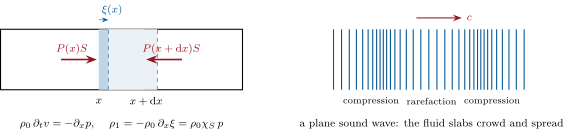
Left: a slab of fluid displaced by ξ(x,t) and pushed by the pressures on its faces; its compression sets the overpressure. Right: a plane sound wave — alternate zones of compression and rarefaction moving at c, the fluid itself oscillating back and forth along the direction of propagation (a longitudinal wave).
7.2 Plane waves, impedance, intensity
Proposition 7.4(Plane progressive sound wave)
For a plane wave p=f(x−ct) travelling toward +x, the fluid velocity is along x, in phase with the overpressure, and
p=Zv,Z=ρ0c=ρ0/χS,
where Z is the acoustic impedance of the medium (kgm−2s−1): 410kgm−2s−1 for air, 1.5×10⁶kgm−2s−1 for water, ∼1.6×10⁶kgm−2s−1 for soft tissue, 4×10⁷kgm−2s−1 for steel. The wave carries the energy density and the intensity (power per unit area, toward +x)
e=21ρ0v2+21χSp2,I=pv,
which obey ∂te+∂xI=0; for the progressive wave the two halves of e are equal and I=p2/Z=Zv2. A sinusoidal wave of pressure amplitude pm has the mean intensity ⟨I⟩=pm2/2Z.
Proof. For p=f(x−ct), ρ0∂tv=−∂xp=f′/c⋅c…: precisely, ρ0∂tv=−f′(x−ct), and v=f(x−ct)/ρ0c satisfies it. The potential term of e is the work stored in compressing the fluid (an isentropic compression of unit volume by dV/V=−χSdp stores ∫pχSdp=21χSp2); I is the work rate of the pressure force pS on the fluid ahead, moving at v, per unit area. Balance: ∂te=ρ0v∂tv+χSp∂tp=−v∂xp−p∂xv=−∂x(pv) by the two linearized equations. ∎
Definition 7.5(Sound level)
The sound level of a wave of mean intensity I is
L=10log10I0IdB,I0=1×10⁻¹²W/m2
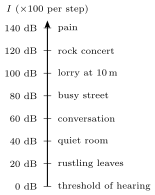
— the threshold of hearing at 1kHz, corresponding in air to the pressure amplitude p0≈2×10⁻⁵Pa (rms) =2×10⁻¹⁰ atmospheres. Doubling the intensity adds 3dB; ten times, 10dB; a hundred times the pressure amplitude, 40dB. Quiet room 30dB, conversation 60dB, busy street 80dB, rock concert 110dB, pain 120dB (I=1W/m2, pm=29Pa).
Example 7.6(How small a sound is)
At the threshold, 1kHz: pm=2.8×10⁻⁵Pa, vm=pm/Z=7×10−8m/s, and the displacement amplitude ξm=vm/ω=1×10−11m — a tenth of an atomic diameter: the eardrum detects motions smaller than an atom. At 120dB, ξm=11µm, still invisible, and pm/P0=3×10−4: even the loudest sounds are tiny perturbations, which is why the linear theory works so well.
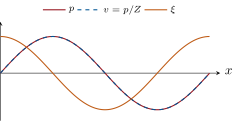
Left: in a plane progressive sound wave the overpressure and the fluid velocity are in phase, and the displacement lags by a quarter period. Right: the decibel scale — each 20dB step multiplies the intensity by a hundred and the pressure amplitude by ten.
7.3 Spherical waves
Proposition 7.7(Spherical waves and the inverse-square law)
A small source radiating equally in all directions produces the spherical wave
p(r,t)=rAf(t−cr),
whose amplitude falls as 1/r and whose intensity falls as 1/r2: for a source of acoustic power P, I=P/4πr2, i.e. −6dB each time the distance doubles. Far from the source the wave is locally plane, with v=p/Z radial.
Proof. In spherical coordinates, for a function of r alone, Δp=r1∂r2∂2(rp) (admitted; Chapter 11), so u=rp obeys the one-dimensional wave equation∂r2u=∂t2u/c2, whence u=Af(t−r/c) for the outgoing wave. The power crossing a sphere of radius r is 4πr2I, constant if nothing is absorbed. ∎
Example 7.8(A siren, a conversation)
A 10W siren: I=10/4πr2, 0.8W/m2 at 1m (119dB, pain), 79dB at 100m, 59dB at 1km — still audible over the city. A voice radiates about 10µW: 60dB at 1m, and 40dB at 10m. Air absorbs sound too (more at high frequency, a few decibels per hundred metres at 10kHz), which is why distant thunder rumbles low.
7.4 The Doppler effect
Theorem 7.9(Doppler effect)
A source emits at frequency f and moves at speed vs along the line joining it to an observer who moves at vo, both speeds counted positive when they approach each other; the sound travels at c in the air at rest. The observer receives the frequency
f′=fc−vsc+vo.
A moving source crowds its wavefronts ahead of it (λ′=(c−vs)/f) and spreads them behind; a moving observer meets wavefronts at the rate (c+vo)/λ. For vs,vo≪c both give Δf/f≈(vs+vo)/c.
Proof. Moving source: the wavefronts emitted at t and t+1/f are separated by c/f−vs/f in the direction of motion, so the wavelength ahead is λ′=(c−vs)/f and the frequency received by a fixed observer is c/λ′. Moving observer: the wavelength is λ=c/f but fronts pass at the relative speed c+vo. Combine. ∎
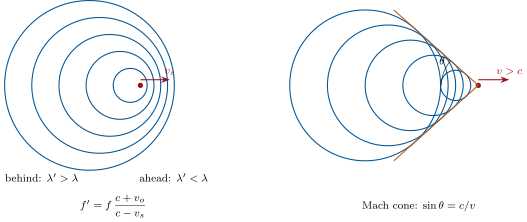
Left: the wavefronts of a moving source crowd ahead and spread behind — higher pitch approaching, lower receding. Right: a source faster than sound leaves its wavefronts behind; their envelope is the Mach cone, heard on the ground as a boom.
Example 7.10(Sirens, radar guns, red cells)
An ambulance siren at 700Hz passing at 25m/s: 755Hz approaching, 651Hz receding — a drop of a sixth of an octave, the familiar "nee-naw" dip. A police radar gun measures the same effect on a 24GHz radio wave reflected by a car (the wave is shifted twice, by the car receiving and re-emitting): Δf=2fv/c=4.8kHz at 30m/s. An ultrasound probe at 5MHz aimed at an artery hears the blood cells at Δf=2fvcosθ/c≈1.6kHz for 0.5m/s at 60∘: an audible whistle whose pitch is the blood speed. And the spectral lines of a receding galaxy are shifted red by Δλ/λ=v/c — the formula holds for light at low speed, with the relativistic correction beyond.
Remark 7.11(Supersonic)
When vs>c the formula breaks down (f′<0 ahead): no sound precedes the source. The wavefronts emitted along the path have a conical envelope of half-angle θ with sinθ=c/vs (the Mach cone); the pressure jump carried by the cone is the sonic boom, which reaches a listener on the ground only after the aircraft has passed — at Mach 2 and 10km of altitude, θ=30∘ and the boom arrives 10km/tanθ/vs≈25s after the overhead passage. A bullet’s crack and the tip of a whip are the same cone.
Method 7.12(Orders of magnitude in acoustics)
Given a sound levelL: I=I010L/10; then pm=2ZI, vm=pm/Z, ξm=vm/ω; the power of a source is 4πr2I if it radiates in all directions (twice less over a hard floor, which reflects into a half-space). Going from r1 to r2 changes L by 20log10(r1/r2). Adding n incoherent equal sources adds 10log10n; two coherent sources in phase at a point add 6dB.
7.5 Exercises
Exercise 7.1★
Speed of sound in air (γ=1.40, M=29g/mol) at 0∘C, 20∘C and at −50∘C (10km altitude); in helium (γ=1.67, M=4g/mol) and carbon dioxide (γ=1.30, M=44g/mol) at 20∘C. Why does a voice sound high-pitched after breathing helium?
Solution
Solution of Exercise 7.1.
c=γRT/M: 331m/s, 343m/s, 299m/s; helium 1010m/s; CO2268m/s. The vocal cords vibrate at the same frequency, but the resonances of the vocal tract (which shape the timbre) scale with c and move up by a factor three: the voice sounds high-pitched.
Exercise 7.2★
A conversation at 60dB, 500Hz: intensity, pressure amplitude, velocity amplitude and displacement amplitude in air (Z=410kgm−2s−1). Same for 120dB. Level of two people talking at once; of a hundred.
A loudspeaker radiates 1.0W of sound equally in all directions. Intensity and level at 1m, 10m, 100m; distance at which the level falls to 60dB; power needed for 100dB at 30m (an open-air concert).
Solution
Solution of Exercise 7.3.
I=1/4πr2: 0.080W/m2 (109dB), 89dB, 69dB; I=10−6 at r=1/4π10−6=280m; 100dB at 30m needs 4π×900×10−2=110W of sound.
Exercise 7.4★
Thunder is heard 4.5s after the flash: distance. A ship’s horn echoes off a cliff after 3.0s: distance. Sonar: an echo from the sea floor returns after 2.4s (c=1500m/s): depth. A 5MHz ultrasound echo returns after 130µs in tissue (1540m/s): depth.
A train horn at 500Hz; c=340m/s. (a) Frequency heard by a person on the platform as the train approaches at 40m/s, and after it has passed. (b) The person is on a train moving toward the horn at 40m/s, the horn at rest; then both moving toward each other at 40m/s: compare with a relative speed of 80m/s and one body at rest. (c) Frequency heard by the driver of the horn’s train from the echo off a wall ahead.
Solution
Solution of Exercise 7.5.
(a) 500×340/300=567Hz; 500×340/380=447Hz. (b) 500×380/340=559Hz; both: 500×380/300=633Hz, against 654Hz (source alone at 80m/s) or 618Hz (observer alone): the air, not the relative speed, sets the result. (c) The wall receives 567Hz and re-emits it at rest; the driver approaches at 40m/s: 567×380/340=633Hz.
Exercise 7.6★★
For a pressure amplitude of 1.0Pa at 1kHz, compute the velocity and displacement amplitudes, the intensity and the level in air, in water (Z=1.5×10⁶kgm−2s−1) and in steel (4×10⁷kgm−2s−1). Same pressure, very different intensities: comment. (Underwater levels are quoted relative to 1µPa: what is 1Pa on that scale?)
Solution
Solution of Exercise 7.6.
vm=pm/Z: 2.4mm/s, 0.67µm/s, 25nm/s; ξm=vm/ω: 390nm, 0.11nm, 4pm; I=pm2/2Z: 1.2×10⁻³W/m2 (91dB), 3.3×10⁻⁷W/m2 (55dB), 1.3×10⁻⁸W/m2 (41dB). A stiff medium barely moves under a given pressure and carries little power. 1Pa is 120dB re 1µPa.
Exercise 7.7★★
(a) Newton’s isothermal speed P0/ρ0 for air at 20∘C (ρ0=1.20kg/m3) and Laplace’s correction. (b) Measured: 343m/s in air, 323m/s in argon (M=40g/mol) at 20∘C: deduce γ for each; interpret with the number of degrees of freedom. (c) Estimate how far heat diffuses in one period at 1kHz (thermal diffusivity of air 2×10⁻⁵m2/s) and compare with the wavelength.
Solution
Solution of Exercise 7.7.
(a) 1.013×10⁵/1.2=290m/s; ×1.4: 343m/s. (b) γ=c2M/RT: 1.40 for air, 1.71 for argon (5/3 within the rounding): three translational degrees of freedom (γ=1+2/3) against five for a diatomic gas (1+2/5). (c) D/f=2×10−8=0.14mm≪λ=34cm: no heat flows between crests and troughs.
Exercise 7.8★★
Organ pipes. In a pipe the overpressure is zero at an open end and the velocity is zero at a closed end. (a) Standing waves in a pipe open at both ends: show the modes are fn=nc/2L; in a pipe closed at one end, fn=(2n−1)c/4L. (b) Lengths for a 440Hz fundamental in each case. (c) Which harmonics does each pipe contain? (d) The real open end sits about 0.6 radius beyond the pipe (end correction): for a 4cm pipe, the correction on L and on f.
Solution
Solution of Exercise 7.8.
(a) Open–open: p=pmsinkxcosωt with kL=nπ; closed–open: p=pmcoskxcosωt (velocity node, pressure antinode at the closed end) with kL=(2n−1)π/2. (b) L=c/2f=39cm; c/4f=19.5cm. (c) All harmonics; odd harmonics only (the clarinet’s hollow sound). (d) 0.6×2=1.2cm per open end: Leff=41.4cm, f=414Hz, 6% flat — the pipe must be cut to 36.6cm.
Exercise 7.9★★
A 2.0kW electric siren converts 20% of its power into sound radiated into a half-space (it sits on a roof). (a) Intensity, level and pressure amplitude at 100m. (b) Distance of the pain threshold (120dB); of the 70dB contour where it stops being alarming. (c) Air absorption adds 1dB per 100m at its frequency: distance of the 70dB contour now (solve numerically). (d) How many such sirens cover a city of 10km radius?
Energy of a standing sound wave. In a closed tube of length L the overpressure is p=pmcos(kx)cos(ωt), k=nπ/L. (a) Find v(x,t) from the linearized Euler equation. (b) Kinetic and potential energy densities; show that they oscillate in quadrature in time and are shifted by a quarter wavelength in space. (c) Total energy in the tube (section S); check it is constant. (d) Mean intensity: zero everywhere — and yet the energy moves: describe how.
Solution
Solution of Exercise 7.10.
(a) ρ0∂tv=pmksinkxcosωt: v=(pm/Z)sinkxsinωt. (b) ek=21χSpm2sin2kxsin2ωt, ep=21χSpm2cos2kxcos2ωt: one is maximal when the other vanishes, in time and in space. (c) E=S∫0L(ek+ep)dx=41χSpm2SL, constant. (d) I=pv=(pm2/4Z)sin2kxsin2ωt: zero mean, but twice per period energy flows from the pressure antinodes to the velocity antinodes and back.
Exercise 7.11★★★
Sonic boom. An aircraft flies horizontally at v=1.6c at altitude h=12km, c=300m/s there. (a) Derive the Mach angle from the envelope of the spherical wavefronts. (b) Time between the overhead passage and the boom on the ground (neglect the variation of c with altitude). (c) Width on the ground of the strip that hears the boom as the aircraft flies by, if the cone’s trace is heard within ±30km of the track: why is supersonic flight over land banned? (d) A rifle bullet at 800m/s: Mach angle; what an observer standing 10m from the trajectory hears, and in what order.
Solution
Solution of Exercise 7.11.
(a) The front emitted at t=0 has radius ct when the source is vt away: the tangent cone has sinθ=c/v. (b) θ=39∘; the cone reaches the ground under the aircraft when it is h/tanθ=15km further: 15000/480=31s after the overhead passage. (c) A 60km-wide carpet along the whole route hears the boom. (d) sinθ=340/800, θ=25∘; the crack of the cone arrives first, the muzzle blast, travelling at c from the gun, later.
Exercise 7.12★★★
Doppler ultrasound. A probe emits at f=5.0MHz into tissue (c=1540m/s); red cells move at v along a vessel making the angle θ with the beam. (a) Frequency received by a cell (moving observer). (b) It re-emits (scatters) this frequency as a moving source: frequency back at the probe; show Δf=2fvcosθ/c for v≪c. (c) Δf for v=0.50m/s, θ=60∘; for θ=90∘ — what does the operator do? (d) The probe can resolve 50Hz: velocity resolution. Why is the Doppler signal made audible rather than displayed only?
Solution
Solution of Exercise 7.12.
(a) f1=f(c+vcosθ)/c. (b) f2=f1c/(c−vcosθ)=f(c+vcosθ)/(c−vcosθ)≈f(1+2vcosθ/c). (c) 2×5×106×0.5×0.5/1540=1.6kHz; zero at 90∘: tilt the probe. (d) Δv=50×1540/(2×5×106×0.5)=1.5cm/s. The ear follows pitch and timbre in real time: a smooth whistle means laminar flow, a hiss means turbulence behind a narrowing.
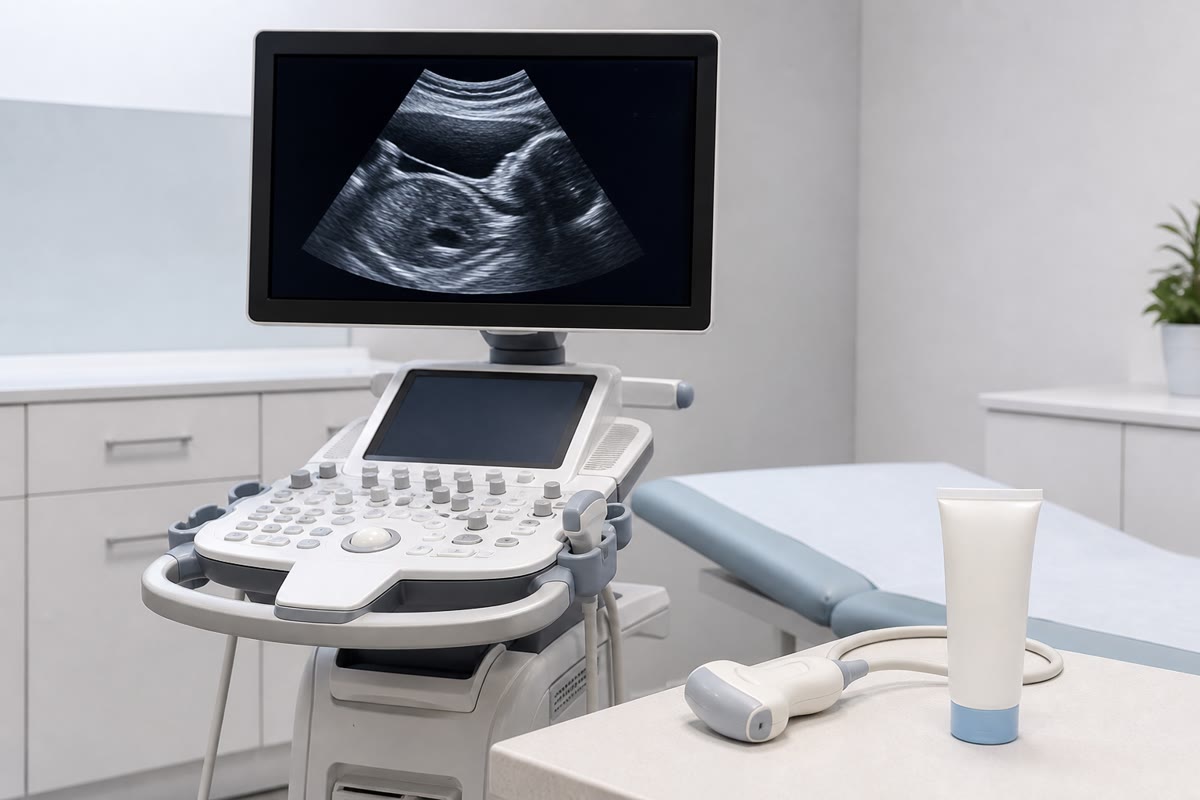
An ultrasound scanner: a few megahertz of sound, timed echoes and the impedance mismatches between tissues draw the image; the gel removes the film of air that would reflect everything.
7.6 Problem: From thunder to the echograph
Problem 7.1
Weekend problem — sound in the open air, in a concert hall, inside the body and from a passing siren
Air: γ=1.40, M=29g/mol, Z=410kgm−2s−1 at 15∘C; R=8.31J/(molK).
Part I — The storm.
Speed of sound at 15∘C and at 30∘C; justify the rule "three seconds per kilometre".
Thunder arrives 4.0s after the flash: distance of the strike. The thunder lasts several seconds although the flash is instantaneous: why?
Near the strike the level reaches 120dB: pressure amplitude and velocity amplitude of the air.
Energy received per square metre of wall during a thunderclap of 2s at 120dB.
On a clear night the ground cools and the air is colder below than above. Sound rays obey Snell’s law between layers, sini/c= const: do rays launched upward bend down or up? Why are distant sounds heard so well at night and over water?
By day, the reverse: a listener at 3km hears nothing. Estimate the angle by which a horizontal ray has bent after 3km if c falls by 1% per 500m of altitude (treat the bending as uniform: the ray is a circle).
Air absorbs high frequencies far more than low ones: why does distant thunder rumble while a nearby strike cracks?
Part II — The concert. A loudspeaker receives 100W of electrical power and converts 2% of it into sound, radiated equally into the half-space in front of it.
Acoustic power; intensity and level at 10m.
Pressure amplitude there; velocity and displacement amplitudes at 100Hz.
Level at 1m (is it safe?) and distance at which the music falls to 60dB.
Ten identical loudspeakers spread around the stage, not in phase: level at 10m. Two loudspeakers fed in phase, at the same distance from a listener on their axis: level there.
The hall (volume 10000m3) has 2000m2 of walls and audience that absorb 30% of the sound hitting them: estimate the acoustic energy stored in the hall at equilibrium and the reverberation time (time for the level to drop 60dB after the music stops), using the balance between the power emitted and the power absorbed (Iwall≈ce/4 for a diffuse field, admitted).
Part III — The echograph. Soft tissue: c=1540m/s, Z=1.6×10⁶kgm−2s−1; bone Z=7×10⁶kgm−2s−1; air 400kgm−2s−1. At normal incidence the pressure amplitude reflected at an interface is r=(Z2−Z1)/(Z2+Z1) times the incident one (derived in Chapter 15); tissue attenuates sound by about 0.5dB per centimetre and per megahertz.
Wavelength in tissue at 3MHz, 5MHz, 10MHz; the smallest detail each can resolve is about one wavelength.
Echo delay from an organ 12cm deep; maximum rate at which pulses can be sent without confusing echoes; time to build an image of 200 lines.
Fraction of the pressure, and of the energy, reflected at a tissue–air interface; at a tissue–bone interface; between fat (Z=1.38×10⁶kgm−2s−1) and muscle (1.70×10⁶kgm−2s−1). Why the gel, and why bones cast shadows?
At 5MHz the beam crosses 2cm of fat before meeting muscle: fraction of the emitted energy that comes back to the probe from that interface (reflection and round-trip attenuation), in decibels.
Round-trip attenuation in decibels for the organ of question 12 at each of the three frequencies; if the scanner can handle 80dB of loss, which frequencies work? State the resolution versus depth trade-off.
The probe emits pulses of 1µs at 5MHz: how many wavelengths long is a pulse, and how does that limit the depth resolution?
Doppler mode at 5MHz on an artery at 0.40m/s, beam at 60∘: shift; what the operator hears.
Part IV — The siren.
An ambulance passes at 90km/h with a 700Hz siren: frequencies heard approaching and receding; the interval between them in semitones (a semitone is a ratio 21/12).
The listener is in a car going at 15m/s toward the approaching ambulance: frequency heard.
At what instant does a listener on the pavement hear exactly 700Hz?
The ambulance’s wavefronts ahead of it: wavelength; speed of the sound relative to the ambulance ahead and behind.
A radar gun at 24GHz reads a 3.2kHz shift from a car: speed of the car (the wave is shifted twice).
Sum up: the six speeds of this problem (sound in air, in tissue, the ambulance, the car, the red cells, light) and the one formula that handles them all.
Solution
Solution of Problem 7.1.
1.c=1.4×8.31×288/0.029=340m/s; 349m/s at 30∘C. 1km in 2.9s.
2.1.4km. The channel is kilometres long; the sound of its different parts arrives over seconds, with echoes from clouds and ground.
3.I=1W/m2: pm=2ZI=29Pa, vm=7cm/s.
4.It=2J/m2.
5.c grows upward; sini/c constant makes i grow, so the ray bends toward the horizontal and back down: sound is channelled along the ground and carries far. Over water the lowest air is cooled by the water: the same.
6. The rays bend upward, leaving a shadow zone. Radius of curvature R=c/(dc/dz)=50km: after 3km the ray has turned by 3/50=0.06rad=3.4∘ and risen 90m: the listener is below it.
7. Absorption grows as f2: the crack’s high frequencies are gone after a few kilometres, the low rumble remains.
10.+20dB: 115dB at 1m — damaging within minutes. 60dB: r=2/2π10−6=560m.
11. Ten incoherent: +10dB, 105dB. Two in phase: the pressure doubles, +6dB, 101dB.
12. Balance P=αAce/4: e=8/(0.3×2000×340)=3.9×10−5J/m3, E=eV=0.4J. After the stop, dE/dt=−(αAc/4V)E: τ=4V/αAc=0.20s, and 60dB takes τln106=2.7s (Sabine’s reverberation time).
13.λ=c/f: 0.51mm, 0.31mm, 0.15mm.
14.2×0.12/1540=156µs; 6.4kHz; 200 lines in 31ms (thirty images a second).
15. Tissue–air: r=−0.9995, 99.9% of the energy reflected — hence the gel, which removes the air film. Tissue–bone: r=0.63, 40% of the energy; the rest is absorbed by the bone, which casts a shadow. Fat–muscle: r=0.10, 1% of the energy: the faint echoes the image is made of.
16. Reflected fraction 1.1% (−20dB); round trip 4cm at 5MHz: −10dB; in all −30dB, one thousandth.
17. Round trip 24cm: 36dB, 60dB, 120dB: 3MHz and 5MHz work, 10MHz does not — deep organs are imaged at low frequency with coarse resolution, superficial ones at high frequency finely.
18. Five wavelengths, 1.5mm long: two interfaces closer than about 0.8mm (half the pulse) give overlapping echoes.
19.2×5×106×0.4×0.5/1540=1.3kHz: a whistle whose pitch rises and falls with each heartbeat.
20.v=25m/s: 700×340/315=756Hz, 700×340/365=652Hz; ratio 1.16, 12log21.16=2.6 semitones.
21.700×355/315=789Hz.
22. At closest approach, when the ambulance’s velocity is perpendicular to the line of sight (strictly, when the sound now arriving was emitted at that point).
23.λ′=(340−25)/700=0.45m (against 0.49m); the sound recedes from the ambulance at 315m/s ahead and 365m/s behind.
24.v=cΔf/2f=3×108×3200/4.8×1010=20m/s=72km/h.
25.340m/s, 1540m/s, 25m/s, 20m/s, 0.4m/s, 3×10⁸m/s: f′=f(c+vo)/(c−vs), applied once or twice, and for light at low speed.