 Coach
CoachA motion is uniform when it covers equal distances in equal times — the steady walk of a metronome listener, the cruise of a train between stations. It is varied when the pace changes: speeding up (the sprinter off the blocks), slowing down (the bus braking), or both by turns (city traffic’s endless stop and go).
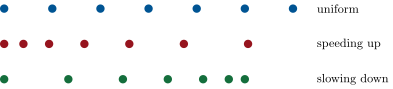
Examples
Example 40.7 (Speed by proportionality)
A tram in uniform motion covers in minutes. What speed is that, in the familiar kilometres-per-hour? Proportionality answers without any new machinery: an hour is three helpings of minutes, so the tram covers in one hour — its speed is kilometres per hour. In a table:
| minutes | ||
|---|---|---|
| kilometres |
Uniform motion is proportionality between distance and time — your mathematics course and your physics course have just shaken hands.