Primary & Middle School Physics · Grades 1–9
40Describing Motion: Trajectory and Speed
A falling leaf, a high-speed train, a carousel horse, a penalty kick: the world never sits still. To study motion, physics asks two tidy questions of every moving thing: along what path? and how fast along it? Path and pace — trajectory and speed — are this chapter’s pair of spectacles.
40.1 Trajectory: the path taken
Definition 40.1 (Trajectory)
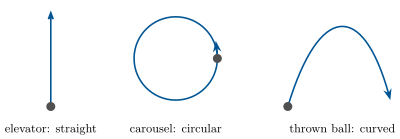
The trajectory of a moving object is the line traced by its journey — the path it draws through space. Three shapes cover most of everyday life: straight (the elevator, the falling apple), circular (the carousel horse, the tip of a clock hand), and curved in freer ways (the thrown ball’s arch, the swallow’s swoop).
Example 40.2 (Whose trajectory?)
Be careful to name which point you follow. The carousel horse’s nose draws a circle; the whole carousel’s center draws nothing at all — it stays put. A rolling wheel’s hub glides in a straight line while a point on its rim traces graceful hops. One machine, many trajectories: physics follows one point at a time.
Remark 40.3 (Moving compared to what?)
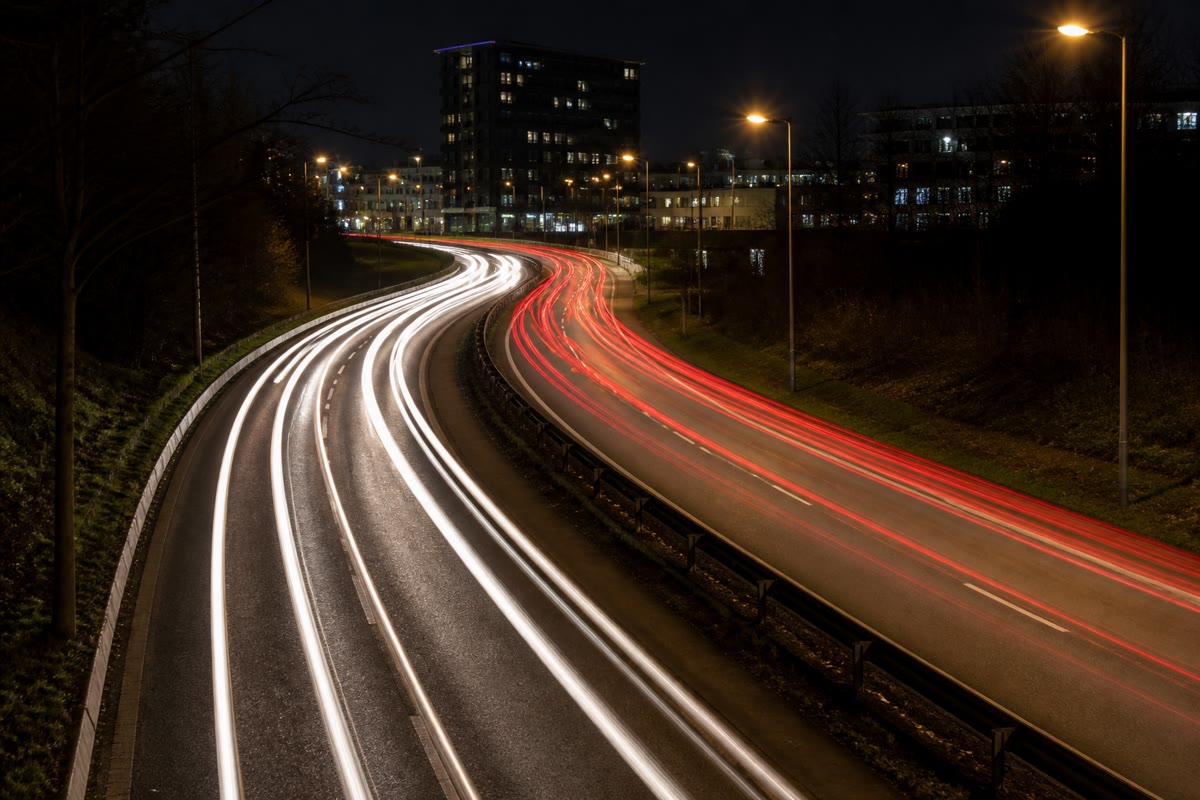
A passenger dozing on the train draws no trajectory at all for the passenger opposite — and a hundred-kilometre line across the map for a cow watching from the field. Both descriptions are honest: motion is always motion compared to something, and the describer must say what. For now we quietly compare everything to the ground; the full power of choosing other viewpoints is a celebrated story kept for the High School volume.
40.2 Uniform or varied?
Definition 40.4 (Uniform and varied motion)
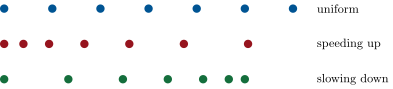
A motion is uniform when it covers equal distances in equal times — the steady walk of a metronome listener, the cruise of a train between stations. It is varied when the pace changes: speeding up (the sprinter off the blocks), slowing down (the bus braking), or both by turns (city traffic’s endless stop and go).
Proposition 40.5 (Reading the dotted film)
Photograph a moving object at equal ticks of time — many quick snapshots on one image — and its motion signs its own name in dots:
- dots evenly spaced: uniform motion;
- dots spreading apart along the way: speeding up;
- dots crowding together: slowing down.
Equal times sit between every pair of dots, so the gaps between dots compare the distances — the whole diagnosis at a glance.
Method 40.6 (Making a dotted film)
Any phone camera can produce these portraits:
- film the moving object — a friend cycling past, a ball rolling off a ramp — holding the camera still;
- step through the video, pausing at equal steps (every half-second of playback, say);
- at each pause, mark the object’s position on a tracing over the screen, or note it against fence posts in the background;
- lay out your marks in a row and read them with Proposition 40.5.
One warning from the professionals: hold the camera still — a drifting camera adds its own motion to the film and muddles whose trajectory is whose (exactly the warning of Remark 40.3).
40.3 Putting numbers on the pace
Example 40.7 (Speed by proportionality)
A tram in uniform motion covers in minutes. What speed is that, in the familiar kilometres-per-hour? Proportionality answers without any new machinery: an hour is three helpings of minutes, so the tram covers in one hour — its speed is kilometres per hour. In a table:
| minutes | ||
|---|---|---|
| kilometres |
Uniform motion is proportionality between distance and time — your mathematics course and your physics course have just shaken hands.
Example 40.8 (The pace board)
Everyday paces, for judging any answer: strolling, about kilometres per hour; brisk walking, ; easy cycling, ; a city bus with stops, ; a car on the open road, ; a high-speed train, up to . When a calculation hands you a walker doing kilometres per hour, the pace board sends it back.
Remark 40.9 (Speed at an instant)
A varied motion has no single speed — the braking bus is fast, then slow, then still. A car’s speedometer needle answers a subtler question: how fast right now? Defining that now-speed precisely is genuinely deep — it needs mathematics you will meet in the last year of high school, and it opened one of the greatest chapters in all of science. For this year: uniform motions get one honest number; varied motions get a story.
40.4 Exercises
Exercise 40.1 ★
Give the trajectory’s shape: a raindrop down a still windowpane; the tip of the minute hand; a basketball’s shot toward the hoop; a skier’s slalom.
Solution
Solution of Exercise 40.1.
Straight (down the pane); circular; curved (an arch); curved (a weaving S-line).
Exercise 40.2 ★
On a rolling bicycle, what trajectory does the hub of the wheel draw? And the valve on the rim? (One word and one sketch each.)
Solution
Solution of Exercise 40.2.
The hub: a straight line, gliding parallel to the road. The valve: a curve of graceful hops — rising, arching, touching down with each turn of the wheel.
Exercise 40.3 ★
Uniform or varied: a train cruising between stations; the same train pulling away from the platform; a parachutist drifting down at a steady rate; a puck sliding and slowing on rough ice?
Solution
Solution of Exercise 40.3.
Uniform; varied (speeding up); uniform; varied (slowing down).
Exercise 40.4 ★
A dotted film shows gaps of , , , between snapshots. Diagnose the motion. Another shows , , , : diagnose that one.
Solution
Solution of Exercise 40.4.
Equal gaps: uniform motion. Growing gaps (): speeding up — more distance in each equal tick.
Exercise 40.5 ★
Why must the camera hold still when making a dotted film? Which remark of the chapter is at stake?
Solution
Solution of Exercise 40.5.
A drifting camera adds its own motion to the record — the dots then mix the object’s journey with the camera’s. Motion is always motion compared to something, and the film must fix its “something”: the remark on viewpoints.
Exercise 40.6 ★
A ferry in uniform motion covers in minutes. Build the proportionality table and give its speed in kilometres per hour.
Exercise 40.7 ★
A cyclist claims a steady kilometres per hour. How far do they ride in minutes? In minutes? (Tables, not formulas.)
Solution
Solution of Exercise 40.7.
min ; min ; min .
Exercise 40.8 ★
Against the pace board of Example 40.8, judge these claims: a stroller covering in one hour; a city bus covering in minutes; a high-speed train covering in minutes.
Solution
Solution of Exercise 40.8.
A stroller at kilometres per hour: rejected — three times the strolling pace. The bus: km in min is kilometres per hour — exactly city-bus pace, accepted. The train: km in min is kilometres per hour — top-of-the-board but plausible for a high-speed train: accepted.
Exercise 40.9 ★★
The dozing passenger of Remark 40.3: describe their motion — trajectory and pace — first for the passenger opposite, then for the cow in the field. Why are both descriptions honest?
Solution
Solution of Exercise 40.9.
For the passenger opposite: no motion at all — no trajectory, pace zero. For the cow: a long straight trajectory at the train’s full pace. Both honest: each describes the dozer compared to their own viewpoint, and motion is always motion compared to something.
Exercise 40.10 ★★
A metro line runs end to end. The timetable allows minutes including six one-minute station stops. During the actual riding time, is the metro’s average pace above or below kilometres per hour? (Find the riding time first, then use a table.)
Solution
Solution of Exercise 40.10.
Riding time: minutes for . Table: min km, so min km — exactly kilometres per hour: neither above nor below, but spot on.
Exercise 40.11 ★★
Design a dotted film to settle a family argument: does the dog run at a steady pace when fetching, or sprint-and-coast? List your steps, what you will measure, and what verdict each pattern of dots would give.
Solution
Solution of Exercise 40.11.
Film the fetch with a still camera; pause every half-second; mark the dog’s positions against fence posts; measure the gaps. Even gaps throughout: steady pace. Gaps that spread, then shrink (or alternate wide and narrow): sprint-and-coast. The dots deliver the verdict, whatever the family shouted.
Exercise 40.12 ★★★
A ball rolls off a table’s edge. Sketch its trajectory from table-edge to floor as seen by someone standing in the room. Then argue — viewpoints again! — what trajectory a tiny observer riding a cart that rolls under the falling ball at just the ball’s forward pace would see. (One of the two sees a curve; the other, something far simpler. This puzzle returns, solved, in the High School volume.)
Solution
Solution of Exercise 40.12.
From the room: a curve — the ball arches forward and down from the table edge to the floor. From the little cart rolling at the ball’s forward pace: the ball keeps no lead and no lag — it appears to fall straight down. Same fall, two viewpoints, and the simpler view belongs to the moving observer: a seed of a great idea.
40.5 Problem: The Dotted Film of Line 7
Problem 40.1
Weekend problem — a transit engineer reads the dotted films of a tram line; diagnosing the ride, timing the line, catching the timetable’s lie
A transit engineer has filmed tram runs with a roadside camera that marks the tram’s position at every tick (one tick seconds), and hands you the films.
Part I — Reading the films. Film A, between two stations, shows gaps (in metres): .
- Diagnose the motion on film A.
- How far did the tram travel during film A’s seconds?
- Film B, leaving a station, shows gaps . Tell the ride’s story in words.
- On film B, during which tick-intervals is the motion (nearly) uniform?
Part II — The line’s true pace.
- On its uniform stretch, the tram covers every seconds. Build the table up to one minute: how far per minute?
- Continue to the hour: what is the tram’s cruising speed in kilometres per hour?
- The whole line is . At cruising speed without stops, how many minutes end to end?
- The timetable allows minutes end to end. How many minutes does the real line lose to stations, red lights and slow zones altogether?
Part III — The advertisement on trial. The company’s poster boasts: “Line 7 — clear across town at kilometres per hour, twice a walker’s best!”
- Check the poster’s arithmetic against the timetable: in minutes — build the table toward one hour. Is “ kilometres per hour” honest for the whole journey?
- A pedant objects: “No number of that kind is ever on the speedometer — the tram is either cruising at or standing at !” Explain what a whole-journey speed really describes, and why it is still the fair number for a journey of many paces.
- The engineer proposes skipping two stations to save four minutes. What would the new end-to-end time be, and — table again — the new whole-journey speed in kilometres per hour? (Round sensibly.)
- Write the engineer’s one-sentence report: which number should commuters trust for planning, the cruising speed or the whole-journey speed, and why?
Solution
Solution of Problem 40.1.
1. Equal gaps of : uniform motion. 2. . 3. The tram pulls away from rest: short gaps growing — speeding up over the first three ticks — then settling to steady gaps: cruising. 4. The last two intervals, at each. 5. s , so s per minute. 6. min : cruising speed kilometres per hour. 7. Table: per min, so in minutes. 8. minutes lost to stops and slow zones. 9. min , so min : the whole journey runs at about kilometres per hour — the poster’s is honest only for the cruising stretches, not “clear across town”. 10. A whole-journey speed describes the trip as if it were uniform: the one steady pace that would cover the same in the same minutes. No speedometer shows it, yet it is the fair number for planning, because it already contains every stop and slow zone. 11. minutes; per hour — call it about . 12. For example: “Commuters should plan by the whole-journey speed — about kilometres per hour today — because it is the only number that includes the waiting; the cruising flatters the line and misses every stop.”