
Physics · Glossary

What is Vapour-compression cycle?

Definition 24.16 University Physics — Year 1 · Chapter 24 — Heat Engines and Machines

Almost every refrigerator, freezer, air conditioner and heat pump runs a refrigerant round four components: a compressor (receives the work, raises the pressure of the vapour), a condenser (the hot vapour liquefies at high pressure, releasing Qh|Q_h| to the hot side), an expansion valve (the liquid drops to low pressure without work or heat, and partly flashes to vapour) and an evaporator (the rest boils at low pressure, absorbing QcQ_c from the cold side). The heat is carried as latent heat of vaporization, and the two pressures set the two boiling temperatures (Chapter 25).
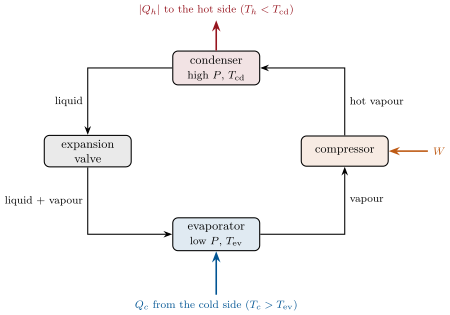
The vapour-compression cycle. The refrigerant boils in the evaporator, colder than the cold side, and condenses in the condenser, hotter than the hot side: heat flows the natural way across each exchanger, and the compressor pays for lifting it from T_ ev to T_ cd.
The vapour-compression cycle. The refrigerant boils in the evaporator, colder than the cold side, and condenses in the condenser, hotter than the hot side: heat flows the natural way across each exchanger, and the compressor pays for lifting it from TevT_{\mathrm{ev}} to TcdT_{\mathrm{cd}}.
Read in context →