A car engine, a power station, a refrigerator and a heat pump are the same object seen from four sides: a fluid taken round a cycle, in contact by turns with a hot source and a cold one, exchanging heat with both and work with a shaft. The first law bookkeeps the energy; the second law, through the entropy balance over one cycle, sets the limit that no cleverness can beat — Carnot’s theorem, the most consequential inequality of engineering. This chapter derives that limit, computes the ideal cycle and the real ones that approach it (Otto, Diesel, Stirling), turns the machine round to make cold and to heat houses, and shows how the created entropy of a real machine is paid for, joule by joule, in lost work.
24.1 Cyclic machines and the two laws
Definition 24.1(Thermodynamic machine)
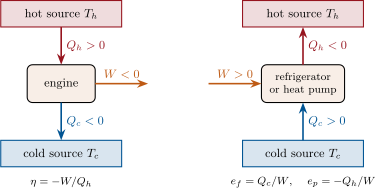
A thermodynamic machine is a closed system (the working fluid) taken round a cycle, so that it returns periodically to the same state, while exchanging work W with the outside and heat Qi with sources at temperatures Ti — thermostats, whose temperature the exchange does not change. A ditherm machine uses two thermostats, the hot source at Th and the cold source at Tc<Th. It is an engine if it delivers work (W<0), a refrigerator if it is driven (W>0) to take heat from the cold source, a heat pump if it is driven to give heat to the hot one. All quantities are reckoned over one cycle, algebraically, as received by the fluid.
Theorem 24.2(The two laws over a cycle; Clausius inequality)
Over one cycle of a ditherm machine,
W+Qh+Qc=0,ThQh+TcQc=−Screated≤0,
with equality in the second relation if and only if the cycle is reversible. More generally, for any number of thermostats, ∑iQi/Ti≤0 (Clausius inequality).
Proof.U and S are state functions, so ΔU=0 and ΔS=0 over a cycle. The first law gives 0=W+Qh+Qc; the entropy balance (Theorem 23.1) gives 0=Sexch+Screated with Sexch=∑Qi/Ti because each thermostat exchanges at its own fixed temperature (Proposition 23.5). ∎
Corollary 24.3(Kelvin again)
A monotherm machine (Qc=0) has Qh≤0, hence W≥0: no cycle can convert the heat of a single source into work. A ship cannot sail by cooling the sea — an engine needs a cold source to reject heat to, and the second law says how much it must reject.
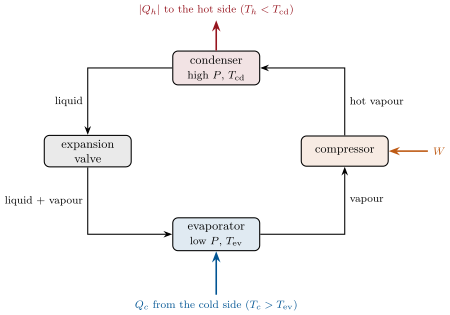
The two ways round a ditherm cycle. Left: the engine takes heat from the hot source, rejects part of it to the cold one and delivers the difference as work. Right: the same machine driven backward pumps heat from cold to hot; it is a refrigerator if one wants Qc, a heat pump if one wants ∣Qh∣.
24.2 Carnot’s theorem
Definition 24.4(Efficiency and coefficients of performance)
The efficiency of an engine is the work delivered per unit heat taken from the hot source, η=−W/Qh; the coefficient of performance (COP) of a refrigerator is the cold produced per unit work, ef=Qc/W; that of a heat pump is the heat delivered per unit work, ep=−Qh/W. Each is the ratio “what one wants” over “what one pays”; an efficiency is at most 1, a COP can exceed 1.
with equality if and only if the cycle is reversible. The bounds depend on the temperatures only — not on the fluid, not on the mechanism.
Proof. For an engine (Qh>0): η=−W/Qh=(Qh+Qc)/Qh=1+Qc/Qh, and the Clausius inequality gives Qc/Qh≤−Tc/Th. For a refrigerator (Qc>0, W>0): W=−Qh−Qc with −Qh≥QcTh/Tc, so W≥Qc(Th/Tc−1) and ef=Qc/W≤Tc/(Th−Tc). For the heat pump, ep=−Qh/W=(W+Qc)/W=1+ef. Equality is the reversible case Screated=0 throughout. ∎
Example 24.6(Three numbers)
A steam turbine between Th=800K and a river at Tc=300K: ηC=0.625; real plants reach about 0.40. A domestic refrigerator between 275K inside and a kitchen at 298K: ef≤275/23=12; real machines give 2 to 4. A heat pump warming a house at 293K from air at 273K: ep≤293/20=14.7; real pumps give 3 to 5 — still three to five times what the same electricity would give in a resistor (Problem 24.1).
Remark 24.7(Why the efficiency cannot be 1)
An engine receives entropy Qh/Th with the heat it takes in; work carries none away; the only exit is heat rejected to the cold source, which carries ∣Qc∣/Tc. Entropy being uncreatable, at least QhTc/Th of heat must be thrown away, and the work is what is left. The lower the cold source and the higher the hot one, the better — hence the cooling towers, and the quest for ever hotter turbine blades.
24.3 The Carnot cycle
Definition 24.8(Carnot cycle)
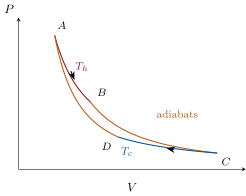
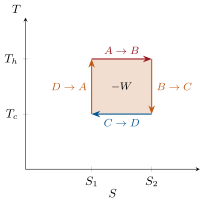
The Carnot cycle is the reversible ditherm cycle: two reversible isotherms, at Th (in contact with the hot source) and at Tc (with the cold one), joined by two reversible adiabatic legs (isentropic, with no source in contact). Run clockwise in the (V,P) plane it is an engine; counterclockwise, a refrigerator or heat pump. In the entropy diagram it is a rectangle.
Proposition 24.9(Carnot cycle of a perfect gas)
For nmoles of perfect gas taken round A→B (isotherm Th, expansion), B→C (adiabat), C→D (isotherm Tc, compression), D→A (adiabat):
the Carnot value — as it must be for any reversible ditherm cycle.
Proof. On an isotherm ΔU=0, so Q=−W=nRTln(Vfinal/Vinitial). On the adiabats TVγ−1 is constant: ThVBγ−1=TcVCγ−1 and ThVAγ−1=TcVDγ−1, whence VC/VD=VB/VA and Qc=nRTcln(VD/VC)=−nRTcln(VB/VA). Then η=1+Qc/Qh=1−Tc/Th. ∎
The Carnot cycle of a perfect gas. Left: in the Clapeyron diagram two isotherms and two (steeper) adiabats, run clockwise; the enclosed area is the work delivered. Right: the same cycle in the entropy diagram is a rectangle of height Th−Tc and width Qh/Th; its area is again −W, and the ratio of that area to the one under the top side, Qh, is 1−Tc/Th by inspection.
Remark 24.10(Carnot’s cycle is a theorem, not an engine)
Reversible isotherms require infinitely slow heat transfer across a vanishing temperature gap: a Carnot engine delivers its maximal work at zero power. Real machines trade efficiency for power by accepting finite temperature differences in their exchangers (Exercise 24.10); the Carnot value remains the ceiling every design is measured against.
24.4 Real engine cycles
Proposition 24.11(Otto cycle)
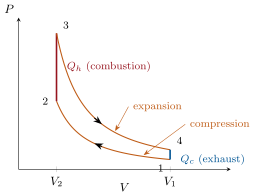
The idealized petrol engine takes air (γ) round: 1→2 adiabatic compression from V1 to V2 (compression ratior=V1/V2); 2→3 isochoric heating (the combustion); 3→4 adiabatic expansion back to V1; 4→1 isochoric cooling (the exhaust). Its efficiency is
ηOtto=1−rγ−11.
Proof. Heat is exchanged only on the isochores: Qh=nCV,m(T3−T2) and Qc=nCV,m(T1−T4). On the adiabats TVγ−1 is constant: T2=T1rγ−1 and T3=T4rγ−1, so T3−T2=(T4−T1)rγ−1 and η=1+Qc/Qh=1−(T4−T1)/(T3−T2)=1−r1−γ. ∎
Example 24.12(Numbers for a petrol engine)
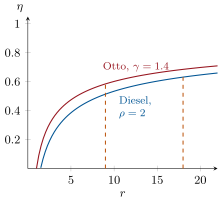
r=9, γ=1.4: 90.4=2.41 and η=0.58. A real engine gives about 0.30: the combustion is not instantaneous, the gas is not perfect at 2500K, heat leaks to the walls, friction and pumping take their share. Raising r helps — until the air–fuel mixture ignites by itself at the end of the compression (knock); the Diesel engine turns that vice into its principle.
Proposition 24.13(Diesel cycle)
Replace the isochoric heating of the Otto cycle by an isobaric one, from V2 to V3=ρV2 (cut-off ratioρ>1): fuel injected into air already hot from a compression ratior of 15 to 22 burns as it arrives. Then
ηDiesel=1−rγ−11γ(ρ−1)ργ−1,
smaller than the Otto value for the same r but reached with much larger r, hence larger in practice (0.40 to 0.45 for big engines).
Proof.Qh=nCP,m(T3−T2), Qc=nCV,m(T1−T4), so η=1−(T4−T1)/[γ(T3−T2)]. With T2=T1rγ−1, T3=ρT2 and, on the adiabat 3→4 (V4=V1=rV2), T4=T3(V3/V4)γ−1=ρT1rγ−1(ρ/r)γ−1=T1ργ: η=1−(ργ−1)/[γrγ−1(ρ−1)]. ∎
Left: the Otto cycle in the Clapeyron diagram (drawn with r=4): two adiabats and two isochores; the heat enters at top dead centre and leaves with the exhaust. Right: ideal efficiencies against the compression ratio; the dashed lines mark a petrol engine (r=9) and a Diesel (r=18, ρ=2).
Proposition 24.14(Stirling cycle and the regenerator)
Two isotherms (Tc, Th) joined by two isochores. The heat of the isochoric legs, ±nCV,m(Th−Tc), is equal and opposite; if it is stored on the cooling leg in a regenerator (a porous mass the gas flows through) and returned on the heating leg, only the isotherms exchange with the sources, and η=1−Tc/Th: the Stirling engine is a Carnot engine in all but the shape of its cycle. Without the regenerator the isochoric heat must come from the hot source and η=nRThln(V1/V2)+nCV,m(Th−Tc)nR(Th−Tc)ln(V1/V2), substantially less (Exercise 24.8).
Proof. On the isotherms Qh=nRThln(V1/V2) and Qc=−nRTcln(V1/V2), so −W=Qh+Qc+0 once the isochoric heats cancel; divide by the heat actually drawn from the hot source in each case. ∎
Remark 24.15(Steam and gas turbines)
Power stations do not use a gas in a cylinder but water boiled, expanded through a turbine, condensed and pumped back (the Rankine cycle, with two phase changes — Chapter 25), or air compressed, heated by combustion and expanded in a gas turbine (the Brayton cycle, two adiabats and two isobars). Their analysis needs the energy balance of a flowing fluid, given in the Year 2 volume; the Carnot bound and the logic of this chapter apply unchanged.
24.5 Refrigerators and heat pumps
Definition 24.16(Vapour-compression cycle)
Almost every refrigerator, freezer, air conditioner and heat pump runs a refrigerant round four components: a compressor (receives the work, raises the pressure of the vapour), a condenser (the hot vapour liquefies at high pressure, releasing ∣Qh∣ to the hot side), an expansion valve (the liquid drops to low pressure without work or heat, and partly flashes to vapour) and an evaporator (the rest boils at low pressure, absorbing Qc from the cold side). The heat is carried as latent heat of vaporization, and the two pressures set the two boiling temperatures (Chapter 25).
The vapour-compression cycle. The refrigerant boils in the evaporator, colder than the cold side, and condenses in the condenser, hotter than the hot side: heat flows the natural way across each exchanger, and the compressor pays for lifting it from Tev to Tcd.
Proposition 24.17(The price of the temperature gaps)
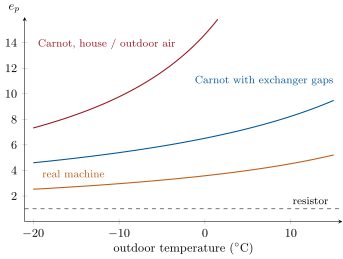
A reversible machine working between its own internal temperatures Tev<Tc and Tcd>Th has ep=Tcd/(Tcd−Tev), smaller than the Carnot value between the sources; a real machine reaches a fraction (typically 0.4 to 0.6) of even that. The performance of a heat pump therefore falls as the outdoor temperature drops and as the temperature demanded by the heating circuit rises.
Proof. Apply Theorem 24.5 to the fluid, whose thermostats are effectively the exchanger temperatures; Tcd−Tev>Th−Tc lowers the ratio. ∎
Coefficient of performance of a heat pump against outdoor temperature: the Carnot bound between house (20∘C) and outdoor air; the bound once the exchanger temperature gaps are counted (Tcd=313K, Tev=Tout−8K); and a realistic machine at 0.55 of the latter. Even at −10∘C the real pump delivers about three joules of heat per joule of electricity, where a resistor gives one.
Example 24.18(Heat pump or resistor?)
A house losing 6kW at −5∘C outdoors needs 6kW of electricity with resistors; an ideal heat pump from 268K to 293K would need 6/11.7=0.51kW; a real one with exchanger temperatures 260K and 313K and a 0.55quality factor, ep=0.55×313/53=3.2, needs 1.9kW. The weekend problem works the season through, entropy included.
24.6 Entropy and lost work
Theorem 24.19(Lost work)
A ditherm engine creating the entropy Screated per cycle delivers
−W=Qh(1−ThTc)−TcScreated,
and a ditherm heat pump delivering ∣Qh∣ consumes W=∣Qh∣(1−Tc/Th)+TcScreated: every joule per kelvin created costs Tc joules of work, the temperature of the cold source being the rate of exchange between entropy and work.
Proof. From Theorem 24.2, Qc=−Tc(Qh/Th+Screated); insert into −W=Qh+Qc. For the pump, write the same two relations with Qh<0. ∎
Method 24.20(Auditing a machine)
Measure (or compute) the heats exchanged with each source and the work; check the first law; compute Screated=−∑Qi/Ti per cycle or per second; the lost power is TcS˙created; locate the creation (finite temperature gaps in exchangers, friction, throttling, non-quasi-static compression) by applying the entropy balance to each component in turn. A component that creates no entropy is not worth improving.
Example 24.21(A power plant’s audit)
Hot source 800K, river 300K, 1.0GW of electricity at η=0.40: Q˙h=2.5GW, Q˙c=1.5GW, so S˙created=1.5/300−2.5/800=1.9MW/K and the lost power is 300×1.9=0.56GW: exactly the gap between the Carnot output 0.625×2.5=1.56GW and the real 1.0GW. The river warms by the 1.5GW it must carry away; in summer, when it is warm and low, plants throttle back.
24.7 Exercises
Exercise 24.1★
A power station takes heat at 800K and rejects it to a river at 300K. Carnot efficiency; if the real efficiency is 0.40 and the electrical output 1.0GW, heat taken from the fuel and heat rejected to the river per second.
Solution
Solution of Exercise 24.1.
ηC=1−300/800=0.625. At 0.40: Q˙h=1.0/0.40=2.5GW from the fuel, Q˙c=2.5−1.0=1.5GW into the river — more heat is thrown away than is sold.
Exercise 24.2★
A refrigerator keeps its interior at 275K in a kitchen at 298K. Maximum coefficient of performance; with a real COP of 3, electrical power needed to remove the 100W that leak in through the walls.
Solution
Solution of Exercise 24.2.
ef≤275/(298−275)=12. With ef=3: P=100/3=33W (and 133W go into the kitchen).
Exercise 24.3★
Ideal efficiency of an Otto cycle with r=9 and γ=1.4; with r=11 (a modern direct-injection engine). Why not r=20?
Solution
Solution of Exercise 24.3.
r=9: 90.4=2.41, η=0.585; r=11: 110.4=2.61, η=0.62. At r=20 the petrol–air mixture, compressed to about 900K, would ignite before the spark (knock), destroying the engine; only the Diesel, which compresses air alone, can go there.
Exercise 24.4★
A heat pump warms a house at 300K from outdoor air at 280K. Maximum ep; electrical power for a 5kW heating demand with that ideal pump and with a real one of ep=3.5; compare with a resistor.
Solution
Solution of Exercise 24.4.
ep≤300/20=15: ideal power 5/15=0.33kW; real, 5/3.5=1.43kW; resistor, 5kW.
Exercise 24.5★★
One mole of perfect gas (γ=1.4) runs a Carnot cycle between Th=500K and Tc=300K; the hot isotherm takes it from 1.0L to 3.0L. Compute VC, VD, Qh, Qc, W and check the efficiency.
An inventor claims a cyclic machine that takes 1000J per cycle from a source at 400K, rejects 800J to a source at 300K and delivers 200J of work. Possible? Entropy created per cycle. A second inventor claims 300J of work from the same 1000J, rejecting 700J. Possible? What is the most work anyone can get from those 1000J?
Solution
Solution of Exercise 24.6.
First claim: energy 200=1000−800 balances; Clausius 1000/400−800/300=2.5−2.67=−0.17J/K, so Screated=0.17J/K≥0: possible (η=0.20). Second: 1000/400−700/300=+0.17J/K>0: entropy would have to be destroyed — impossible. Maximum: ηC=1−300/400=0.25, i.e. 250J.
rγ−1=180.4=3.18; ργ=21.4=2.64: η=1−1.64/(1.4×3.18×1)=0.63. Otto at r=18: 1−1/3.18=0.69; at r=9: 0.585. The Diesel compresses pure air: no fuel is present to pre-ignite, and the fuel, injected into air at 900K, burns as it enters — the knock limit does not exist.
Exercise 24.8★★
Stirling cycle of one mole of diatomic gas (CV,m=25R) between 600K and 300K with a volume ratio V1/V2=2. Work per cycle; efficiency with a perfect regenerator and without one.
Solution
Solution of Exercise 24.8.
Qh=RThln2=8.314×600×0.693=3.46kJ, Qc=−8.314×300×0.693=−1.73kJ: W=−1.73kJ per cycle. With the regenerator η=1.73/3.46=0.50=1−300/600. Without it the hot source must also supply CV,m(Th−Tc)=2.5×8.314×300=6.24kJ: η=1.73/(3.46+6.24)=0.18.
Exercise 24.9★★
Two identical blocks of heat capacity C=4.0kJ/K at T1=400K and T2=300K are used as the sources of an engine until they reach a common temperature Tf. Show that the maximum work is obtained for a reversible engine, that Tf=T1T2 then, and compute Wmax. What would Tf be if the blocks were simply put in contact, and what is the entropy then created?
Solution
Solution of Exercise 24.9.
Entropy of the two blocks: ΔS=Cln(Tf/T1)+Cln(Tf/T2)=Cln(Tf2/T1T2)=Screated≥0 (the engine’s own entropy returns to its value each cycle), so Tf≥T1T2, and W=C(T1+T2−2Tf) (first law) is largest for the smallest Tf: the reversible case, Tf=400×300=346.4K, Wmax=4000×(700−692.8)=29kJ. Direct contact: Tf=350K, no work, Screated=4000ln(3502/120000)=82J/K.
Exercise 24.10★★★
Engine at maximal power. A reversible engine works between internal temperatures x and y, and exchanges heat with the sources through exchangers of conductance K: Q˙h=K(Th−x) and ∣Q˙c∣=K(y−Tc). (a) Write the power P and the entropy condition of the reversible core. (b) Show that y=xTc/(2x−Th) and that P=2K[(Th+Tc)−u−ThTc/u] with u=2x−Th. (c) Maximize over u and show that the efficiency at maximal power is η∗=1−Tc/Th. (d) Numbers for Th=800K, Tc=300K; compare with Exercise 24.1.
Solution
Solution of Exercise 24.10.
(a) P=Q˙h−∣Q˙c∣=K(Th−x)−K(y−Tc); the reversible core exchanges no net entropy: K(Th−x)/x=K(y−Tc)/y. (b) Cross-multiply: y(Th−x)=x(y−Tc), so y(Th−2x)=−xTc and y=xTc/(2x−Th). Then P=K(Th−x)(1−y/x)=K(Th−x)(2x−Th−Tc)/(2x−Th); with u=2x−Th, Th−x=(Th−u)/2 and P=K(Th−u)(u−Tc)/(2u)=2K[(Th+Tc)−u−ThTc/u]. (c) dP/du=2K(−1+ThTc/u2)=0 at u=ThTc, a maximum; then x=(Th+ThTc)/2, y=xTc/u=(ThTc+Tc)/2, and η∗=1−y/x=1−Tc(Th+Tc)/[Th(Th+Tc)]=1−Tc/Th; Pmax=2K(Th−Tc)2. (d) η∗=1−0.375=0.39, against ηC=0.625: the real 0.40 of Exercise 24.1 is an engine built for power, not for efficiency.
Exercise 24.11★★★
Absorption refrigerator. A machine with no moving parts takes the heat Qh from a burner at Th, the heat Qc from a cold chamber at Tc, and rejects heat to the room at T0 (Tc<T0<Th), with no work. Show that Qc/Qh≤(1−T0/Th)Tc/(T0−Tc), interpret the two factors, and compute the bound for Th=400K, T0=300K, Tc=275K.
Solution
Solution of Exercise 24.11.
Cycle: Qh+Qc+Q0=0 and Qh/Th+Qc/Tc+Q0/T0≤0. Eliminate Q0=−(Qh+Qc): Qh(1/Th−1/T0)+Qc(1/Tc−1/T0)≤0, i.e. Qc(T0−Tc)/(TcT0)≤Qh(Th−T0)/(ThT0), whence Qc/Qh≤(1−T0/Th)Tc/(T0−Tc). The first factor is the efficiency of a Carnot engine between burner and room, the second the COP of a Carnot refrigerator between chamber and room: the bound is what one gets by coupling the two ideally. Numbers: 0.25×11=2.75 (real absorption fridges: about 0.6).
Exercise 24.12★★★
Heating with electricity, three ways. Electricity is made in a thermal power station of efficiency0.40. Per joule of fuel heat, how much heat reaches a house (a) through a resistor, (b) through a heat pump of ep=3.5, (c) if the fuel is burned directly in a boiler of efficiency0.90? (d) The ideal: a reversible engine between 800K and 293K driving a reversible heat pump between 273K and 293K — how much heat per joule of fuel, and why is the answer greater than one without contradicting anything?
Solution
Solution of Exercise 24.12.
(a) 0.40J. (b) 0.40×3.5=1.4J. (c) 0.90J. (d) Engine η=1−293/800=0.634, pump ep=293/20=14.65: 0.634×14.65=9.3J (and the engine’s own 0.37J rejected at 293K could warm the house too: 9.7J). More than one joule because the rest is lifted from the outdoor air: energy is conserved, and the second law only asks that entropy not be destroyed, which a reversible chain respects exactly.
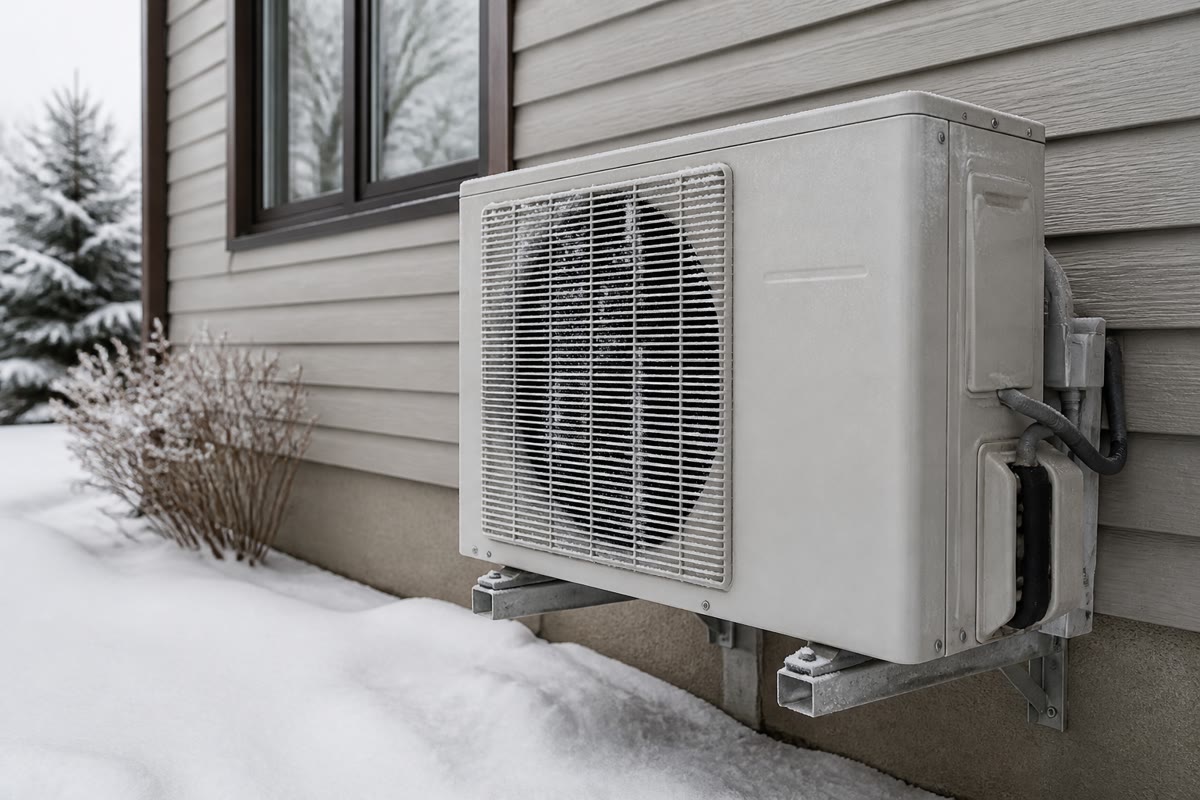
An air-source heat pump in winter: it takes heat from cold outdoor air and delivers three to four times the electrical energy it consumes to the house — the weekend problem.
24.8 Problem: The house heat pump
Problem 24.1
Weekend problem — heating a house through a winter: the bill with resistors, with gas, with an ideal heat pump and with a real one, and where the real one’s electricity goes
A house loses heat at the rate K(Tin−Tout) with K=250W/K; it is kept at Tin=20∘C. Design outdoor temperature −5∘C; heating season: 200 days with a mean outdoor temperature of 7∘C. Prices: electricity 0.25 € per kWh, gas 0.10 € per kWh; 1kWh=3.6MJ.
Part I — The house and the old ways.
Heating power needed at the design temperature.
Energy needed over the season, in joules and in kWh.
The electricity comes from a thermal power station of efficiency0.40. Fuel energy consumed, per season, by the resistors and by the boiler; comment on “electric heating is thermodynamically wasteful”.
Define ep and prove, from the two laws over one cycle, that ep≤Tin/(Tin−Tout).
Ideal ep at the design temperature, and the electrical power then needed.
Ideal ep at the season’s mean temperature, and (taking that value for the whole season) the seasonal electricity.
Explain physically why ep falls when the outdoor temperature falls, and why this is the worst possible behaviour for a heating device.
At the design point the ideal pump draws 0.53kW and delivers 6.25kW: where do the other 5.7kW come from, and why does cooling the cold outdoor air to heat a warm house not violate the second law?
Part III — The real machine. The pump runs a vapour-compression cycle. The refrigerant evaporates at Tev=Tout−8K and condenses at Tcd=313K (the water of a floor-heating circuit runs at 35∘C); the machine achieves 0.55 of the Carnot value computed between Tev and Tcd. Latent heat of the refrigerant: L=200kJ/kg.
Name the four components of the cycle, say in which the fluid receives Qc, gives ∣Qh∣ and receives W, and why the evaporator must be colder than the outdoor air and the condenser hotter than the house.
At the design temperature: Tev, and the Carnot ep between Tev and Tcd.
Real ep, electrical power drawn, and heat taken from the outdoor air, at the design temperature.
Mass flow rate of refrigerant through the evaporator.
Same questions (real ep, electrical power) at the mean temperature of 7∘C, where the house loses 3.25kW.
Give ep as a function of Tout; seasonal electricity and cost, taking the mean-temperature ep for the season. Compare with Part I.
Fuel energy consumed at the power station for the heat-pump season; compare with the resistors and the boiler.
A cold snap at −15∘C: heat demand, real ep, electrical power if the pump could deliver it. The compressor’s capacity actually falls with Tev and the pump can only deliver 3.8kW there: backup resistor power needed, and the meaning of “sizing a heat pump”.
Had the house old radiators needing water at 60∘C (Tcd=338K): real ep and electrical power at the design temperature; conclude on the choice of emitters.
Part IV — Where the electricity goes.
Show that for a heat pump delivering ∣Qh∣ to the house at Tin from outdoor air at Tout, W=∣Qh∣(1−Tout/Tin)+ToutScreated.
At the design point, entropy created per second by the heat transfer across the condenser (from 313K to the house) and across the evaporator (from the outdoor air to 260K).
Electrical power these two temperature gaps cost; fraction of the 1.92kW drawn.
Total entropy created per second by the real machine (compare its 1.92kW with the ideal 0.53kW); share of the exchangers; name the other sources.
Halve the two gaps (4K and 10K): entropy created in the exchangers and electrical power saved; what does halving a gap cost the designer?
Sum up in three numbers: kilowatt-hours of heat per kilowatt-hour of electricity over the season; seasonal cost against gas; and, with electricity at 60g of CO2 per kWh and gas at 200g, the carbon emitted by each route.
Solution
Solution of Problem 24.1.
1.P=250×25=6.25kW.
2. Mean loss 250×13=3.25kW for 200×86400=1.73×10⁷s: E=5.6×10¹⁰J=15600kWh.
3.15600×0.25=3900 €.
4. Gas 15600/0.90=17300kWh: 1730 €.
5.Resistors: 15600/0.40=39000kWh of fuel; boiler 17300kWh: 2.25 times less. Electricity is work, the form that can do anything; turning it into 20∘C heat in a resistor discards the 60% of the fuel already lost at the plant and the possibility of pumping heat.
6. Over a cycle W+Qh+Qc=0 and Qh/Tin+Qc/Tout≤0 with Qh<0, Qc>0: Qc≤∣Qh∣Tout/Tin, so W=∣Qh∣−Qc≥∣Qh∣(1−Tout/Tin) and ep=∣Qh∣/W≤Tin/(Tin−Tout).
7.293/25=11.7; 6.25/11.7=0.53kW.
8.293/13=22.5; 15600/22.5=690kWh (about 170 €).
9. The work per joule lifted is (Tin−Tout)/Tin, the “height” of the lift; the colder it is outside, the higher each joule must be pumped — and the more joules are needed, since the loss is also proportional to Tin−Tout: the electrical power grows as the square of the temperature difference, worst exactly when heating matters most.
10. From the outdoor air, which is cooled: Qc=6.25−0.53=5.7kW. The second law forbids heat flowing spontaneously from cold to hot; here work pays the lift. Check: entropy taken from the air 5.72/268=21.3W/K, entropy given to the house 6.25/293=21.3W/K — nothing destroyed, nothing created: the ideal pump.
11. Compressor (receives W), condenser (gives ∣Qh∣), expansion valve (neither), evaporator (receives Qc). Heat only flows down a temperature slope: the refrigerant must be colder than the air to take heat from it and hotter than the house water to give heat to it.
12.Tev=268−8=260K; ep,C=313/(313−260)=5.9.
13.ep=0.55×5.9=3.25; W=6.25/3.25=1.92kW; Qc=6.25−1.92=4.33kW from the air.
16.ep=0.55×313/(321−Tout)=172/(321−Tout) (Tout in kelvin). Season: 15600/4.2=3700kWh, 930 € — against 3900 with resistors and 1730 with gas.
17.3700/0.40=9300kWh of fuel: 46% less than the boiler and four times less than the resistors, even through a 40% power station.
18. Demand 250×35=8.75kW; Tev=250K, 313/63=5.0, ep=2.7, W=3.2kW if it could. Capacity 3.8kW: backup 8.75−3.8≈5kW of resistors. A pump sized for the coldest hour would be oversized — and cycling inefficiently — all winter; one sizes for the design temperature and lets a cheap resistor cover the rare extreme.
19.338/(338−260)=4.33, ep=2.4, W=6.25/2.4=2.6kW: 36% more electricity than with the floor at 35∘C. Low-temperature emitters are half the installation.
20. Entropy over a cycle: Qh/Tin+Qc/Tout+Screated=0 gives Qc=Tout∣Qh∣/Tin−ToutScreated; insert in W=∣Qh∣−Qc.
23.(1.92−0.53)/268=5.2W/K; the exchangers make 36%; the rest comes from the compressor (friction, non-isentropic compression, motor losses), the throttling in the valve (a free expansion), pressure drops, the fans.
24.Tcd=303K, Tev=264K: condenser 6250(1/293−1/303)=0.70W/K, evaporator 4330(1/264−1/268)=0.25W/K: 0.95W/K instead of 1.86, i.e. 268×0.91≈0.25kW saved (13%; the whole machine, rated at 0.55 of a better Carnot value, would gain more). Halving a gap means doubling the exchange surface: bigger, dearer exchangers and more fan power.
25.15600/3700=4.2 kilowatt-hours of heat per kilowatt-hour of electricity; 930 € against 1730 for gas; carbon: 3700×0.060=220kg against 17300×0.20=3500kg — fifteen times less.