
सभी किताबें

पेशेवर

ऐप्स परिचय Coach लॉग इन पढ़ना शुरू करें

Quantitative Finance · शब्दावली

Asian option क्या है?

Definition 16.1 Derivatives and Volatility · अध्याय 16 — Asians, Lookbacks, Cliquets and Forward-Starts

An Asian option pays on the average of the underlying over a set of fixing dates: the average-rate form pays (Sˉ−K)+(\bar S-K)^+ (the average-price option of One Quant Book 3, chapter 12), and the average-strike form pays (ST−Sˉ)+(S_T-\bar S)^+. The average is arithmetic unless stated.
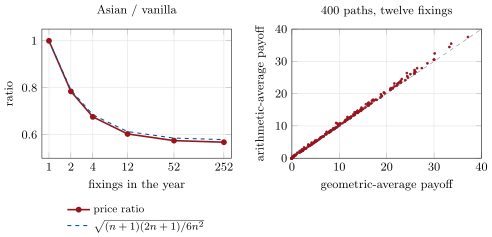
Left: the price of an at-the-money one-year Asian call relative to the vanilla, by the number of fixings, against the volatility factor of the geometric average. Right: the arithmetic and geometric payoffs path by path: nearly the same random variable, which is why the geometric Asian, known in closed form, is an efficient control variate. Data: the tutorial.
Figure 16.1. Left: the price of an at-the-money one-year Asian call relative to the vanilla, by the number of fixings, against the volatility factor of the geometric average. Right: the arithmetic and geometric payoffs path by path: nearly the same random variable, which is why the geometric Asian, known in closed form, is an efficient control variate. Data: the tutorial.

उदाहरण

Example 16.2 (Where the 40% went)

Spot and strike 100, one year, r=3%r=3\%, q=1%q=1\%, volatility 20%. The vanilla call is worth 8.83, and the call on the average of twelve monthly fixings is worth 5.32, 40% less. The variance factor is 13×25/(6×144)=0.37613\times25/(6\times144)=0.376, so the geometric average moves with a volatility of 0.61×20%=12.3%0.61\times20\%=12.3\%. As the fixings multiply, the Asian’s price relative to the vanilla falls from 0.78 with two fixings to 0.68 with four, 0.60 with twelve and 0.57 with daily fixings. It tracks the volatility factor (n+1)(2n+1)/(6n2)\sqrt{(n+1)(2n+1)/(6n^2)}: 0.79, 0.68, 0.61 and 0.58 (Figure 16.1, left).

अध्याय में पढ़ें →