
All books

Professional

Apps About Coach Log in Start reading

Quantitative Finance · Glossary

What is Cash gamma and straddle?

Also known as: cash gamma · straddle

Definition 4.2 Derivatives and Volatility · Chapter 4 — Greeks and the Hedging P&L

The cash gamma of a position is 12ΓS2\tfrac12\Gamma S^2: the P&L of the delta-hedged position per unit of squared return, since 12Γ dS2=12ΓS2(dS/S)2\tfrac12\Gamma\,dS^2=\tfrac12\Gamma S^2(dS/S)^2. Risk reports also give ΓS2/100\Gamma S^2/100, the change of the cash delta ΔS\Delta S for a 1% move. A straddle is a call and a put with the same strike and expiry: at the money its delta is close to zero and its gamma and vega are twice the call’s.
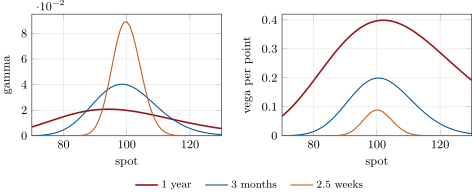
Gamma (left) and vega per volatility point (right) of a call struck at 100 (=20\%, r=0) at three expiries. Short options concentrate gamma near the strike; long options carry the vega. Both are positive for every long option. Data: the chapter’s code.
Figure 4.1. Gamma (left) and vega per volatility point (right) of a call struck at 100 (σ=20%\sigma=20\%, r=0r=0) at three expiries. Short options concentrate gamma near the strike; long options carry the vega. Both are positive for every long option. Data: the chapter’s code.

Examples

Example 4.6 (The desk’s month)

The one-month at-the-money straddle on a share at 100 is worth 4.6059 at 20 volatility and 5.7570 at 25, with zero rates. A desk short 1 000 straddles (multiplier 100) expects to lose (5.7570−4.6059)×100 000(5.7570-4.6059)\times100\,000, about USD 115 100, when realised volatility comes in at 25. Its vega, 0.2302 per point per straddle, times five points gives nearly the same number: for small changes the expected loss is vega times the volatility gap.

Read in context →