Semua buku

Profesional

Aplikasi Tentang Pelatih Masuk Mulai membaca

Quantitative Finance · Glosarium

Apa itu Cox–Ross–Rubinstein and Jarrow–Rudd trees?

Dikenal juga sebagai: Cox--Ross--Rubinstein tree · Jarrow--Rudd tree

Definition 2.6 Derivatives and Volatility · Bab 2 — The Binomial Model

The Cox–Ross–Rubinstein tree takes u=eσΔtu=e^{\sigma\sqrt{\Delta t}} and d=1/ud=1/u, so that the tree is symmetric in log-price and the drift enters only through pp. The Jarrow–Rudd tree takes u,d=exp⁡((r−q−12σ2)Δt±σΔt)u,d=\exp\bigl((r-q-\tfrac12\sigma^2)\Delta t\pm\sigma\sqrt{\Delta t}\bigr), which puts the drift into the factors and makes pp close to one half.

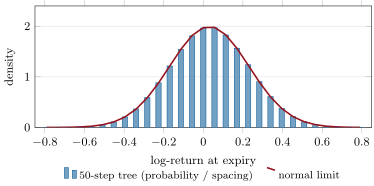
The risk-neutral law of the terminal log-return in a 50-step Cox–Ross–Rubinstein tree (one year, r=5\%, =20\%), each probability divided by the spacing 2 √ t between nodes, against the normal density with mean (r- 2/2)T and standard deviation √ T. Data: the tutorial.
Figure 2.2. The risk-neutral law of the terminal log-return in a 50-step Cox–Ross–Rubinstein tree (one year, r=5%r=5\%, σ=20%\sigma=20\%), each probability divided by the spacing 2σΔt2\sigma\sqrt{\Delta t} between nodes, against the normal density with mean (r−σ2/2)T(r-\sigma^2/2)T and standard deviation σT\sigma\sqrt T. Data: the tutorial.
Baca dalam konteks →