সব বই

পেশাদার

1 Markets I: The Ecosystem and Exchange-Traded Marketsবাজার অনলাইন 2 Markets II: Rates, FX and Creditবাজার অনলাইন 3 Markets III: Commodities, Energy and Cryptoবাজার অনলাইন 4 Quantitative Methodsপদ্ধতি অনলাইন 5 Derivatives and Volatilityডেরিভেটিভস অনলাইন 6 Rates, Credit, XVA and Riskসুদহার, ঋণ ও ঝুঁকি অনলাইন 7 Research Craft: Predictors, Backtests, Measurement, Portfoliosগবেষণা অনলাইন 8 Strategies I: Equities and Futuresকৌশল অনলাইন 9 Strategies II: Volatility, Relative Value, Macro and the Bank Desksকৌশল অনলাইন 10 Microstructure and Executionএক্সিকিউশন অনলাইন 11 Market Making and High-Frequency Tradingমার্কেট মেকিং অনলাইন 12 Machine Learning for Marketsমেশিন লার্নিং অনলাইন 13 Low-Latency Softwareপ্রযুক্তি অনলাইন 14 Networks, Hardware and Trading Infrastructureপ্রযুক্তি অনলাইন 15 Research, Data and Risk Platformsপ্রযুক্তি অনলাইন 16 The Desk and the Firmপ্রতিষ্ঠান অনলাইন 17 The Industry: Firms, Roles and Careersক্যারিয়ার অনলাইন 18 Interviews I: Maths, Probability and Speedক্যারিয়ার অনলাইন 19 Interviews II: Markets, Trading Games and the Final Roundক্যারিয়ার অনলাইন 20 Interviews III: Codeক্যারিয়ার অনলাইন
অ্যাপ পরিচিতি Coach সাইন ইন পড়া শুরু করো

বইগুলো এখনো বাংলা ভাষায় পাওয়া যায় না — ইংরেজি সংস্করণ দেখানো হচ্ছে।

Quantitative Finance · পরিভাষা

Duration, DV01, convexity কী?

অন্য নাম: Macaulay duration · modified duration · DV01 · convexity

Definition 3.8 Markets II: Rates, FX and Credit · অধ্যায় 3 — Government Bonds

With flows aka_k at times tkt_k (in periods) and v=1/(1+y/f)v = 1/(1 + y/f), the Macaulay duration is the present-value weighted average time of the flows, D=1fP∑ktkakvtkD = \frac{1}{f P}\sum_k t_k a_k v^{t_k}, in years. The modified duration is Dmod=−1PdPdy=D/(1+y/f)D_{\mathrm{mod}} = -\frac1P \frac{dP}{dy} = D/(1 + y/f). The DV01 is the fall in price for a one-basis-point rise in yield, P Dmod×10−4P\,D_{\mathrm{mod}} \times 10^{-4} per 100, usually quoted per million of face. The convexity is C=1Pd2Pdy2\mathcal C = \frac1P \frac{d^2P}{dy^2}.

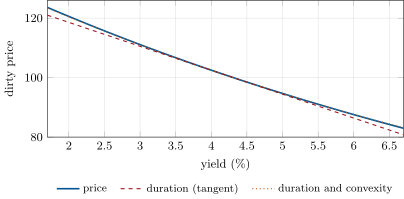
Price against yield for the ten-year note of , two and a half percentage points either side of 4.20%. The tangent (duration) lies below the curve on both sides: a bond gains more when yields fall than it loses when they rise by the same amount, here by 2.2 to 2.6 points at the edges. The second-order approximation stays close to the curve over the whole range. Data: the chapter’s tutorial.
Figure 3.2. Price against yield for the ten-year note of Example 3.10, two and a half percentage points either side of 4.20%. The tangent (duration) lies below the curve on both sides: a bond gains more when yields fall than it loses when they rise by the same amount, here by 2.2 to 2.6 points at the edges. The second-order approximation stays close to the curve over the whole range. Data: the chapter’s tutorial.

উদাহরণ

Example 3.10 (The ten-year note)

At 4.200% the note of Example 3.4 has a clean price of 100.397405 (100-12+), a dirty price of 100.870911, a Macaulay duration of 8.142 years, a modified duration of 7.975, a DV01 of USD 804 per million and a convexity of 75.8. A 100-basis-point rise costs 7.675 points; duration alone predicts 8.044, duration and convexity together 7.662 (Figure 3.2).

প্রসঙ্গসহ পড়ো →