
সব বই

পেশাদার

1 Markets I: The Ecosystem and Exchange-Traded Marketsবাজার অনলাইন 2 Markets II: Rates, FX and Creditবাজার অনলাইন 3 Markets III: Commodities, Energy and Cryptoবাজার অনলাইন 4 Quantitative Methodsপদ্ধতি অনলাইন 5 Derivatives and Volatilityডেরিভেটিভস অনলাইন 6 Rates, Credit, XVA and Riskসুদহার, ঋণ ও ঝুঁকি অনলাইন 7 Research Craft: Predictors, Backtests, Measurement, Portfoliosগবেষণা অনলাইন 8 Strategies I: Equities and Futuresকৌশল অনলাইন 9 Strategies II: Volatility, Relative Value, Macro and the Bank Desksকৌশল অনলাইন 10 Microstructure and Executionএক্সিকিউশন অনলাইন 11 Market Making and High-Frequency Tradingমার্কেট মেকিং অনলাইন 12 Machine Learning for Marketsমেশিন লার্নিং অনলাইন 13 Low-Latency Softwareপ্রযুক্তি অনলাইন 14 Networks, Hardware and Trading Infrastructureপ্রযুক্তি অনলাইন 15 Research, Data and Risk Platformsপ্রযুক্তি অনলাইন 16 The Desk and the Firmপ্রতিষ্ঠান অনলাইন 17 The Industry: Firms, Roles and Careersক্যারিয়ার অনলাইন 18 Interviews I: Maths, Probability and Speedক্যারিয়ার অনলাইন 19 Interviews II: Markets, Trading Games and the Final Roundক্যারিয়ার অনলাইন 20 Interviews III: Codeক্যারিয়ার অনলাইন
অ্যাপ পরিচিতি Coach সাইন ইন পড়া শুরু করো

বইগুলো এখনো বাংলা ভাষায় পাওয়া যায় না — ইংরেজি সংস্করণ দেখানো হচ্ছে।

Quantitative Finance · পরিভাষা

First-passage model, default barrier কী?

অন্য নাম: first-passage model · default barrier

Definition 14.7 Rates, Credit, XVA and Risk · অধ্যায় 14 — Structural Credit Models

A first-passage model defaults the firm the first time its assets touch a default barrier BtB_t below the current value, whenever that happens, instead of only at the debt’s maturity. A barrier stands for covenants that let creditors take over, or for the level at which the firm can no longer refinance. The CreditGrades model (2002), published by RiskMetrics with three dealers, puts the barrier at the average recovery on debt times the debt per share and makes that recovery lognormally uncertain, so that default can come as a surprise and short spreads are not zero.
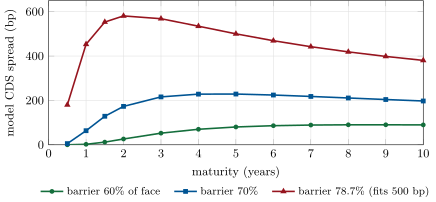
Model default-swap spreads of the chapter’s firm in the first-passage model, for three barriers. Raising the barrier lifts the curve and moves its hump to shorter maturities; the highest barrier fits a five-year quote of 500 basis points. Data: the chapter’s tutorial.
Figure 14.3. Model default-swap spreads of the chapter’s firm in the first-passage model, for three barriers. Raising the barrier lifts the curve and moves its hump to shorter maturities; the highest barrier fits a five-year quote of 500 basis points. Data: the chapter’s tutorial.

উদাহরণ

Example 14.9 (The firm under a barrier)

With the barrier at 70% of the debt face, the firm’s model default-swap spreads are 64, 173, 216, 229 and 197 basis points at one, two, three, five and ten years (Figure 14.3); its five-year survival probability is 82.3%. A market quote of 500 basis points at five years needs a barrier at 78.7% of the face.

প্রসঙ্গসহ পড়ো →