সব বই

পেশাদার

1 Markets I: The Ecosystem and Exchange-Traded Marketsবাজার অনলাইন 2 Markets II: Rates, FX and Creditবাজার অনলাইন 3 Markets III: Commodities, Energy and Cryptoবাজার অনলাইন 4 Quantitative Methodsপদ্ধতি অনলাইন 5 Derivatives and Volatilityডেরিভেটিভস অনলাইন 6 Rates, Credit, XVA and Riskসুদহার, ঋণ ও ঝুঁকি অনলাইন 7 Research Craft: Predictors, Backtests, Measurement, Portfoliosগবেষণা অনলাইন 8 Strategies I: Equities and Futuresকৌশল অনলাইন 9 Strategies II: Volatility, Relative Value, Macro and the Bank Desksকৌশল অনলাইন 10 Microstructure and Executionএক্সিকিউশন অনলাইন 11 Market Making and High-Frequency Tradingমার্কেট মেকিং অনলাইন 12 Machine Learning for Marketsমেশিন লার্নিং অনলাইন 13 Low-Latency Softwareপ্রযুক্তি অনলাইন 14 Networks, Hardware and Trading Infrastructureপ্রযুক্তি অনলাইন 15 Research, Data and Risk Platformsপ্রযুক্তি অনলাইন 16 The Desk and the Firmপ্রতিষ্ঠান অনলাইন 17 The Industry: Firms, Roles and Careersক্যারিয়ার অনলাইন 18 Interviews I: Maths, Probability and Speedক্যারিয়ার অনলাইন 19 Interviews II: Markets, Trading Games and the Final Roundক্যারিয়ার অনলাইন 20 Interviews III: Codeক্যারিয়ার অনলাইন
অ্যাপ পরিচিতি Coach সাইন ইন পড়া শুরু করো

বইগুলো এখনো বাংলা ভাষায় পাওয়া যায় না — ইংরেজি সংস্করণ দেখানো হচ্ছে।

Quantitative Finance · পরিভাষা

Forward variance কী?

Definition 12.1 Derivatives and Volatility · অধ্যায় 12 — Rough Volatility and Forward-Variance Models

The forward variance for date uu seen at time t≤ut\le u is ξt(u)=EtQ[vu]\xi_t(u)=\E^{\mathbb Q}_t[v_u], the pricing-measure expectation of the instantaneous variance at uu. The curve u↦ξt(u)u\mapsto\xi_t(u) is the forward-variance curve; ξ0\xi_0 is today’s.

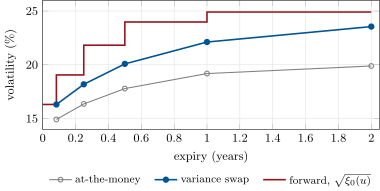
The forward-variance curve of chapter 9’s surface. The variance-swap volatility comes from each expiry’s option strip and lies above the at-the-money volatility because the strip weights the skewed puts. Its forward is piecewise constant between the pillars. Data: the chapter’s code.
Figure 12.1. The forward-variance curve of chapter 9’s surface. The variance-swap volatility comes from each expiry’s option strip and lies above the at-the-money volatility because the strip weights the skewed puts. Its forward is piecewise constant between the pillars. Data: the chapter’s code.

উদাহরণ

Example 12.2 (The forward-variance curve of chapter 9’s surface)

Integrating each expiry’s strip on chapter 9’s surface gives variance-swap volatilities of 16.3%, 18.2%, 20.1%, 22.1% and 23.6% at one month, three months, six months, one year and two years, against at-the-money volatilities of 14.9%, 16.4%, 17.8%, 19.2% and 19.9%. With total variance linear between the pillars, the forward volatility ξ0\sqrt{\xi_0} is 16.3% up to one month, then 19.1%, 21.8%, 24.0% and, from one to two years, 24.9% (Figure 12.1).

Example 12.11 (The VIX in rough Bergomi)

With the parameters of Example 12.8, the one-month VIX has E[VIX2]=0.0400\E[\mathrm{VIX}^2]=0.0400, the forward variance, as it must. The future is 18.74 against a forward variance-swap volatility of 20: a convexity gap of 1.26 points. The implied volatility of one-month VIX options is 123.1% at a strike of 80% of the future, 123.9% at the money and 125.7% at 160%. The model’s VIX is nearly lognormal, and its smile is nearly flat, with a level set by η\eta and HH. Guerreiro and Guerra make the same observation, and contrast it with the upward-sloping VIX smiles of the market.

প্রসঙ্গসহ পড়ো →