Todos los libros

Profesional

Apps Acerca de Coach Iniciar sesión Empezar a leer

Quantitative Finance · Glosario

¿Qué es Futures-to-cash lead, lead–lag estimator?

También llamado: futures-to-cash lead · lead--lag estimator

Definition 10.4 Research Craft: Predictors, Backtests, Measurement, Portfolios · Capítulo 10 — Cross-Sectional and Cross-Asset Features

The futures-to-cash lead is the tendency of an index future’s price to move before the prices of the index’s constituents and of the funds that track it. A lead–lag estimator estimates the time shift ϑ\vartheta at which two price series are most related: here the lag maximising the Hayashi–Yoshida cross-covariance of one series with the other’s clock shifted by ϑ\vartheta, computed from all observations without synchronising them (Hoffmann, Rosenbaum and Yoshida, 2013).
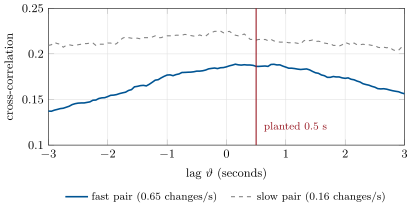
Hayashi–Yoshida cross-correlation of two simulated instruments’ mid-prices, the second’s clock shifted by , for a planted latency of 0.5 seconds; normalised by one-minute realised variances. The fast pair’s function is flat-topped and centred on the latency; the slow pair’s price changes too rarely to show it. Data: firm.tape, one hour, seed 10.
Figure 10.3. Hayashi–Yoshida cross-correlation of two simulated instruments’ mid-prices, the second’s clock shifted by ϑ\vartheta, for a planted latency of 0.5 seconds; normalised by one-minute realised variances. The fast pair’s function is flat-topped and centred on the latency; the slow pair’s price changes too rarely to show it. Data: firm.tape, one hour, seed 10.
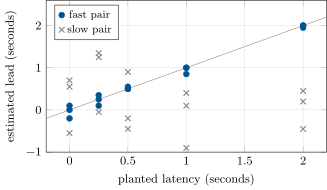
Estimated lead (symmetric centre of the Hayashi–Yoshida cross-correlation) against the planted latency, three seeds each, with the diagonal. Data: firm.tape, one hour per run.
Figure 10.4. Estimated lead (symmetric centre of the Hayashi–Yoshida cross-correlation) against the planted latency, three seeds each, with the diagonal. Data: firm.tape, one hour per run.
Leer en el capítulo →