
جميع الكتب

مهني

1 Markets I: The Ecosystem and Exchange-Traded Marketsالأسواق عبر الإنترنت 2 Markets II: Rates, FX and Creditالأسواق عبر الإنترنت 3 Markets III: Commodities, Energy and Cryptoالأسواق عبر الإنترنت 4 Quantitative Methodsالأساليب عبر الإنترنت 5 Derivatives and Volatilityالمشتقات عبر الإنترنت 6 Rates, Credit, XVA and Riskالفائدة والائتمان والمخاطر عبر الإنترنت 7 Research Craft: Predictors, Backtests, Measurement, Portfoliosالبحث عبر الإنترنت 8 Strategies I: Equities and Futuresالاستراتيجيات عبر الإنترنت 9 Strategies II: Volatility, Relative Value, Macro and the Bank Desksالاستراتيجيات عبر الإنترنت 10 Microstructure and Executionالتنفيذ عبر الإنترنت 11 Market Making and High-Frequency Tradingصناعة السوق عبر الإنترنت 12 Machine Learning for Marketsتعلم الآلة عبر الإنترنت 13 Low-Latency Softwareالتكنولوجيا عبر الإنترنت 14 Networks, Hardware and Trading Infrastructureالتكنولوجيا عبر الإنترنت 15 Research, Data and Risk Platformsالتكنولوجيا عبر الإنترنت 16 The Desk and the Firmالشركة عبر الإنترنت 17 The Industry: Firms, Roles and Careersالمسارات المهنية عبر الإنترنت 18 The Interview Bookالمسارات المهنية عبر الإنترنت
التطبيقات حول المدرب تسجيل الدخول ابدأ القراءة

Quantitative Finance · المسرد

ما معنى Gross basis, net basis, implied repo, basis trade؟

يُعرف أيضًا باسم: gross basis · net basis · implied repo rate · basis trade

Definition 6.7 Markets II: Rates, FX and Credit · الفصل 6 — Bond Futures

For a deliverable note with clean price PP, factor CF\mathrm{CF} and future price FF: the gross basis is P−F CFP - F\,\mathrm{CF}; the net basis is the gross basis less the note’s carry to delivery (Proposition 5.3); the implied repo rate is the financing rate at which buying the note, financing it and delivering it into the future exactly breaks even,

IRR  =  F CF+Adel+C−(P+A0)P+A0 360d,\text{IRR} \;=\; \frac{F\,\mathrm{CF} + A_{\text{del}} + C - (P + A_0)}{P + A_0}\,\frac{360}{d},

with accrued interest A0A_0 today and AdelA_{\text{del}} at delivery, coupons CC received in between and dd days. A basis trade buys the note and sells the future in the ratio of the factor (long the basis), or the reverse (short the basis).
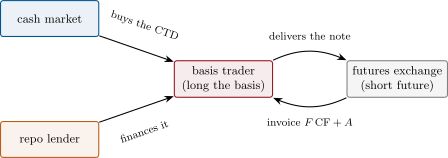
The cash-and-carry basis trade. The trader buys the cheapest note, finances it in repo, sells futures in the ratio of the factor, and delivers the note at expiry against the invoice price. It earns the implied repo rate and pays the repo rate; with leverage from repo, a few basis points on a large position is the business.
Figure 6.1. The cash-and-carry basis trade. The trader buys the cheapest note, finances it in repo, sells futures in the ratio of the factor, and delivers the note at expiry against the invoice price. It earns the implied repo rate and pays the repo rate; with leverage from repo, a few basis points on a large position is the business.

أمثلة

Example 6.8 (A December basket)

On 25 September 2026 a December ten-year future trades at 111-24+ (111.765625); delivery is assumed on 31 December, 97 days away, and repo is 3.90%. The table below shows five deliverable notes. The 3.875% of August 2033, the shortest, has the smallest net basis, two thirds of a 32nd, and the highest implied repo, 3.82%, eight basis points below repo: it is the CTD. The longest note would deliver at an implied repo of 0.05%. These notes and prices are illustrative.

اقرأ في الفصل →