Markets II: Rates, FX and Credit · Markets
5Repo and Specials
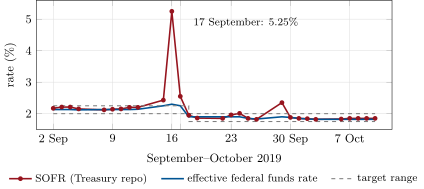
On Monday 16 September 2019 American companies paid their quarterly taxes and USD 54 billion of newly auctioned Treasury notes and bonds settled. Both payments drained cash from banks’ accounts at the Federal Reserve: reserves fell by about 120 billion dollars in two days, to 1.34 trillion, their lowest since 2012. On Tuesday the rate on overnight loans secured by Treasuries, the market where every dealer finances its inventory, printed at 5.25%. The Federal Reserve’s target range for its policy rate was 2.00 to 2.25%, and the federal funds rate itself rose above it, to 2.30%. At 9:30 that morning the New York Fed offered up to 75 billion dollars in an overnight repo operation and lent 53 billion. Repo is the plumbing under every position in this book: a bond bought is a bond financed, and a bond sold short is a bond borrowed. This chapter follows cash and collateral through it, and prices the one bond that everyone wants to borrow.
5.1 The repo trade from both sides
A repurchase agreement (One Quant Book 1, chapter 6) is a sale of securities with an agreement to buy them back at a fixed price on a later date: an exchange of collateral for cash, reversed later, whose price difference is interest.
Definition 5.1 (Repo rate, reverse repo, term repo)
The repo rate is the simple interest rate, actual/360 in dollars, implied by the difference between the repurchase and the sale price. The side that sells the collateral and borrows cash does a repo; the side that lends cash and receives collateral does a reverse repo. An overnight repo matures on the next business day; a term repo has a fixed longer maturity; an open repo rolls each day until one side ends it.
Example 5.2 (Financing the ten-year note)
A dealer buys USD 100 million of the ten-year note of Chapter 3 at a dirty price of 100.870911 and finances it in repo for 30 days at 3.90%. With an illustrative 2% haircut, the lender pays and receives 321 274 of interest at the end; the dealer funds the other 2% from its own capital. Over the 30 days the note accrues USD 346 467 of coupon.
Proposition 5.3 (Carry of a financed bond)
A long position of face in a bond with coupon and dirty price , financed in full at the repo rate for days in a coupon period of days, earns, if yields do not move,
plus the (small) pull of the clean price towards par. The yield rise that would wipe it out is the carry divided by the position’s DV01.
Proof. The first term is the coupon accrued over the days, which the holder collects in the dirty price; the second is the repo interest on the cash borrowed. A yield change changes the value by in basis points. ∎
At 3.90% the dealer’s carry on the ten-year is over the month, and a rise of 0.23 basis points in yield would erase it. Positive carry is the reward for owning a bond that yields more than its financing; a curve on which long bonds yield less than overnight money makes carry negative, and holding bonds a bet on falling yields.
5.2 Tri-party, bilateral and sponsored
Definition 5.4 (Tri-party and bilateral repo)
In tri-party repo a clearing bank acting as agent holds the collateral, allocates it from the borrower’s inventory according to the lender’s eligibility schedule, values it and applies the haircuts; the lender is lent against a basket, never a specific security. In bilateral repo the two sides settle directly, delivery versus payment, and the cash lender can ask for a specific security.
Definition 5.5 (Sponsored repo)
In sponsored repo a dealer that is a member of the Treasury clearing house sponsors a non-member, typically a money-market fund lending cash or a hedge fund borrowing it, into the clearing house: the trade is novated to the central counterparty and nets against the dealer’s other cleared trades.
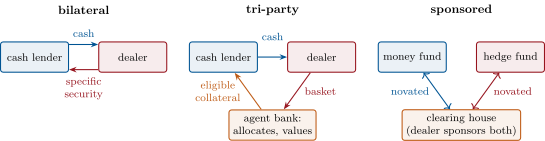
Netting is the point. A dealer that borrows cash from a money fund in one repo and lends it to a hedge fund in another holds two trades on its balance sheet if both are bilateral, and, if both are cleared through the same central counterparty, a net position close to zero. Because a dealer’s balance sheet is costly, above all on the dates it is measured (Chapter 2), sponsored clearing has grown into a major way for dealers to intermediate repo at scale (Figure 5.2), and the clearing mandate of Box 4.2 will send much more repo through the clearing house.
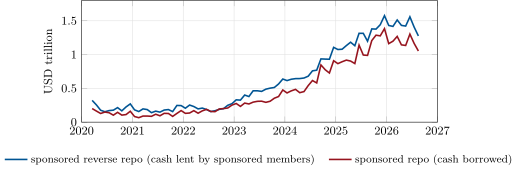
As of September 2026 — FICC sponsored repo
Sponsored repo plus sponsored reverse repo reached USD 2.96 trillion on 31 December 2025 (1.38 trillion of repo and 1.58 trillion of reverse repo), and stood at 2.33 trillion on 21 August 2026, the latest date published.
5.3 Specials and specialness
Most repo is general collateral (One Quant Book 1, chapter 16): the cash lender accepts any security of a class, and the rate is the price of cash. When someone needs a particular security, to deliver it against a short sale or into a futures contract, the rate is also the price of that security.
Definition 5.6 (Special repo rate and specialness)
The special repo rate of a security is the repo rate at which cash lenders will lend against that specific security. Its specialness is the general-collateral rate minus the special rate: what a cash lender gives up in interest to obtain the security.
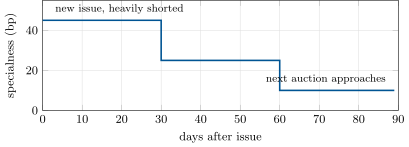
Specialness is paid to the holder of the security: a dealer who owns the on-the-run ten-year can borrow cash against it more cheaply than against any other note. The on-the-run is the most shorted issue, since traders hedge with it, and the most often special. As its successor’s auction approaches, the shorts move to the new issue and its specialness fades (Figure 5.3).
Proposition 5.7 (What specialness is worth)
A holder who finances at specialness for days in successive periods saves, per 100 of dirty price ,
price points. The security can therefore trade that much richer than an otherwise identical one, or basis points lower in yield, before owning it stops paying.
Proof. Each day the holder repos the security at instead of GC, saving per 100. Summed over the expected special life this is the present gain, to first order; an investor indifferent between the two securities pays it up front in the price. ∎
5.4 Fails and the fails charge
A short who cannot borrow a security it has sold fails to deliver it. Until 2009 the convention was simply to postpone delivery, without penalty and at an unchanged price: failing cost only the interest on the sale proceeds, which the buyer does not pay until delivery. When short rates collapsed after Lehman Brothers’ insolvency in September 2008, that cost collapsed with them and fails reached an extraordinary volume. The market’s practice committee then introduced a charge, from May 2009.
Definition 5.8 (Fails charge)
The fails charge on a Treasury transaction that fails to settle is, for each day of the fail,
where is the proceeds and , in percent, is the reference rate (the lower limit of the Federal Reserve’s target range) on the preceding business day. It is paid by the failing seller to the buyer.
Proposition 5.9 (A floor under special rates)
With a fails charge of a year, no short borrows a security at a special rate below : rather than accept less, it fails. When the floor is zero; when special rates can be negative, down to .
Proof. To deliver, the short lends cash at the special rate and receives the security, then delivers it and is paid about : it earns on . Failing instead, it is not paid, so earns nothing, and pays on . It borrows the security if and only if . ∎
As of September 2026 — The fails charge today
The charge applies to Treasury transactions entered into since 1 May 2009. With the lower limit of the target range at 3.75% since 17 September 2026, : failing to deliver a Treasury currently carries no charge, and special rates are floored at zero by the proposition. The charge bites again if the range’s lower limit falls below 3%.
5.5 September 2019
Reserves had been falling since the Federal Reserve began to shrink its balance sheet, and kept falling after that programme ended in August 2019; at the same time the Treasury’s growing issuance had filled dealers’ inventories with securities to finance. On 16 September the tax date and the coupon settlement took another 120 billion of reserves out of the system in two days. The overnight Treasury repo rate reached 5.25% on 17 September (Figure 5.4), and the federal funds rate left its target range. The New York Fed’s repo operation at 9:30 that morning added 53 billion of reserves; the Committee cut its range on the 18th, and from mid-October the Federal Reserve bought bills, at about 60 billion dollars a month at first, to keep reserves at least at their early-September level.
The episode showed that a floor system (Chapter 1) needs its reserves to be ample in every bank that has to lend them, not only on average. In July 2021 the Committee created a standing repo facility, a daily overnight repo operation against Treasuries at a fixed minimum rate, which now puts a ceiling on the repo rate for eligible counterparties.
5.6 Tutorial: a repo book
Goal. Book the financing of Example 5.2, compute its carry and its margin call after a price fall, and value the specialness path of Figure 5.3. End state: the numbers of the example and of the weekend problem.
The trade: cash is collateral value less the haircut; interest accrues actual/360.
@dataclass(frozen=True)
class RepoTrade:
    side: str                  # "repo" (borrow cash) or "reverse" (lend cash)
    collateral: str
    face: float
    dirty_price: float         # per 100, at the start
    haircut: float             # fraction of collateral value withheld (0.02 = 2%)
    rate: float
    start: dt.date
    end: dt.date

    @property
    def cash(self) -> float:
        """Cash lent against the collateral: its value less the haircut."""
        return self.face * self.dirty_price / 100.0 * (1.0 - self.haircut)

    def interest(self, until: dt.date | None = None) -> float:
        d = (until or self.end) - self.start
        return self.cash * self.rate * d.days / 360.0

    def repurchase_price(self) -> float:
        return self.cash + self.interest()
Listing 5.1. A repo trade: cash, interest, repurchase price. code/firm/repo/firm_repo.py Margin. If the collateral loses value, the cash borrower must post more to restore the haircut.
def margin_call(trade: RepoTrade, new_dirty_price: float, accrued_to: dt.date) -> float:
    """Collateral (in cash value) the cash borrower must add, positive, or may withdraw, negative,
    to restore the haircut on the cash plus accrued repo interest."""
    owed = trade.cash + trade.interest(accrued_to)
    required = owed / (1.0 - trade.haircut)
    held = trade.face * new_dirty_price / 100.0
    return required - held
Listing 5.2. The margin call on a repo after a price move. code/firm/repo/firm_repo.py A fall of 1.5 points on USD 100 million calls USD 1.5 million on the day.
Specialness and fails.
def value_of_specialness(dirty_price: float, path: list[tuple[int, float]]) -> float:
    """Price points (per 100) that a holder saves by financing at special rates: the sum over
    periods of days x specialness / 360 on the dirty price. path = [(days, specialness), ...]."""
    return dirty_price * sum(days * s for days, s in path) / 360.0


def fails_charge(proceeds: float, reference_rate_pct: float, days: int = 1, base_pct: float = 3.0) -> float:
    """TMPG fails charge: 1/360 x 0.01 x max(base - R, 0) x P per day (base 3 for Treasuries)."""
    return days * proceeds * 0.01 * max(base_pct - reference_rate_pct, 0.0) / 360.0


def special_rate_floor(reference_rate: float, base: float = 0.03) -> float:
    """Lowest special repo rate a short would accept rather than fail: -(base - R)+."""
    return -max(base - reference_rate, 0.0)
Listing 5.3. The value of specialness, the fails charge, and the floor it puts under special rates. code/firm/repo/firm_repo.py Check the practice committee’s example: USD 5 555.56 a day on 100 million when the reference rate is 1%.
- Run
repo_demo.financed_note()andrepo_demo.special_value();fig_repo.pywrites the three charts.
What to change next. Finance the note at 4.30% and find the negative carry; then let the specialness of the first month double and express the new value in 32nds.
5.7 Build: the repo book
Purpose. Every position the miniature firm holds in bonds is financed or borrowed; the repo book records the trades, accrues them, calls and meets margin, and tells the traders what their bonds cost to hold and what their shorts cost to borrow.
Interface. RepoTrade(side, collateral, face, dirty_price, haircut, rate, start, end) with cash, interest(until), repurchase_price(); margin_call(trade, new_dirty_price, accrued_to); specialness(gc, special); value_of_specialness(dirty, path); fails_charge(proceeds, R, days); special_rate_floor(R); carry(…).
Rules. Actual/360; the haircut withheld from the cash; margin restores the haircut on cash plus accrued interest; the fails charge by the practice committee’s formula with the reference rate of the preceding business day.
Acceptance tests. code/firm/repo/tests/: cash, interest and repurchase price; margin calls in both directions; the practice committee’s worked example to the cent; the special-rate floor above and below 3%; a bond whose coupon equals its financing has zero carry.
Stretch. Open repos repriced daily from a rate feed; substitution of collateral; a tri-party eligibility schedule; interest accrual through the overnight-rate engine (Section 1.6).
Sources and further reading
- Board of Governors of the Federal Reserve System, FEDS Notes, “What Happened in Money Markets in September 2019?”, 27 February 2020.
- Treasury Market Practices Group, Frequently Asked Questions: TMPG Fails Charges, 2013.
- Office of Financial Research, Hedge Fund Monitor: FICC sponsored repo service volumes.
- K. D. Garbade, F. M. Keane, L. Logan, A. Stokes and J. Wolgemuth, “The introduction of the TMPG fails charge for U.S. Treasury securities”, Federal Reserve Bank of New York Economic Policy Review, 2010.
5.8 Exercises
Exercise 5.1 ★
A fund lends USD 50 million in repo from Friday to Tuesday at 3.90%. What interest does it receive?
Solution
Solution of Exercise 5.1.
Friday to Tuesday is four days: .
Exercise 5.2 ★
USD 100 million face of a note with a dirty price of 101.5 is repoed with a 2% haircut. How much cash does the borrower receive?
Solution
Solution of Exercise 5.2.
Collateral value ; less 2%: USD 99 470 000.
Exercise 5.3 ★
General collateral trades at 3.90% and a note’s special rate at 3.10%. Give its specialness, and what owning USD 100 million of it saves in financing per day.
Solution
Solution of Exercise 5.3.
Specialness basis points. Financing USD 100 million at 3.10% instead of 3.90% saves a day (on the cash borrowed; scale by the dirty price for the exact amount).
Exercise 5.4 ★★
Verify the carry of the dealer’s ten-year position in Example 5.2 and the yield rise that would erase it. What is the carry if the repo rate is 4.30%?
Solution
Solution of Exercise 5.4.
Coupon ; repo ; carry USD 18 637. DV01 USD 80 444 per basis point: breakeven 0.23 basis points. At 4.30% the repo costs 361 454 and the carry is : the note now yields less than its financing, and holding it is a bet that yields fall.
Exercise 5.5 ★★
A seller fails to deliver USD 100 million of a note for five days. What does it owe under the fails charge when the reference rate is 1%? When it is 3.75%?
Solution
Solution of Exercise 5.5.
At 1%: a day, USD 27 777.78 for five days. At 3.75%: ; nothing.
Exercise 5.6 ★★
In 2021 the reference rate was 0%. What was the lowest special rate a short would accept rather than fail? What is it today? What happened to specials before 2009 when rates were near zero?
Solution
Solution of Exercise 5.6.
With : floor ; shorts would pay up to 3% a year to borrow a scarce issue before failing. Today, with : floor 0. Before 2009 there was no charge: failing cost only the forgone interest on the proceeds, so no short would lend cash below 0%, and when rates collapsed at the end of 2008 that cost vanished too; fails became the cheapest alternative to borrowing, and they multiplied.
Exercise 5.7 ★★★
Coding. With margin_call, compute the call on the dealer’s 30-day repo of Example 5.2 if the note’s dirty price falls by 1.5 points on the first day. Then compute the call after 30 days if the price has not moved, counting the accrued repo interest.
Solution
Solution of Exercise 5.7.
After a fall of 1.5 points on the first day: the lender is owed plus one day’s interest (10 709), which requires collateral worth ; the collateral is worth 99 370 911: call USD 1 510 928. After 30 days at an unchanged price: the accrued interest alone, grossed up by the haircut, : USD 327 830. Real repo books usually settle interest at maturity and margin on the principal; the difference is a matter of each agreement’s terms.
Exercise 5.8 ★★★
Find the flaw. “The federal funds rate traded above the top of the range on 17 September 2019, so the Committee had tightened policy.” Correct the statement from Figure 5.4 and the chapter.
Solution
Solution of Exercise 5.8.
The Committee’s decisions did not change on 17 September: the range stayed at 2.00–2.25% and the administered rates with it. The market rate escaped the range because reserves had become scarce for a day (tax payments and coupon settlement drained 120 billion), so banks short of cash paid up and those with cash lent it where rates were highest, in repo. The Fed responded by adding reserves through repo operations, and the next day it cut the range by a quarter point: the opposite of tightening.
5.9 Problem: The Special
Problem 5.1
Weekend problem — what a special is worth
The ten-year note of Example 5.2 is the on-the-run. A dealer expects it to trade special by 45 basis points for the next 30 days, 25 for the 30 after, and 10 for the last 30 before the next auction, with general collateral at 3.90%. Its dirty price is 100.870911 and its DV01 is 0.080444 per 100.
Part I — The rates.
- Give the special repo rate in each of the three months.
- What does the dealer save in financing on USD 100 million in the first month?
- And over the 90 days?
- Why is the specialness highest just after issue?
- Who pays the specialness, and why would they?
Part II — The price.
- Give the value of the specialness in price points per 100 (Proposition 5.7).
- Express it in 32nds.
- Express it in basis points of yield.
- An off-the-run note of nearly the same maturity and coupon yields 4.210%. Ignoring liquidity, at what yield should the on-the-run trade?
- It trades at 4.195%. Is it rich or cheap on financing alone?
Part III — The trade.
- Describe the trade that captures the difference, leg by leg, including how each leg is financed.
- What does each leg earn or pay in repo?
- What if specialness turns out to be twice the dealer’s forecast?
- What if a large short squeezes the issue and its special rate goes to zero?
- With the reference rate at 3.75%, how low can the special rate go?
Part IV — Judgement.
- Why is the on-the-run’s yield discount larger than its financing value alone would justify, in most markets?
- Why does a dealer that holds the on-the-run and lends it out care about the fails charge?
- How would the Treasury’s decision to reopen the issue (sell more of it) change the specialness?
- State the named result: the value of the expected specialness in price, 32nds and yield.
- In one sentence: what is a special?
Solution
Solution of Problem 5.1.
1. 3.45%, 3.65% and 3.80%. 2. . 3. . 4. The new issue is the market’s hedging instrument, so shorts are largest just after issue, while the supply that holders are willing to lend is still building. 5. The shorts, through the cash they lend at the low rate to borrow the note. They pay because failing to deliver would cost them their sale proceeds’ interest (and, when rates are low, the fails charge), and because the note is the hedge they need. 6. points per 100. 7. 32nds. 8. basis points. 9. About . 10. At 4.195% it is 0.7 basis points richer than financing alone justifies: the rest is the price of liquidity. 11. Buy the off-the-run and sell the on-the-run in the same DV01; repo the off-the-run at general collateral to finance it; reverse-repo the on-the-run (lend cash, borrow the note) to deliver the short; hold until the next auction makes the on-the-run old. 12. The long pays GC, 3.90%, on its financing; the short earns only the special rate on the cash it lends, 3.45% then 3.65% then 3.80%: the trade pays the specialness, which is what it is betting is priced too richly. 13. The short pays twice as much: 0.1345 points instead of 0.0672, and the trade loses unless the yield spread moves in its favour by more. 14. A special rate of 0% makes specialness 3.90%: the short pays USD 10 928 a day on 100 million in forgone interest, and more if a squeeze makes the note impossible to borrow at all. 15. Zero (Proposition 5.9): with the reference rate above 3% the fails charge is zero and failing costs no more than a 0% loan. 16. Liquidity: the benchmark trades in the tightest markets, is accepted everywhere as collateral and as a hedge, and investors pay for that beyond its financing value. 17. If a borrower fails to return it, the lender loses its own ability to deliver; the fails charge is what the failing party would pay, and at today’s rates it is zero, so the protection is gone. 18. More supply of the same security to lend: specialness falls. 19. Named result: the value of the special over the auction cycle is 0.0672 points per 100 (2.15 32nds), 0.84 basis points of yield, USD 67 247 on USD 100 million. 20. A security so much in demand for borrowing that lenders of cash accept less than the general rate to get it.
5.10 Interview questions
Interview question 5.1 ★ trader, bank
What is repo, and why is it the most important funding market for bond traders?
Solution
Solution of Interview question 5.1.
A sale of securities with an agreement to buy them back: a loan of cash against collateral, or of collateral against cash. Every long bond position is financed in it and every short is borrowed in it; its rate is the traders’ cost of carry, and its specialness is the price of the securities they are short.
What the interviewer is looking for: both directions of the trade, and financing as the link to every position.
Interview question 5.2 ★ trader, researcher
What does it mean for a bond to trade special, and who benefits?
Solution
Solution of Interview question 5.2.
Its specific repo rate is below general collateral: cash lenders accept a lower rate to obtain that security, usually because it is in demand to cover shorts or for delivery. The holder benefits: it borrows cash more cheaply against it, or lends the security out; the shorts pay.
What the interviewer is looking for: specialness as a transfer from shorts to holders.
Interview question 5.3 ★★ trader, researcher, bank
What happened in the repo market in September 2019, and what did the Fed do?
Solution
Solution of Interview question 5.3.
On 16 September 2019 tax payments and a coupon settlement drained about 120 billion of reserves, to 1.34 trillion; on the 17th Treasury repo printed at 5.25% and the federal funds rate rose above its range. The New York Fed lent 53 billion in an overnight repo operation, the Committee cut rates the next day, and from October it bought bills to rebuild reserves; in 2021 it created a standing repo facility.
What the interviewer is looking for: reserve scarcity as the cause, and the three responses.
Interview question 5.4 ★★ trader
You are long a ten-year note financed in repo. What is your carry, and what is your breakeven?
Solution
Solution of Interview question 5.4.
Carry: the coupon accrued over the period less the repo interest on the dirty price (plus a small pull to par). Breakeven: the yield rise that wipes it out, carry divided by DV01; for a ten-year at 4.20% financed at 3.90% about a quarter of a basis point a month.
What the interviewer is looking for: the formula, and the conversion into basis points via DV01.
Interview question 5.5 ★★ bank, developer
Why do dealers prefer sponsored, cleared repo to bilateral repo?
Solution
Solution of Interview question 5.5.
Netting: cleared trades facing the central counterparty offset each other, so a dealer’s matched book of repo and reverse repo shrinks to its net, saving balance sheet and capital; the central counterparty also removes bilateral credit exposure. The client gets access to dealers’ balance sheet on better terms, and the clearing mandate will require clearing for most repo anyway.
What the interviewer is looking for: netting of balance sheet as the reason, not only credit risk.
Interview question 5.6 ★★★ researcher, trader
Can a repo rate be negative? Derive the lower bound on a special rate.
Solution
Solution of Interview question 5.6.
Yes, for a special. A short that must deliver compares lending cash at the special rate to borrow the bond, earning , with failing, earning nothing and paying the fails charge . It borrows while , so special rates can fall to when the reference rate is below 3%, and to zero otherwise. General collateral rates themselves go negative only when policy rates are negative.
What the interviewer is looking for: the arbitrage against failing, and the role of the fails charge.