Tous les livres

Professionnel

Applis À propos Coach Connexion Commencer la lecture

Quantitative Finance · Glossaire

Qu'est-ce que « Hagan formula » ?

Definition 11.2 Derivatives and Volatility · Chapitre 11 — SABR and Smile Dynamics

The Hagan formula for the SABR Black volatility at strike KK and expiry TT is

σB(K)=α(FK)1−β2(1+(1−β)224ℓ2+(1−β)41920ℓ4) zx(z) (1+cT),\sigma_B(K)=\frac{\alpha}{(FK)^{\frac{1-\beta}2}\bigl(1+\frac{(1-\beta)^2}{24}\ell^2+ \frac{(1-\beta)^4}{1920}\ell^4\bigr)}\,\frac{z}{x(z)}\,\bigl(1+cT\bigr),
c=(1−β)2α224(FK)1−β+ρβνα4(FK)1−β2+2−3ρ224ν2,c=\frac{(1-\beta)^2\alpha^2}{24(FK)^{1-\beta}}+\frac{\rho\beta\nu\alpha}{4(FK)^{\frac{1-\beta}2}} +\frac{2-3\rho^2}{24}\nu^2,

with ℓ=ln⁡(F/K)\ell=\ln(F/K), z=να(FK)1−β2ℓz=\frac\nu\alpha(FK)^{\frac{1-\beta}2}\ell and x(z)=ln⁡((1−2ρz+z2+z−ρ)/(1−ρ))x(z)=\ln\bigl((\sqrt{1-2\rho z+z^2}+z-\rho)/(1-\rho)\bigr).

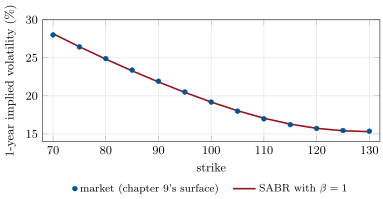
SABR with a lognormal backbone fitted to one equity expiry: 13 strikes, errors of at most 0.15 volatility point. Data: the tutorial.
Figure 11.1. SABR with a lognormal backbone fitted to one equity expiry: 13 strikes, errors of at most 0.15 volatility point. Data: the tutorial.

Exemples

Example 11.3 (A three-percent forward)

A one-year option on a forward rate of 3%, at-the-money Black volatility 20%, β=0.5\beta=0.5, ρ=−0.6\rho=-0.6, ν=0.5\nu=0.5: the cubic gives α=0.0346\alpha=0.0346. The Black smile runs from 28.8% at a 2% strike to 15.8% at 4%; the same prices read as normal volatilities run from 70.8 to 55.0 basis points a year, 59.9 at the money. The normal smile is far less skewed: much of the Black skew is the lognormal model’s own scaling.

Example 11.4 (SABR on an equity smile)

With β=1\beta=1 (a lognormal backbone), SABR fitted to the one-year smile of chapter 9’s surface returns α=0.194\alpha=0.194, ρ=−0.68\rho=-0.68, ν=0.72\nu=0.72, with a root-mean-square error of 0.07 volatility point and at most 0.15 point, at the 70 strike (Figure 11.1). One expiry, three free parameters, a good fit: SABR is a smile interpolator as much as a model.

Lire dans le chapitre →