All books

Professional

Apps About Coach Log in Start reading

Quantitative Finance · Glossary

What is Heavy-tailed distribution, tail index?

Also known as: heavy-tailed distribution · tail index

Definition 15.8 Quantitative Methods · Chapter 15 — Robust Statistics and Heavy Tails

A distribution is heavy-tailed (in the Pareto sense) if P(X>x)=x−αL(x)\P(X > x) = x^{-\alpha}L(x) for a slowly varying LL (L(tx)/L(x)→1L(tx)/L(x) \to 1 as x→∞x \to \infty for every t>0t > 0). The exponent α>0\alpha > 0 is its tail index.

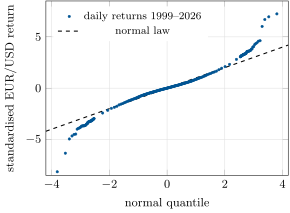
Quantile-quantile plot of the 7 098 daily EUR/USD returns, standardised, against the normal law (every observation in the tails, every fiftieth in the body). The largest moves, -8.2 and +7.2 standard deviations, sit where a normal law puts odds below one in a hundred billion. Data: ECB euro reference rates (source: ECB statistics).
Figure 15.3. Quantile-quantile plot of the 7 098 daily EUR/USD returns, standardised, against the normal law (every observation in the tails, every fiftieth in the body). The largest moves, −8.2-8.2 and +7.2+7.2 standard deviations, sit where a normal law puts odds below one in a hundred billion. Data: ECB euro reference rates (source: ECB statistics).
Read in context →