
全部书籍

专业

应用 关于 Coach 登录 开始阅读

书籍暂未推出简体中文版——当前显示英文版。

Quantitative Finance · 术语表

什么是 Impulse response function, forecast-error variance decomposition?

又称: impulse response function · forecast-error variance decomposition

Definition 20.3 Quantitative Methods · 第 20 章 — Multivariate Series and Cointegration

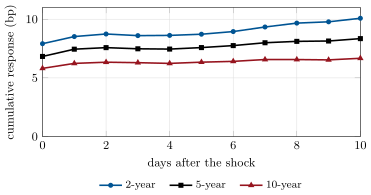
The impulse response function gives the effect on Yt+hY_{t+h} of a one-standard-deviation shock at tt; with correlated shocks, they are first orthogonalised by the Cholesky factor of Σ\Sigma, which makes the result depend on the ordering of the variables. The forecast-error variance decomposition gives the share of each variable’s hh-step forecast-error variance attributable to each orthogonalised shock.
Cumulative orthogonalised responses of the 2-, 5- and 10-year yields to a one-standard-deviation (7.9 bp) shock to the 2-year, from a VAR(10) of daily changes, 1976–2026, ordered 2-, 5-, 10-year. Data: FRED series DGS2, DGS5 and DGS10 (Board of Governors of the Federal Reserve System, H.15).
Figure 20.1. Cumulative orthogonalised responses of the 2-, 5- and 10-year yields to a one-standard-deviation (7.9 bp) shock to the 2-year, from a VAR(10) of daily changes, 1976–2026, ordered 2-, 5-, 10-year. Data: FRED series DGS2, DGS5 and DGS10 (Board of Governors of the Federal Reserve System, H.15).
在原文中阅读 →