
Tous les livres

Professionnel

Applis À propos Coach Connexion Commencer la lecture

Quantitative Finance · Glossaire

Qu'est-ce que « LIBOR market model » ?

Definition 8.5 Rates, Credit, XVA and Risk · Chapitre 8 — Forward-Rate and Market Models

The LIBOR market model (or lognormal forward market model) makes each forward rate lognormal with a deterministic volatility under the forward measure of its payment date: dFk(t)=σk(t)Fk(t) dWkTk+1(t)dF_k(t) = \sigma_k(t)F_k(t)\,dW^{T_{k+1}}_k(t), with d⟨Wi,Wj⟩=ρij dtd\langle W_i,W_j\rangle = \rho_{ij}\,dt. Its name comes from the interbank index it was built for; the dynamics serve any tenor structure of forward-looking rates, and chapter 10 extends them to overnight-rate compounding.
Rebonato’s volatility function with a=0.05, b=0.10, c=0.60, d=0.15: a forward’s volatility is highest about a year and a half before its reset. Scaled per forward, it makes the volatility of each forward depend on its time to reset, so the volatility curve seen in a year looks like today’s. Data: the chapter’s tutorial.
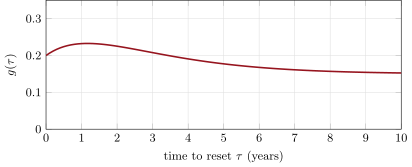
Figure 8.1. Rebonato’s volatility function with a=0.05a=0.05, b=0.10b=0.10, c=0.60c=0.60, d=0.15d=0.15: a forward’s volatility is highest about a year and a half before its reset. Scaled per forward, it makes the volatility of each forward depend on its time to reset, so the volatility curve seen in a year looks like today’s. Data: the chapter’s tutorial.
Lire dans le chapitre →