Definition 9.9Quantitative Methods · Bab 9 — Stochastic Control
The Merton fraction is π∗=(μ−r)/(γσ2).
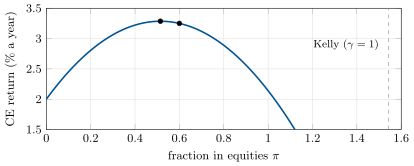
Figure 9.1. Certainty-equivalent return of a constant fraction in equities for a CRRA investor with γ=3 (μ=7%, r=2%, σ=18%): a parabola peaking at the Merton fraction (left dot, 51.4%), flat enough that 60% (right dot) costs only 3.6 bp a year. The Kelly fraction, optimal for γ=1, is 154%. Data: closed form, the chapter’s tutorial.
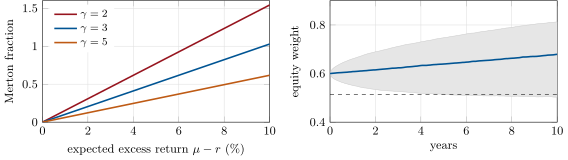
Figure 9.2. Left: the Merton fraction against the expected excess return, for three risk aversions (σ=18%): ten points of fraction per point of return at γ=3. Right: the equity weight of a fund that starts at 60% and never rebalances, median and 10th–90th percentile band over 20 000 simulated paths, against the Merton fraction (dashed). Data: the chapter’s tutorial, seeded.
 Pelatih
Masuk
Mulai membaca
Pelatih
Masuk
Mulai membaca