
جميع الكتب

مهني

1 Markets I: The Ecosystem and Exchange-Traded Marketsالأسواق عبر الإنترنت 2 Markets II: Rates, FX and Creditالأسواق عبر الإنترنت 3 Markets III: Commodities, Energy and Cryptoالأسواق عبر الإنترنت 4 Quantitative Methodsالأساليب عبر الإنترنت 5 Derivatives and Volatilityالمشتقات عبر الإنترنت 6 Rates, Credit, XVA and Riskالفائدة والائتمان والمخاطر عبر الإنترنت 7 Research Craft: Predictors, Backtests, Measurement, Portfoliosالبحث عبر الإنترنت 8 Strategies I: Equities and Futuresالاستراتيجيات عبر الإنترنت 9 Strategies II: Volatility, Relative Value, Macro and the Bank Desksالاستراتيجيات عبر الإنترنت 10 Microstructure and Executionالتنفيذ عبر الإنترنت 11 Market Making and High-Frequency Tradingصناعة السوق عبر الإنترنت 12 Machine Learning for Marketsتعلم الآلة عبر الإنترنت 13 Low-Latency Softwareالتكنولوجيا عبر الإنترنت 14 Networks, Hardware and Trading Infrastructureالتكنولوجيا عبر الإنترنت 15 Research, Data and Risk Platformsالتكنولوجيا عبر الإنترنت 16 The Desk and the Firmالشركة عبر الإنترنت 17 The Industry: Firms, Roles and Careersالمسارات المهنية عبر الإنترنت 18 The Interview Bookالمسارات المهنية عبر الإنترنت
التطبيقات حول المدرب تسجيل الدخول ابدأ القراءة

Quantitative Finance · المسرد

ما معنى Merton model؟

Definition 14.2 Rates, Credit, XVA and Risk · الفصل 14 — Structural Credit Models

The Merton model takes assets following a geometric Brownian motion with volatility σV\sigma_V and one zero-coupon debt of face DD due at TT. At TT the shareholders receive max⁡(VT−D,0)\max(V_T-D,0) and the creditors min⁡(VT,D)\min(V_T,D). Equity is a European call on the assets struck at the debt, priced by the Black–Scholes formula, and debt is the assets minus the equity:
E0=V0N(d1)−De−rTN(d2),B0=V0−E0,d1,2=ln⁡(V0/D)+(r±12σV2)TσVT.E_0 = V_0N(d_1)-De^{-rT}N(d_2),\qquad B_0 = V_0-E_0,\qquad d_{1,2} = \frac{\ln(V_0/D)+(r\pm\tfrac12\sigma_V^2)T}{\sigma_V\sqrt T}.
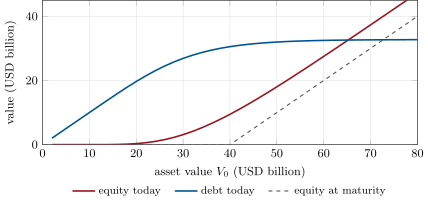
Equity and debt of the chapter’s firm (debt face USD 40 billion due in five years, asset volatility 15.6%) as functions of the asset value. Equity is a call on the assets; debt rises towards the riskless value of the face and falls one-for-one with the assets when they are low. Data: the chapter’s tutorial.
Figure 14.1. Equity and debt of the chapter’s firm (debt face USD 40 billion due in five years, asset volatility 15.6%) as functions of the asset value. Equity is a call on the assets; debt rises towards the riskless value of the face and falls one-for-one with the assets when they are low. Data: the chapter’s tutorial.

أمثلة

Example 14.3 (A leveraged firm)

An illustrative firm has equity worth USD 10 billion with a volatility of 50%, and debt of face USD 40 billion treated as due in five years; r=4%r = 4\%. The inversion gives assets of USD 40.69 billion with a volatility of 15.6%: the equity is more than three times as volatile as the assets because it is levered. The debt is worth USD 30.69 billion, a yield spread of 130 basis points, and the risk-neutral probability that the assets end below the face is 32.7%.

اقرأ في الفصل →