
Alle boeken

Professioneel

Apps Over Coach Inloggen Begin met lezen

Quantitative Finance · Begrippenlijst

Wat is Merton model?

Definition 14.2 Rates, Credit, XVA and Risk · Hoofdstuk 14 — Structural Credit Models

The Merton model takes assets following a geometric Brownian motion with volatility σV\sigma_V and one zero-coupon debt of face DD due at TT. At TT the shareholders receive max⁡(VT−D,0)\max(V_T-D,0) and the creditors min⁡(VT,D)\min(V_T,D). Equity is a European call on the assets struck at the debt, priced by the Black–Scholes formula, and debt is the assets minus the equity:
E0=V0N(d1)−De−rTN(d2),B0=V0−E0,d1,2=ln⁡(V0/D)+(r±12σV2)TσVT.E_0 = V_0N(d_1)-De^{-rT}N(d_2),\qquad B_0 = V_0-E_0,\qquad d_{1,2} = \frac{\ln(V_0/D)+(r\pm\tfrac12\sigma_V^2)T}{\sigma_V\sqrt T}.
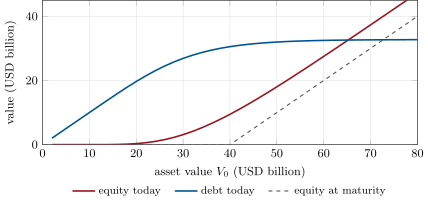
Equity and debt of the chapter’s firm (debt face USD 40 billion due in five years, asset volatility 15.6%) as functions of the asset value. Equity is a call on the assets; debt rises towards the riskless value of the face and falls one-for-one with the assets when they are low. Data: the chapter’s tutorial.
Figure 14.1. Equity and debt of the chapter’s firm (debt face USD 40 billion due in five years, asset volatility 15.6%) as functions of the asset value. Equity is a call on the assets; debt rises towards the riskless value of the face and falls one-for-one with the assets when they are low. Data: the chapter’s tutorial.

Voorbeelden

Example 14.3 (A leveraged firm)

An illustrative firm has equity worth USD 10 billion with a volatility of 50%, and debt of face USD 40 billion treated as due in five years; r=4%r = 4\%. The inversion gives assets of USD 40.69 billion with a volatility of 15.6%: the equity is more than three times as volatile as the assets because it is levered. The debt is worth USD 30.69 billion, a yield spread of 130 basis points, and the risk-neutral probability that the assets end below the face is 32.7%.

Lees in het hoofdstuk →