 Coach
CoachThe moving-block bootstrap (Künsch, 1989) builds a resample by concatenating blocks of consecutive observations, , with starting points drawn uniformly (indices taken modulo in the circular version). The stationary bootstrap (Politis and Romano, 1994) draws the block lengths independently from a geometric law of mean : each resampled day continues the current block with probability and starts a new block at a uniform position with probability .
Ejemplos
Example 13.5 (The volatility seller)
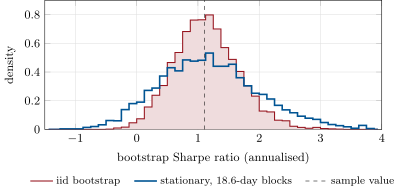
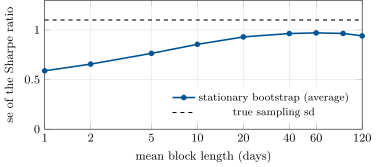
Each day the strategy earns a premium and pays the day’s squared return, , with and an AR(1) with coefficient 0.9 and stationary standard deviation 0.4, scaled so that . The market returns are uncorrelated, but the squared returns are not: , and the P&L’s long-run variance is 3.9 times its variance. The premium is set for a population Sharpe ratio of 1.1. The seeded five-year history has a Sharpe ratio of 1.11, a skewness of , a kurtosis of 34, and autocorrelations of 0.13 at one day, 0.10 at five, at twenty.