Todos los libros

Profesional

Apps Acerca de Coach Iniciar sesión Empezar a leer

Quantitative Finance · Glosario

¿Qué es Parkinson, Garman–Klass and Yang–Zhang estimators?

También llamado: Parkinson estimator · Garman--Klass estimator · Yang--Zhang estimator

Definition 7.4 Research Craft: Predictors, Backtests, Measurement, Portfolios · Capítulo 7 — Price and Volume Features

With H,L,O,CH, L, O, C a day’s high, low, open and close, the Parkinson estimator of the daily variance is (ln⁡H/L)2/(4ln⁡2)(\ln H/L)^2/(4\ln 2); the Garman–Klass estimator is 12(ln⁡H/L)2−(2ln⁡2−1)(ln⁡C/O)2\tfrac12(\ln H/L)^2 - (2\ln 2 - 1)(\ln C/O)^2; the Rogers–Satchell estimator is ln⁡(H/C)ln⁡(H/O)+ln⁡(L/C)ln⁡(L/O)\ln(H/C)\ln(H/O) + \ln(L/C)\ln(L/O). The Yang–Zhang estimator over nn days adds the sample variance of overnight returns, kk times that of open-to-close returns and 1−k1 - k times the average Rogers–Satchell term, with k=0.34/(1.34+(n+1)/(n−1))k = 0.34/(1.34 + (n+1)/(n-1)).

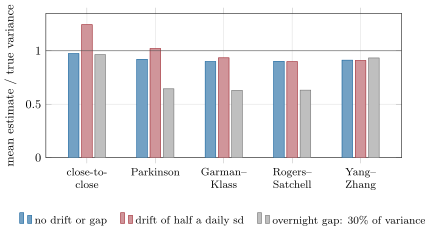
Mean of each daily variance estimator relative to the true diffusion variance, on 4 000 simulated days of 390 one-minute steps. All range estimators read 8–10% low from discrete monitoring; a drift inflates close-to-close and Parkinson; an overnight gap is invisible to the single-day range estimators and recovered by Yang–Zhang. Data: the chapter’s module, seeded.
Figure 7.2. Mean of each daily variance estimator relative to the true diffusion variance, on 4 000 simulated days of 390 one-minute steps. All range estimators read 8–10% low from discrete monitoring; a drift inflates close-to-close and Parkinson; an overnight gap is invisible to the single-day range estimators and recovered by Yang–Zhang. Data: the chapter’s module, seeded.
Leer en el capítulo →