
সব বই

পেশাদার

1 Markets I: The Ecosystem and Exchange-Traded Marketsবাজার অনলাইন 2 Markets II: Rates, FX and Creditবাজার অনলাইন 3 Markets III: Commodities, Energy and Cryptoবাজার অনলাইন 4 Quantitative Methodsপদ্ধতি অনলাইন 5 Derivatives and Volatilityডেরিভেটিভস অনলাইন 6 Rates, Credit, XVA and Riskসুদহার, ঋণ ও ঝুঁকি অনলাইন 7 Research Craft: Predictors, Backtests, Measurement, Portfoliosগবেষণা অনলাইন 8 Strategies I: Equities and Futuresকৌশল অনলাইন 9 Strategies II: Volatility, Relative Value, Macro and the Bank Desksকৌশল অনলাইন 10 Microstructure and Executionএক্সিকিউশন অনলাইন 11 Market Making and High-Frequency Tradingমার্কেট মেকিং অনলাইন 12 Machine Learning for Marketsমেশিন লার্নিং অনলাইন 13 Low-Latency Softwareপ্রযুক্তি অনলাইন 14 Networks, Hardware and Trading Infrastructureপ্রযুক্তি অনলাইন 15 Research, Data and Risk Platformsপ্রযুক্তি অনলাইন 16 The Desk and the Firmপ্রতিষ্ঠান অনলাইন 17 The Industry: Firms, Roles and Careersক্যারিয়ার অনলাইন 18 Interviews I: Maths, Probability and Speedক্যারিয়ার অনলাইন 19 Interviews II: Markets, Trading Games and the Final Roundক্যারিয়ার অনলাইন 20 Interviews III: Codeক্যারিয়ার অনলাইন
অ্যাপ পরিচিতি Coach সাইন ইন পড়া শুরু করো

বইগুলো এখনো বাংলা ভাষায় পাওয়া যায় না — ইংরেজি সংস্করণ দেখানো হচ্ছে।

Quantitative Finance · পরিভাষা

Particle filter, sequential importance resampling কী?

অন্য নাম: particle filter · sequential importance resampling

Definition 19.9 Quantitative Methods · অধ্যায় 19 — State-Space Models and the Kalman Filter

A particle filter represents the filtering law of a state by a weighted sample of particles. Sequential importance resampling, the bootstrap filter of Gordon, Salmond and Smith (1993), propagates each particle through the state equation, weights it by the density of the new observation given the particle, and resamples in proportion to the weights; the average weight at each step estimates the one-step predictive density, and their product the likelihood.
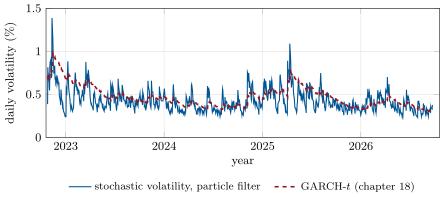
EUR/USD daily volatility over the last 1 000 ECB fixings to 23 September 2026: the particle-filtered stochastic-volatility estimate (= 0.9, _ = 0.4, 5 000 particles) and the GARCH-t conditional volatility. Data: ECB euro reference rates (source: ECB statistics).
Figure 19.5. EUR/USD daily volatility over the last 1 000 ECB fixings to 23 September 2026: the particle-filtered stochastic-volatility estimate (ϕ=0.9\phi = 0.9, ση=0.4\sigma_\eta = 0.4, 5 000 particles) and the GARCH-tt conditional volatility. Data: ECB euro reference rates (source: ECB statistics).
প্রসঙ্গসহ পড়ো →