Tous les livres

Professionnel

Applis À propos Coach Connexion Commencer la lecture

Quantitative Finance · Glossaire

Qu'est-ce que « Performance alarm » ?

Definition 27.3 Machine Learning for Markets · Chapitre 27 — Monitoring and Retraining

A performance alarm is a monitor on realised outcomes (the information coefficient, hit rate, P&L or mark-outs of the model’s trades) that pages when their level falls below what validation led the firm to expect, by more than the outcomes’ own noise allows at the chosen false-alarm rate.

noneunit changereversalslow fade
monitorfirstfirstsustainedfirstsustainedfirstsustained
largest feature PSI120012never1242
largest feature KS100010never860
prediction PSI170017never19.5never
share inside threshold110011never9.5never
IC CUSUM139.5never1013never
Table 27.1. Days from the failure (day 200) to each monitor’s first alarm and to a sustained alarm (five alarm days in 21), medians over 20 runs, every monitor calibrated to one false page a month; “none” is the same count on runs without a failure, what a blind monitor scores; “never” means no sustained alarm in the 200 days that follow. Data: ml_monitor.delays.
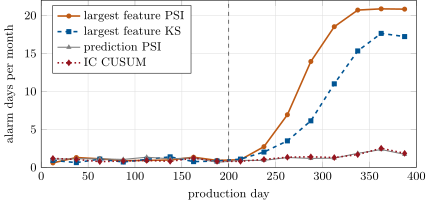
Alarm days per month (21 days) under the slow fade, in 25-day windows, averaged over 20 runs; the fade starts on day 200 (dashed) and ends on day 350. A blind monitor alarms on about one day a month. Data: ml_monitor.alarm_rates.
Figure 27.1. Alarm days per month (21 days) under the slow fade, in 25-day windows, averaged over 20 runs; the fade starts on day 200 (dashed) and ends on day 350. A blind monitor alarms on about one day a month. Data: ml_monitor.alarm_rates.
Lire dans le chapitre →