
全部书籍

专业

应用 关于 Coach 登录 开始阅读

书籍暂未推出简体中文版——当前显示英文版。

Quantitative Finance · 术语表

什么是 Strong duality, Slater’s condition, shadow price?

又称: strong duality · Slater's condition · shadow price

Definition 23.5 Quantitative Methods · 第 23 章 — Convex Optimisation

Strong duality holds when the primal and dual optimal values are equal. Slater’s condition is the existence of a strictly feasible point (gi(x)<0g_i(x) < 0 for the nonlinear constraints, Ax=bAx = b). The optimal dual variable of a constraint is its shadow price: the rate at which the optimal value changes when the constraint is relaxed.
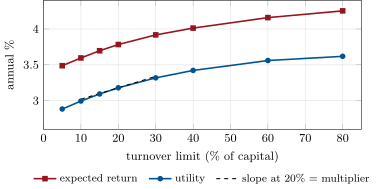
The price of turnover: the optimal long-short portfolio’s utility and expected return as the turnover limit is relaxed from 5% to 80% of capital. The dashed line through the 20% point has the slope of the turnover constraint’s multiplier, 0.0159 (1.6 basis points of utility per 1% of turnover). Data: the chapter’s tutorial, seeded.
Figure 23.1. The price of turnover: the optimal long-short portfolio’s utility and expected return as the turnover limit is relaxed from 5% to 80% of capital. The dashed line through the 20% point has the slope of the turnover constraint’s multiplier, 0.0159 (1.6 basis points of utility per 1% of turnover). Data: the chapter’s tutorial, seeded.
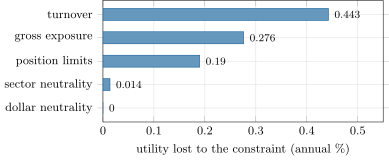
What each constraint group costs the long-short portfolio: the gain in utility when it is removed and the problem re-solved. Dollar neutrality costs nothing because the sector neutralities imply it. Data: the chapter’s tutorial, seeded.
Figure 23.2. What each constraint group costs the long-short portfolio: the gain in utility when it is removed and the problem re-solved. Dollar neutrality costs nothing because the sector neutralities imply it. Data: the chapter’s tutorial, seeded.
在原文中阅读 →