
সব বই

পেশাদার

1 Markets I: The Ecosystem and Exchange-Traded Marketsবাজার অনলাইন 2 Markets II: Rates, FX and Creditবাজার অনলাইন 3 Markets III: Commodities, Energy and Cryptoবাজার অনলাইন 4 Quantitative Methodsপদ্ধতি অনলাইন 5 Derivatives and Volatilityডেরিভেটিভস অনলাইন 6 Rates, Credit, XVA and Riskসুদহার, ঋণ ও ঝুঁকি অনলাইন 7 Research Craft: Predictors, Backtests, Measurement, Portfoliosগবেষণা অনলাইন 8 Strategies I: Equities and Futuresকৌশল অনলাইন 9 Strategies II: Volatility, Relative Value, Macro and the Bank Desksকৌশল অনলাইন 10 Microstructure and Executionএক্সিকিউশন অনলাইন 11 Market Making and High-Frequency Tradingমার্কেট মেকিং অনলাইন 12 Machine Learning for Marketsমেশিন লার্নিং অনলাইন 13 Low-Latency Softwareপ্রযুক্তি অনলাইন 14 Networks, Hardware and Trading Infrastructureপ্রযুক্তি অনলাইন 15 Research, Data and Risk Platformsপ্রযুক্তি অনলাইন 16 The Desk and the Firmপ্রতিষ্ঠান অনলাইন 17 The Industry: Firms, Roles and Careersক্যারিয়ার অনলাইন 18 Interviews I: Maths, Probability and Speedক্যারিয়ার অনলাইন 19 Interviews II: Markets, Trading Games and the Final Roundক্যারিয়ার অনলাইন 20 Interviews III: Codeক্যারিয়ার অনলাইন
অ্যাপ পরিচিতি Coach সাইন ইন পড়া শুরু করো

বইগুলো এখনো বাংলা ভাষায় পাওয়া যায় না — ইংরেজি সংস্করণ দেখানো হচ্ছে।

Quantitative Finance · পরিভাষা

Structuring margin কী?

Definition 19.6 Derivatives and Volatility · অধ্যায় 19 — The Structured-Products Business

The structuring margin is the difference between a note’s issue price and the value of its components at the issuer’s own funding curve and the desk’s option prices: the revenue shared between the issuer and the distributors.
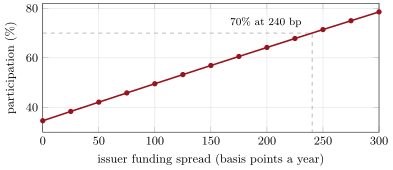
The participation a two-year 100%-protected note can offer, after a 1.5% margin, against the issuer’s funding spread (rate 3%, dividend yield 1.5%, chapter 9’s two-year volatility). The spread, not the option, sets the participation: without it the note could offer 35%. Data: the tutorial.
Figure 19.1. The participation a two-year 100%-protected note can offer, after a 1.5% margin, against the issuer’s funding spread (rate 3%, dividend yield 1.5%, chapter 9’s two-year volatility). The spread, not the option, sets the participation: without it the note could offer 35%. Data: the tutorial.
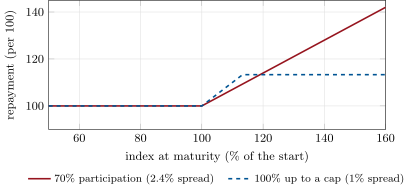
Two two-year 100%-protected notes that each cost the client 100: 70% participation without a cap, which needs a 2.4% funding spread, and full participation capped at 113.3%, which a 1% spread pays for. Data: the tutorial.
Figure 19.2. Two two-year 100%-protected notes that each cost the client 100: 70% participation without a cap, which needs a 2.4% funding spread, and full participation capped at 113.3%, which a 1% spread pays for. Data: the tutorial.

উদাহরণ

Example 19.7 (Seventy percent participation)

A two-year note, 100% protected, on an index with a 3% rate and a 1.5% dividend yield, at chapter 9’s two-year at-the-money volatility of 20.5%. The at-the-money call costs 12.49 per 100, and the margin is 1.5. At a zero funding spread the bond costs 94.18, leaving 4.32 for options: a participation of 34.6%. Each half point of spread adds about 7.5 points of participation. At 1% it is 49.6%, at 2% it is 64.2%, and at 2.40% the bond costs 89.76 and the participation reaches 70% (Figure 19.1).

Example 19.8 (A one-year reverse convertible)

Strike 90%, one year, the issuer’s spread 1%, the same market. The investor sells 100/0.9100/0.9 puts struck at 90%, worth 4.26, and the issuer’s funding benefit is worth 3.92. After a 1.5 margin the note pays a coupon of 6.96%, against a risk-free rate of 3%. If the index ends below 90%, the investor receives 100 ST/(0.9 S0)100\,S_T/(0.9\,S_0) instead of par, and the coupon.

প্রসঙ্গসহ পড়ো →